The True Cost of New Glasses vs. Replacing Just the Lenses

Walk into an optician’s office expecting a quick lens swap, and you’ll leave holding a receipt for $400 to $600 in frames you never planned to buy. That gap between what you anticipated and what you’re actually paying? Most people don’t see it coming, and it’s usually much wider than expected. Knowing what drives each price point gives you real control over the decision.
Breaking Down the Price of Buying Completely New Glasses
Nearly every part of your eyewear budget gets affected when you’re choosing between new frames and a lens replacement, so before you head to any retail optician, it’s worth considering online lens replacement for existing frames. Buying new glasses looks simple enough until you start adding up the actual costs across multiple line items. Each one carries more weight than most people expect. At an optical chain, frames alone can cost anywhere from $100 to $400 before you even get to the lens work. That’s before coatings, lens materials, or progressive prescriptions get factored in. A standard single-vision pair with anti-reflective coating at a mid-range retailer typically lands between $250 and $500. Progressive lenses? Add premium materials like high-index 1.67 or photochromic treatment, and you’re easily past $600. Insurance does help, but most vision plans cap the frame benefit at $130 to $150. That leaves a substantial gap for anyone who picks something with a name brand or designer label. There’s another cost most buyers miss entirely: the fitting and adjustment time that’s baked into the retail markup, adding expense without any optical value to the lens itself.
Why Frame Costs Are Often Inflated
Frames carry retail markups of 10 to 20 times their manufacturing cost, a figure consumer advocacy outlets have documented for years. A frame costing $15 to $25 to produce shows up on retail shelves at $200 to $350. A handful of large conglomerates control much of the wholesale frame market; this limits the price competition you’d normally expect from something so commoditized. So when your prescription changes and an optician suggests a full replacement, pause for a moment. Ask yourself whether the frame actually needs to change at all. If your current frames fit well and are in good condition, paying full frame-plus-lens cost just because the lenses need work doesn’t make sense financially for most people. Recognizing where that markup lives gives you actual leverage in the conversation.
When Insurance Actually Helps (and When It Doesn’t)
Most employer-sponsored vision plans cover one eye exam plus one pair of glasses or contacts per year; the frame allowance typically caps between $100 and $200. That sounds useful until you realize the average retail frame sits well above that ceiling, leaving you responsible for the gap. The lens benefit tends to be more generous. It covers single-vision lenses fully and subsidizes progressive or bifocal lenses up to a dollar limit. But here’s the thing: many plans reimburse for a full new pair while offering nothing for standalone lens replacement. That structure pushes you toward buying everything new, even when only the lenses need work. Reading your specific benefit schedule matters more than people assume. The plan’s logic can actually make lens-only replacement the smarter financial move in several common scenarios, even without direct coverage for that service.
The Real Math on Lens Replacement Without New Frames
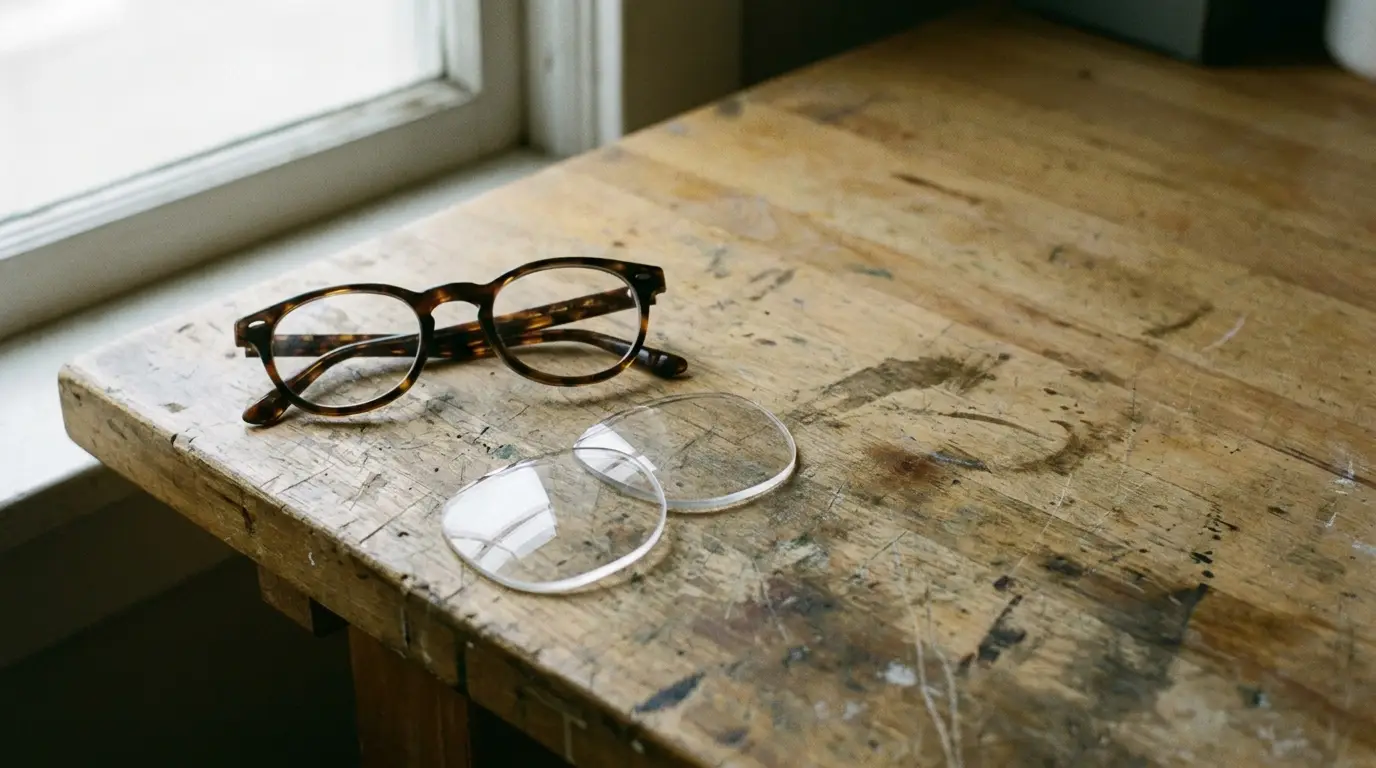
Lens replacement costs significantly less than buying completely new glasses in most situations. A straightforward single-vision replacement through an optical lab or online provider typically runs between $50 and $150 for standard materials. Compare that to $250 to $500 or more for a full pair at retail. Progressive lens replacements run $150 to $300; still well below what you’d pay for the full replacement at a chain store. The key requirement is that your frames be in good structural condition and compatible with modern lens cuts. Rimless and semi-rimless frames sometimes complicate things because drilling and mounting tolerances are tighter; most full-rim frames accept replacement lenses without issue. You keep the frames you already paid for. You keep the ones already adjusted to your face. You only pay for the part that actually needs work. For most people with an updated prescription, that difference alone saves $150 to $300 per pair, per year.
When Lens Replacement Genuinely Makes Sense
Four specific situations call for lens replacement instead of a full purchase. Your frames are in solid shape, but your prescription changed at your last exam. You have high-quality frames you paid a premium for and don’t want to replace unnecessarily. Your current lenses are scratched or damaged, but optically correct for your prescription. You want to upgrade a lens feature, moving from standard to anti-reflective or adding photochromic tint, without buying new frames. In each case, the frame isn’t the problem. Replacing it just adds cost without solving anything. And there is one genuine exception: when your frames are warped, broken, or structurally compromised. New lenses in a damaged frame sit misaligned and cause vision problems. Short of that, keeping a well-fitting frame and only updating the lenses is the more practical path for most prescriptions.
The Hidden Value in Keeping Your Existing Frames
There’s practical value that most people overlook beyond the dollar savings. Frames you’ve worn for months or years are already precisely adjusted to your face, your nose, your ears. New frames need fitting adjustments. Even well-fitted new glasses take days or weeks before they stop feeling noticeable. Your optician adjusts them at the point of sale, but those adjustments shift over time (especially metal frames that flex). Your existing frames are past that break-in period. They sit where they belong. Your eyes already know where to find the optical center of each lens. You’re not starting over on comfort. For people particular about fit, this matters beyond just the numbers; it’s worth adding to the total-cost comparison.
Conclusion
The true cost of new glasses vs. replacing just the lenses comes down to one thing: does your frame actually need to change? Full replacements cost $250 to $600 or more, while lens-only replacements typically run $50 to $300, depending on your prescription. Keep your frames if they fit well and are structurally sound; only pay for what actually needs updating. The savings are real, the logic is straightforward, and for most updated prescriptions, lens replacement is the financially smarter move.