Chess Board Setup: How to Arrange All Pieces Correctly

You sit down to play your first chess game. The pieces are out, but nothing is where it should be. Sound familiar?
Getting the chessboard set up right from the start prevents illegal moves, confusion, and a frustrating mid-game restart.
This post walks through each step for placing all chess pieces in their correct starting squares. You will also find the most common setup mistakes and two simple memory tricks that make it click fast.
What Is the Correct Chess Board Set Up?
A correct chess board setup means placing all 32 pieces, 16 white and 16 black, in their standard starting squares before the first move.
Each player controls one king, one queen, two rooks, two bishops, two knights, and eight pawns. White pieces start on ranks 1 and 2. Black pieces mirror those on ranks 7 and 8. The middle four ranks stay empty until play begins.
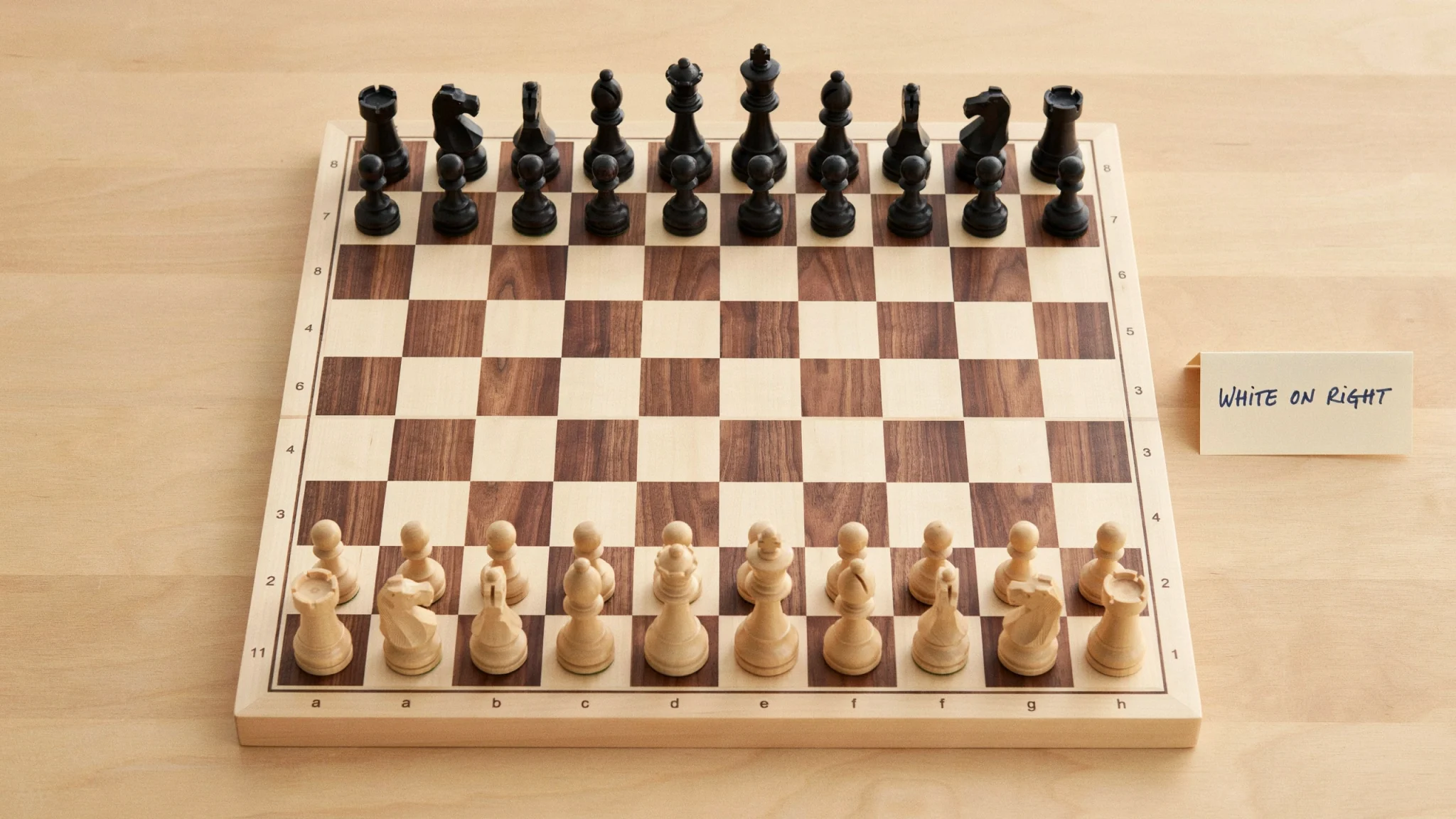
One rule anchors the whole setup: the bottom-right corner square must always be light-colored. Every other placement follows from there.
How to Set Up a Chess Board Step by Step
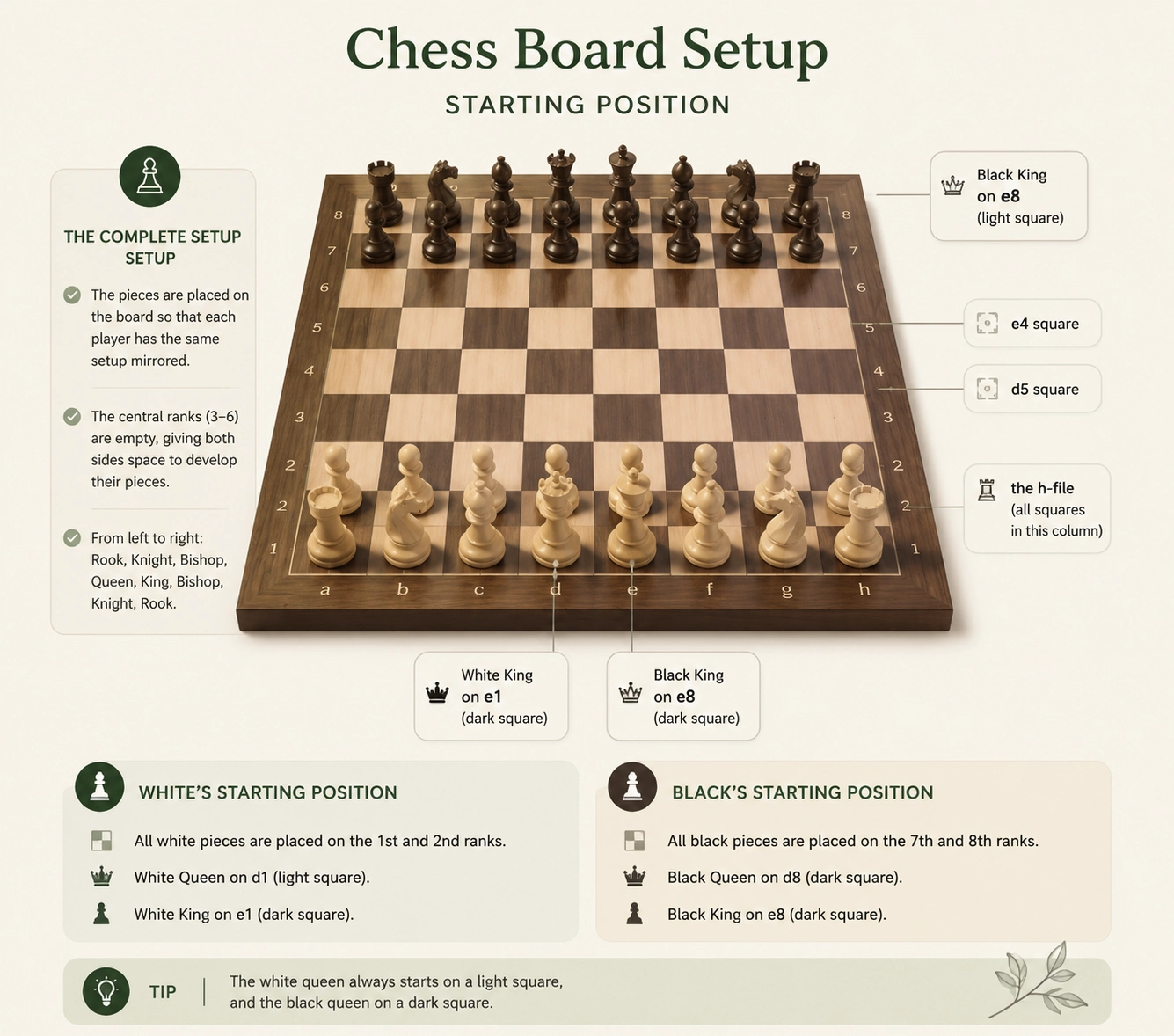
Setting up the chess board layout becomes fast and automatic once you learn the order. Work from the outside in. Corners first, royals last.
Step 1: Orient the Board Correctly
Before placing a single piece, check that the board faces the right way.
A chessboard has 64 squares in an 8×8 grid, alternating between light and dark. From your seat, the square in the bottom-right corner must be light. If it is dark, rotate the board 90 degrees.
This keeps the board’s coordinate system consistent for both players. It also matches every chess book, app, and tournament notation you will ever use.
Quick tip: Remember the phrase “white on right.” It takes one second to check and saves you from restarting mid-game.
Step 2: Place the Pawns First
Pawns go down before any other piece. Each player has eight pawns.
- White pawns fill the entire second rank (row 2)
- Black pawns fill the entire seventh rank (row 7)
Pawns are the least mobile pieces at the start of the game. But they control the center of the board and shield the more valuable pieces behind them. Placing them first also clears the pile next to the board, making the remaining placement steps easier.
Step 3: Put the Rooks in the Corners
Rooks anchor all four corners of the board.
- White rooks: squares a1 and h1
- Black rooks: squares a8 and h8
Rooks move in straight lines, horizontally or vertically, any number of squares. The corners are their natural home. They often stay there until the middle of the game, typically after castling.
Step 4: Place the Knights Next to the Rooks
Knights sit directly beside the rooks, one square inward.
- White knights: squares b1 and g1
- Black knights: squares b8 and g8
Knights are the only pieces that can jump over other pieces. They move in an “L” shape, two squares in one direction, then one square to the side. This makes them useful early in the game, even when other pieces are still blocked in.
Step 5: Place the Bishops Next to the Knights
Bishops take the next squares inward, right beside the knights.
- White bishops: squares c1 and f1
- Black bishops: squares c8 and f8
Each player ends up with one bishop on light squares and one on dark squares. Bishops always move diagonally, so they never change the color they travel on. That is why you want both colors covered from the start.
Step 6: Put the Queen on Her Own Color
This is the step where most beginners go wrong. The rule is short and memorable: the queen always starts on a square that matches her own color.
- White queen: square d1 (a light square)
- Black queen: square d8 (a dark square)
If the white queen lands on a dark square, the king ends up misplaced too. Since only one square remains for each, the whole back rank shifts off. Double-check this placement every time until it becomes automatic.
Memory trick: “Queen goes on her own color.”
Step 7: Place the King in the Last Square
The king takes the one remaining central square, right beside the queen.
- White king: square e1
- Black king: square e8
Once every piece is placed, White’s back rank reads from left to right: rook, knight, bishop, queen, king, bishop, knight, rook.
Chess Board Layout: Where All Chess Pieces Start
Every piece has a fixed starting square. This table shows the correct chess board layout for all 32 pieces before the first move.
| Piece | Count Per Side | White Starts On | Black Starts On |
|---|---|---|---|
| King | 1 | e1 | e8 |
| Queen | 1 | d1 | d8 |
| Rooks | 2 | a1, h1 | a8, h8 |
| Bishops | 2 | c1, f1 | c8, f8 |
| Knights | 2 | b1, g1 | b8, g8 |
| Pawns | 8 | Rank 2 (a2–h2) | Rank 7 (a7–h7) |
White always moves first. This has been standard in organized chess for centuries. Once both sides are placed correctly, White opens the game, and players alternate turns from there.
Chess Board Set Up Mistakes Beginners Make
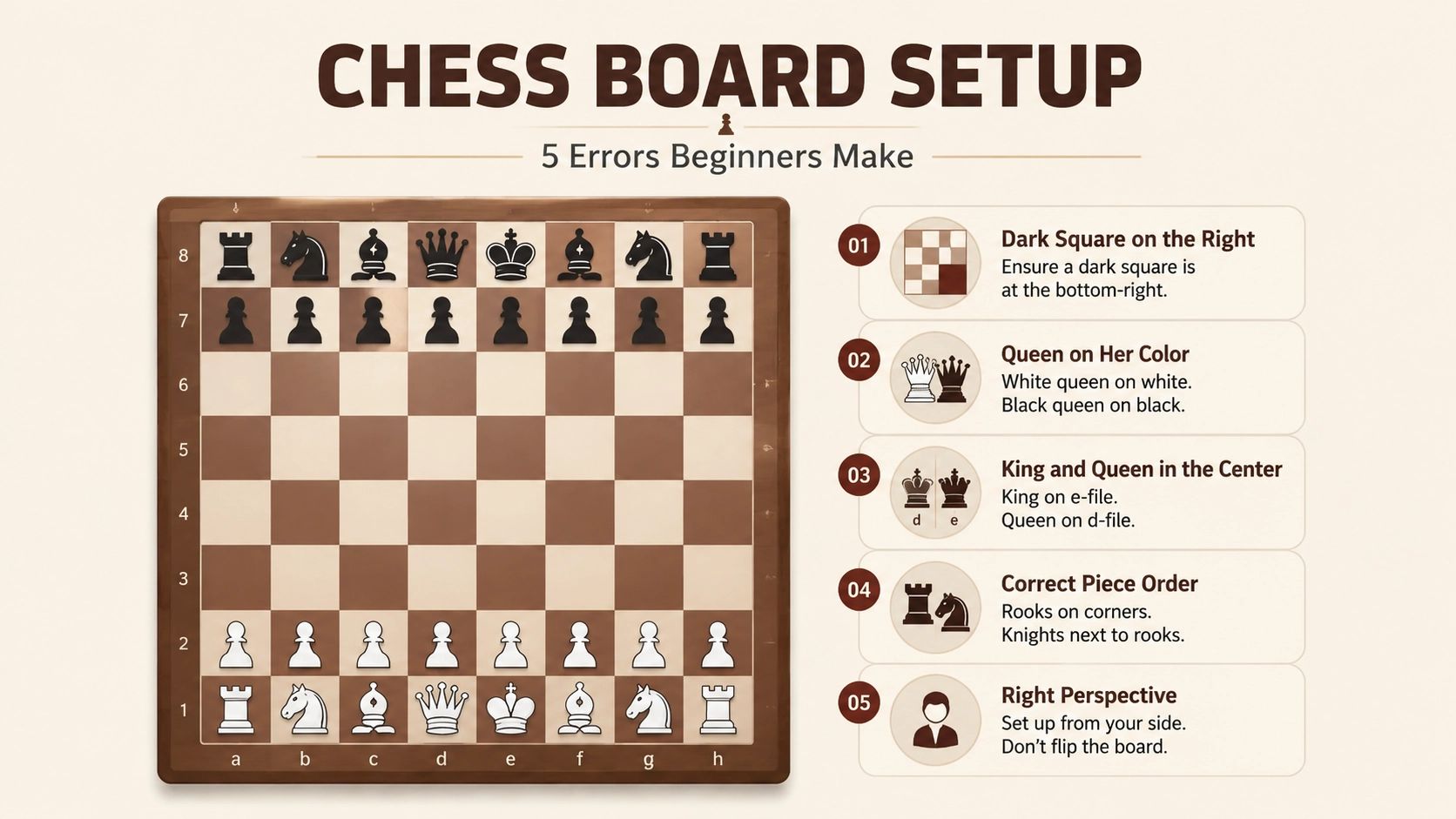
Most setup errors stem from a single moment of inattention. These are the five that happen most often.
1. Dark Square in The Bottom-Right Corner
This flips the entire board orientation. The position may look fine at first glance, but the coordinates run backward. The moment someone tries to read or record moves, the confusion becomes clear. Always check before placing a single piece.
2. Placing the Queen on The Wrong Square
Swapping the queen and king is the most common chess board setup error. If you are ever unsure, go back to the rule: the queen starts on her own color. White queen on a light square. Black queen on a dark square.
3. Switching the King and Queen
Related to the mistake above. The king and queen sit side by side in the center. The queen goes on her matching color. The king takes the one square that remains. Getting these two reversed means neither piece can move correctly in the early game.
4. Mixing White and Black Pieces
Each side needs exactly 16 pieces. One king, one queen, two rooks, two bishops, two knights, and eight pawns. Check that no pieces have been swapped between sides before starting. This is easy to miss with pieces that look similar in shape.
5. Setting up From the Wrong Angle
Always arrange pieces from your own seat. Setting up while standing at an angle or reading a diagram upside down is a common cause of reversed positions. Sit down, orient the board toward you, then place your pieces.
Easy Ways to Remember the Chess Board Layout
You do not need to memorize square names or diagram positions right away. These three tricks cover everything.
Trick 1: White on Right
Before touching any piece, check the bottom-right corner square. It must be light. Chess is one of the few games where orientation affects every move you make.
It also happens to be one of the better hobbies for building pattern recognition and focus over time. One glance before setup saves you from restarting mid-game.
Trick 2: Queen on Her Color
This single phrase solves both the queen’s and the king’s placement in one step. Say it once before placing the royals, and the back rank falls into place.
Trick 3: Corners First
Build the back rank from the outside in:
- Rooks in the corners
- Knights beside the rooks
- Bishops beside the knights
- Queen on her own color
- King in the last square
- Pawns on the full second and seventh ranks
What Do Chess Board Coordinates Mean?
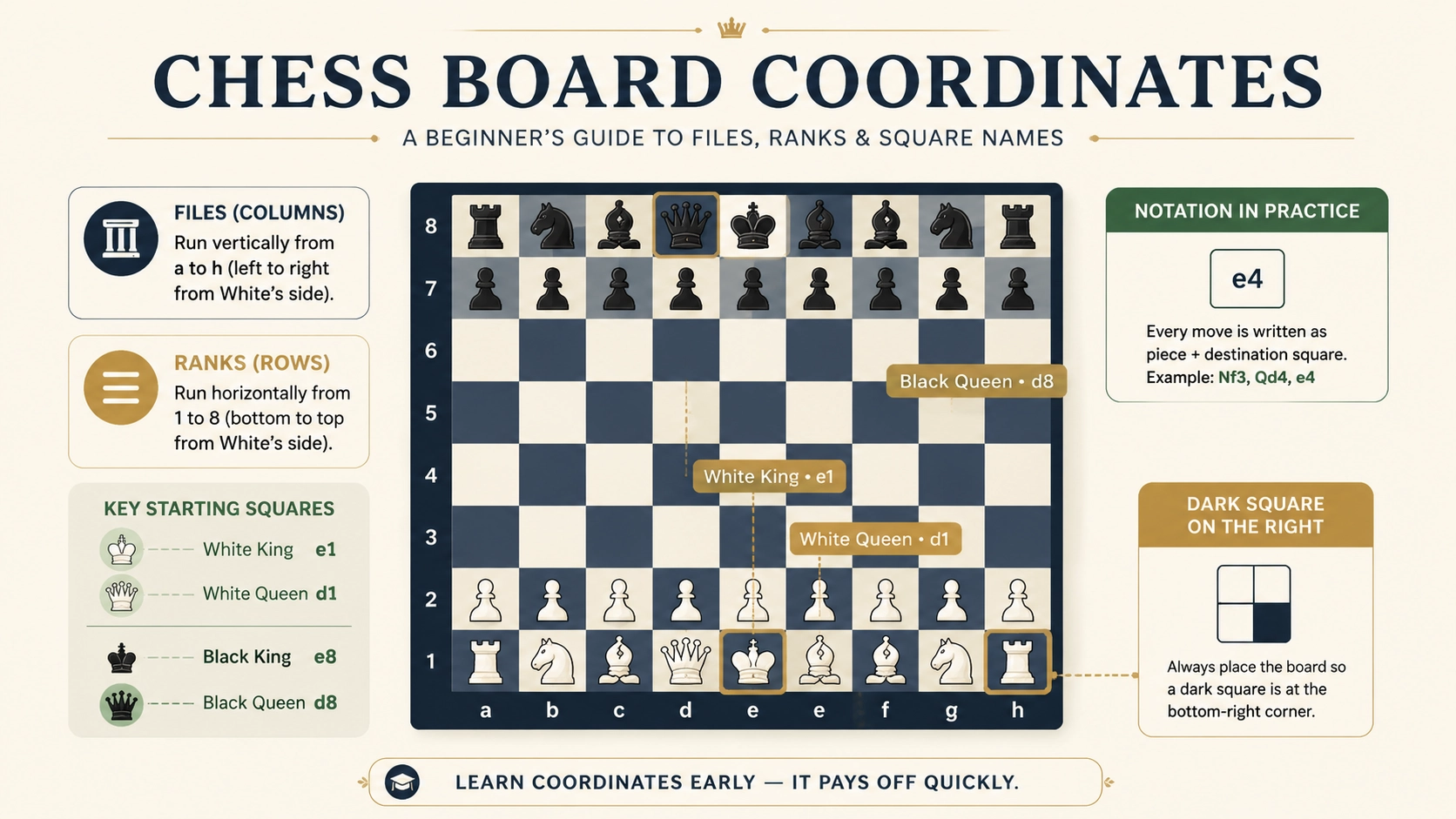
You do not need coordinates to set up the board. But learning them early makes every other part of chess, openings, notation, apps, and books, much easier to follow.
Files are the columns, labeled a through h from White’s left to right. Ranks are the rows, numbered 1 through 8 starting from White’s side.
Together, they give every square a unique two-character label, like e4 or d5.
Key squares to remember from the starting position:
- White king: e1
- White queen: d1
- Black king: e8
- Black queen: d8
Nearly every chess resource- books, apps, online games, broadcast commentary, refers to moves by square name. Learning the coordinate system as you learn the chess board setup saves you from relearning it later.
What Happens After You Set Up the Chess Board?
Once all pieces are in their correct squares, White makes the first move. From there, both players typically start moving pieces toward the center of the board.
Some of the most common first moves include:
- e4: moving the king’s pawn two squares forward. This opens lines for the bishop and queen and is one of the most popular opening moves in chess.
- d4: moving the queen’s pawn two squares forward. Equally common at all levels of play.
- Knight to f3 or c3: bringing a knight out early. Knights can jump over other pieces, so they work well before the center pawns move.
Openings are a deep subject in their own right. But all of them build on one thing: a correct chess board setup. Getting that right every time gives you a clean, legal starting point for whatever opening you choose.
Start Every Game the Right Way
The chess board setup is the one step that every game depends on. Get it wrong and the whole game goes off track. Get it right, and you can put all your attention into your strategy from move one.
Three rules cover everything: light square on the right, queen on her own color, king beside the queen. Run through them before each game until the placement becomes second nature.
Ready to sit down and try it? Set the board up right now using the steps above — then make your first move.
Frequently Asked Questions
Can A Knight Jump Over Other Pieces?
Yes. The knight is the only piece that can jump over others, no matter what’s blocking its path.
Who Starts First, Black Or White?
White always moves first, then players alternate turns for the rest of the game.
What’s a Commonly Debated Rule In Chess?
En passant confuses beginners, since a pawn captures diagonally onto an empty square rather than the piece itself.
What Are Three Illegal Moves In Chess?
Moving into check, moving a piece against its rules, and castling after the king or rook has moved.
What’s Considered A Rare Move In Chess?
Multi-pawn promotions leading straight to checkmate are extremely rare, happening in very few real games.