Concrete Lifting Foam: How It Works, Pros, Cons & Costs

Your driveway slab is two inches lower than it should be. You trip over it every morning. Your guests notice it.
And somewhere in the back of your mind, you have been telling yourself this repair is going to cost a fortune. It does not have to.
Concrete lifting foam, also called foam jacking or polyurethane concrete raising, lifts sunken slabs back into position without tearing anything out. No heavy machinery. No days of waiting. No replacing what does not need replacing.
This guide explains how concrete lifting foam works, what it actually costs, how long it lasts, and whether it is the right choice for your property.
Why Does Concrete Sink in the First Place?
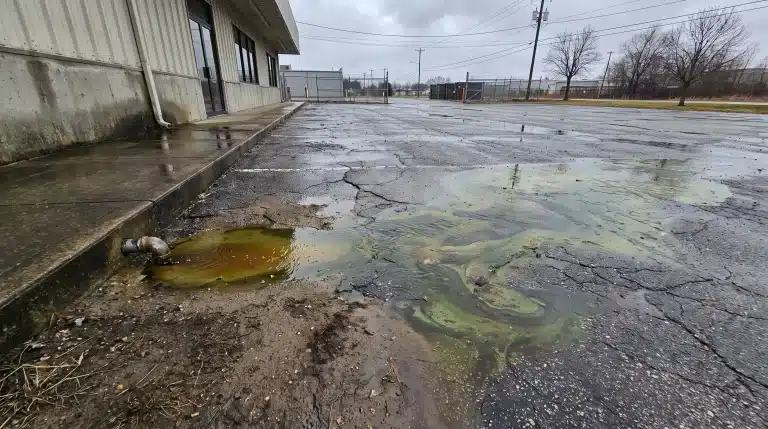
Concrete does not sink on its own; the soil beneath it does. Water from rain, sprinklers, or poor drainage slowly washes away fine soil particles, leaving empty gaps under the slab.
Once those gaps grow large enough, the concrete has nothing firm to sit on and starts to drop.
Poor soil compaction during the original pour, freeze-thaw cycles, drought, and even burrowing animals can all accelerate this process.
What Is Polyurethane Concrete Raising and How Does It Work?
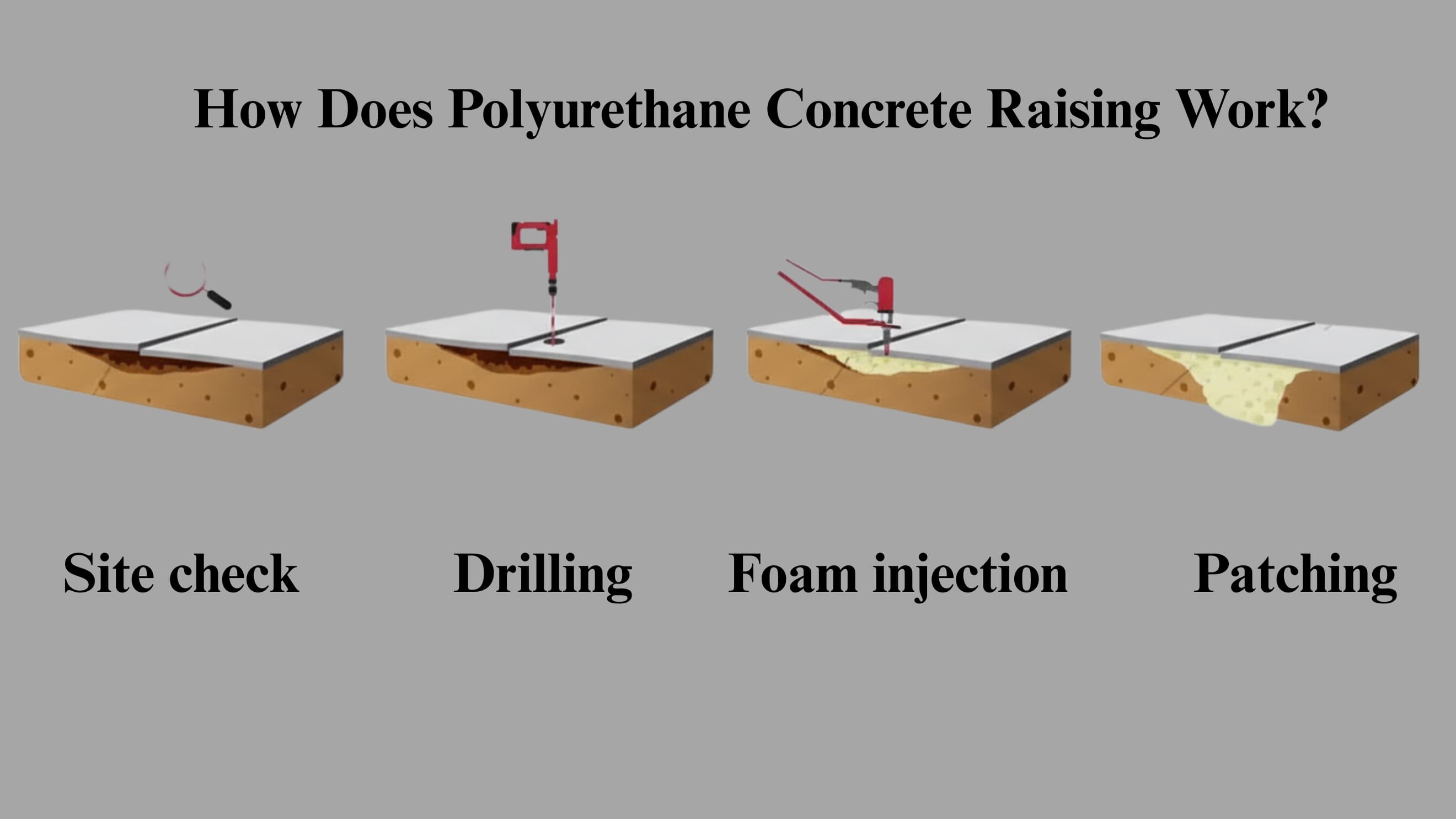
Polyurethane concrete raising, also known as polyjacking or foam jacking, uses an expanding foam to lift settled concrete slabs back into position.
A contractor drills small holes into the slab, injects a two-part liquid foam beneath it, and the foam expands to fill voids and push the slab upward.
Here Is What the Process Looks Like, Step by Step:
- Site check: The technician identifies settled areas and marks where to drill
- Drilling: Small holes, about 5/8 inch wide, are drilled through the slab
- Port installation: Injection ports are placed into each hole
- Foam injection: Two-part polyurethane foam is injected as a liquid under the slab
- Controlled lift: The foam expands and raises the slab; the technician monitors every inch
- Curing: The foam hardens in roughly 15 minutes
- Patching: Ports are removed, and holes are filled with a concrete patch
The foam weighs just 2 to 4 lbs per cubic foot and does not shrink, rot, or absorb water after it cures. Once the job is done, the surface is ready to use within an hour.
Types of Polyurethane Foam Used for Concrete Lifting
Not every foam is built the same way. The type used on your project depends on the weight of the slab, the size of the void beneath it, and the site conditions.
| Foam Type | Density | Best For | Cure Time | Key Strength |
|---|---|---|---|---|
| Low-density foam | 2 lbs/cu ft | Sidewalks, patios, light slabs | ~1 hour | High expansion, fills large voids |
| Medium-density foam | 2–4 lbs/cu ft | Driveways, garage floors | ~15–30 min | Balance of lift strength and spread |
| High-density foam | 4+ lbs/cu ft | Foundations, roadways, heavy loads | ~15 min | Maximum load-bearing support |
| Fast-reaction foam | Varies | Small slabs, sidewalk sections | Very fast | Stays contained in small areas |
| Slow-reaction foam | Varies | Large road panels, wide voids | Slower set | Spreads widely before hardening |
Pros and Cons of Concrete Lifting Foam
Concrete lifting foam checks a lot of boxes, but it is not the right fit for every situation. Here is a clear look at what it does well and where it falls short.
Pros
- Fast results. The foam hardens in about 15 minutes. Most slabs are back in use within an hour of the repair. There are no waiting days on end.
- Small drill holes. The holes are only about 5/8 of an inch wide, roughly the size of a dime. Once patched, they are barely visible, even on a well-used driveway or patio.
- Very lightweight. At 2 to 4 lbs per cubic foot, the foam adds almost no extra weight to the soil below. This matters a lot when the ground is already unstable or prone to shifting.
- Moisture resistant. Once cured, the foam does not absorb water or break down in wet conditions. It also resists mold and mildew growth over time.
- Long lifespan. Properly installed foam can last 20 to 50 years, often for the full life of the concrete slab above it.
- Works in tight spaces. Portable foam units can reach places that large equipment cannot, including narrow side yards, indoor floors, and areas around landscaping.
- Good for indoor use. The process creates very little dust and uses no water, making it well-suited for hospitals, warehouses, and commercial spaces.
- No shrinkage. Unlike mud-based materials, the foam holds its shape after it cures. It does not dry out, leaving new gaps under the slab.
Cons
- Higher upfront cost. Foam concrete lifting costs 20 to 50% more than traditional mudjacking. The materials are more expensive, and that cost gets passed along to the customer.
- Not right for severely damaged slabs. If the concrete is heavily cracked or the structure is failing, lifting will not solve the problem. The slab itself may need to be replaced.
- UV sensitivity. Foam exposed to direct sunlight after lifting can break down over time. It needs to stay covered and buried under the slab to hold up properly.
- Temperature-dependent curing. Most foam products need specific temperature and humidity conditions to cure correctly. Cold or very wet weather can affect the result.
- Harder to find. Foam jacking contractors are not available everywhere. In rural areas, your options may be limited compared to traditional mudjacking services.
- Not a DIY job. The equipment and precision required for a good result are hard to match without professional training and calibrated injection tools.
Foam Concrete Lifting vs. Mudjacking: A Comparison
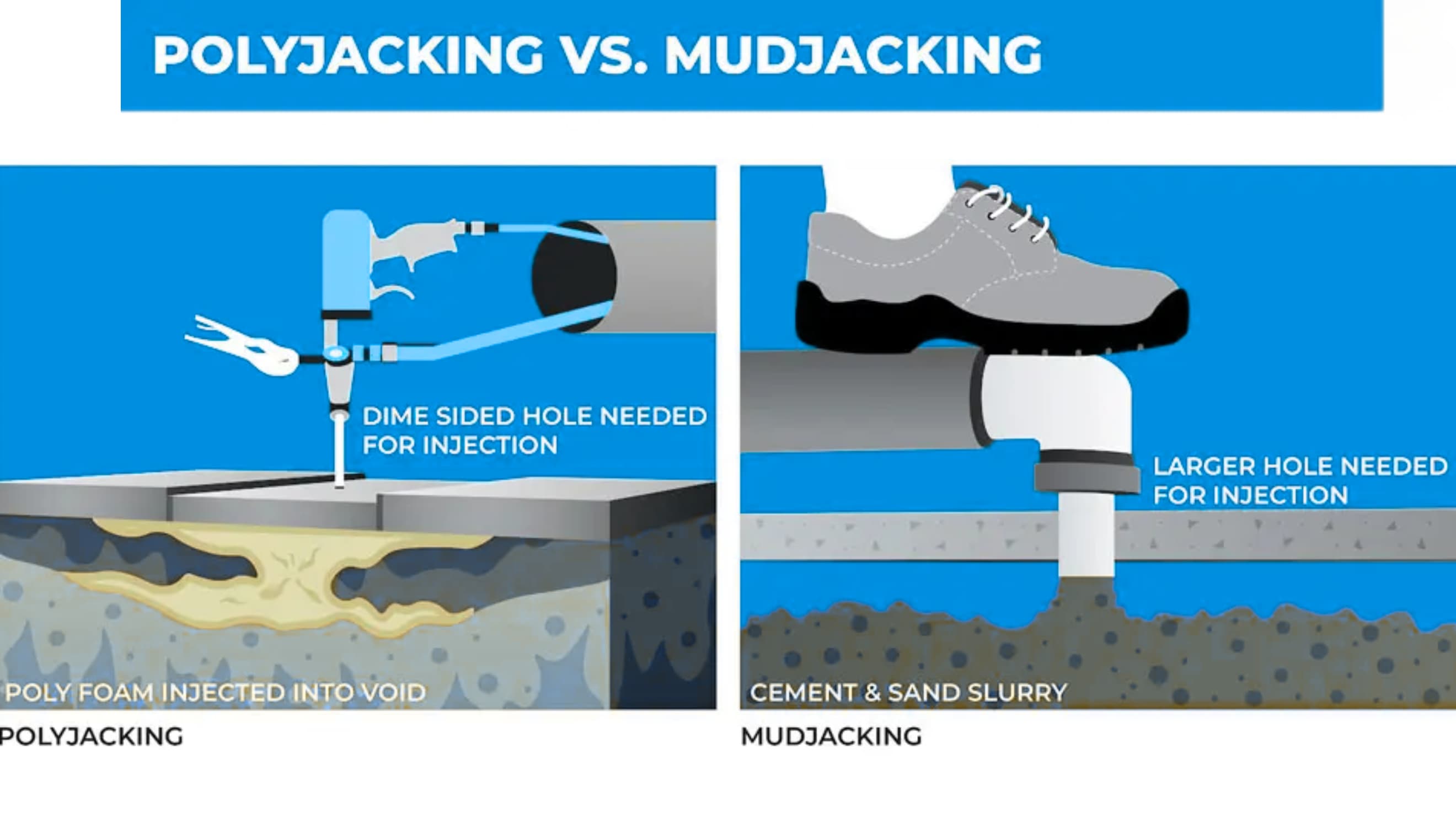
Both methods lift sunken concrete, but they do so in very different ways. Before you choose one, here is how they compare on the things that actually matter.
1. Material Weight
Polyurethane foam weighs 2 to 4 lbs per cubic foot. Mudjacking slurry weighs around 100 to 150 lbs per cubic foot. For slabs resting on weak or unstable soil, that weight difference is significant.
Adding heavy slurry to an already struggling base can worsen future settling.
2. Drill Hole Size
Foam jacking uses holes about 5/8 of an inch wide. Mudjacking requires holes of 1 to 1.5 inches, roughly the size of a small soda can opening. Larger holes are harder to patch cleanly and are more noticeable after the job is done.
3. Cure Time
Foam cures in 15 to 60 minutes. Mudjacking slurry needs 24 to 72 hours before the surface can be used again. For a business entrance or a busy driveway, that difference is hard to ignore.
4. Lifespan
Polyurethane foam can last 20 to 50 years. Mudjacking materials typically hold up for 2 to 10 years before the slab may need attention again. Mudjacking slurry can also erode in wet conditions and shrink as it dries, creating new voids under the slab over time.
5. Cost
Mudjacking runs around $3 to $8 per square foot. Foam jacking costs $5 to $25 per square foot. Mudjacking is cheaper upfront, but if it needs to be redone in a few years, the long-term cost catches up fast.
6. Best Use Case
Mudjacking works well for large slabs on stable soil where budget is the main concern. Foam jacking is the better option when the soil is weak, the area handles heavy traffic, or getting back to normal quickly matters.
How Much Does Concrete Lifting Foam Cost?
Foam concrete lifting typically costs between $5 and $25 per square foot. But square footage alone does not tell the full story. The depth of the void, the amount of lift needed, and site conditions all affect the final number.
Here Is What Most Residential Projects Cost in Practice:
| Project Type | Estimated Cost Range |
|---|---|
| Single sidewalk (2–6 sections) | $1,000 – $1,500 |
| Small garage area (slight lift) | $1,200 – $1,500 |
| Large 3–4 car garage | $3,000 – $6,000+ |
| Small porch (up to 165 sq ft) | $1,600 – $8,100 |
| Partial pool deck (4–6 sections) | $2,000 – $6,000+ |
| Full driveway (~450 sq ft) | $3,200 – $7,500 |
| Single slab or step | From $500 |
| Large commercial/warehouse slab | $20,000+ |
What Affects the Final Price:
- Void depth: Deeper voids need more foam, which increases material cost
- Amount of lift: A 1-inch correction costs less than a 4-inch lift
- Site access: Hard-to-reach areas add labor time
- Soil stability: Weak or shifting soil may need more material to stabilize
- Your location: Labor rates vary noticeably by city and region
- Extra repairs: Cracks or structural damage beyond the slab add to the overall cost
Pro Tip: Always ask for a written, itemized estimate. Some contractors charge overage fees if more foam is needed than originally quoted. Get at least two or three quotes before making a final call.
Where Can Concrete Lifting Foam Be Used?
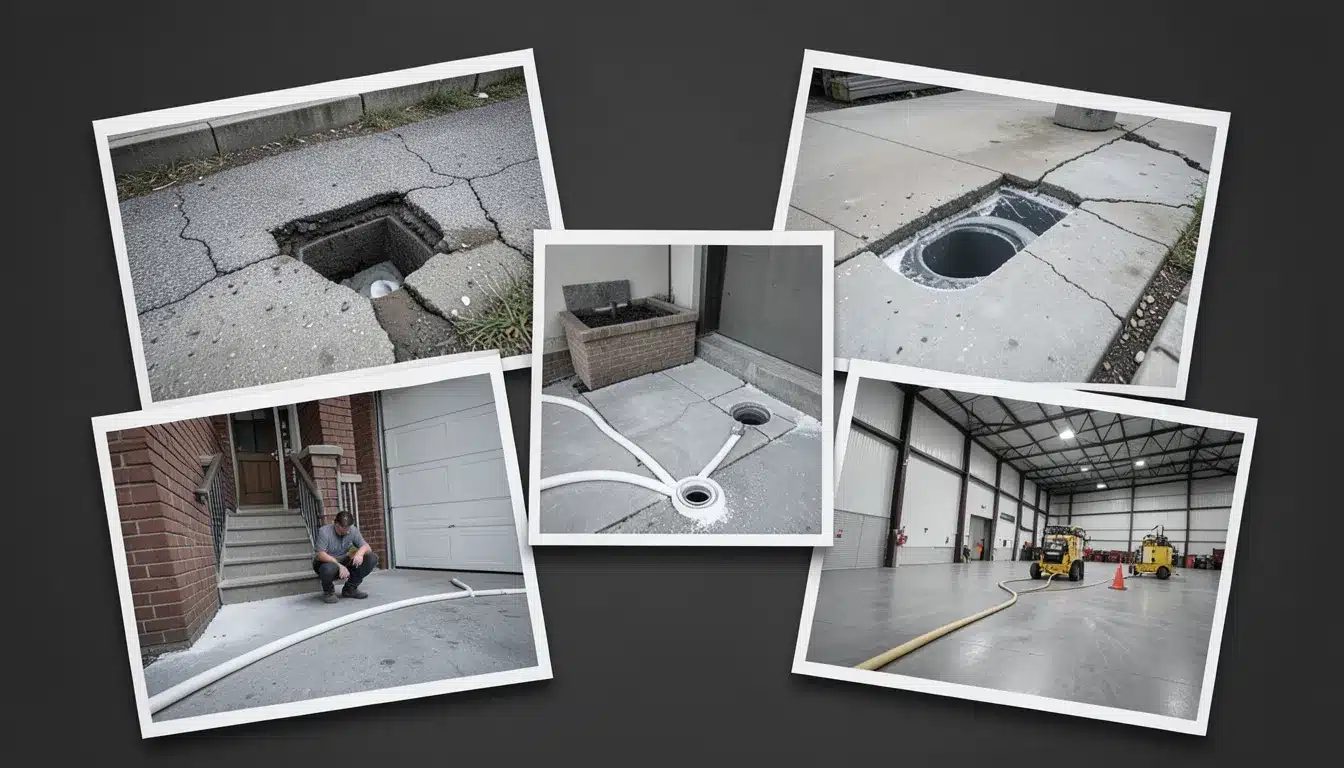
Foam jacking is not limited to driveways and sidewalks. It works across a wide range of surfaces, both inside and outside your property.
- Driveways: One of the most common uses; handles vehicle weight well after the foam cures to full strength
- Sidewalks and walkways: Quickly fixes trip hazards with very little disruption to foot traffic
- Patios: Level outdoor surfaces so furniture sits flat and foot traffic stays safe
- Garage floors: Corrects slabs that have shifted due to soil movement or temperature changes
- Pool decks: Works well near water since cured foam resists moisture and does not erode
- Concrete steps and stairs: Lifts settled steps back to a safe, even height without full replacement
- Warehouse and commercial floors: High-density foam supports the weight of heavy equipment and machinery
- Indoor spaces: Clinics, hospitals, and retail floors benefit from the low-dust, water-free application process
- Highways and road panels: Used by transportation departments for its lightweight properties and fast cure time
How Long Does Foam Concrete Lifting Last?
When the job is done correctly, polyurethane foam can last anywhere from 20 to 50 years. In many cases, it outlasts the concrete slab sitting above it.
That puts it well ahead of mudjacking, which typically lasts 2 to 10 years before the concrete may start to settle again.
That said, longevity depends on several factors. The condition of the soil beneath the slab, how well drainage is managed around the repaired area, and whether all voids were fully filled during installation all play a role.
Most professional foam jacking contractors back their work with a warranty ranging from 5 to 10 years.
Keeping up with crack sealing and directing water flow away from the slab helps the repair hold up for as long as possible.
The Bottom Line
Sunken concrete is one of those problems that feels bigger than it is until you see what foam jacking can actually do.
Concrete lifting foam fixes settled slabs quickly, lasts for decades, and costs far less than tearing everything out and starting over.
It works on driveways, patios, sidewalks, pool decks, and more. Most jobs take a few hours. The results last for years.
The one thing that matters most? Getting the job done right. Hire a licensed contractor, ask the right questions, and get a written estimate before you commit.
If your concrete has been sitting unevenly for too long, this is a good time to call a professional and find out what foam jacking would cost for your situation.