Art Nouveau Interior Design: Style, Rooms & History

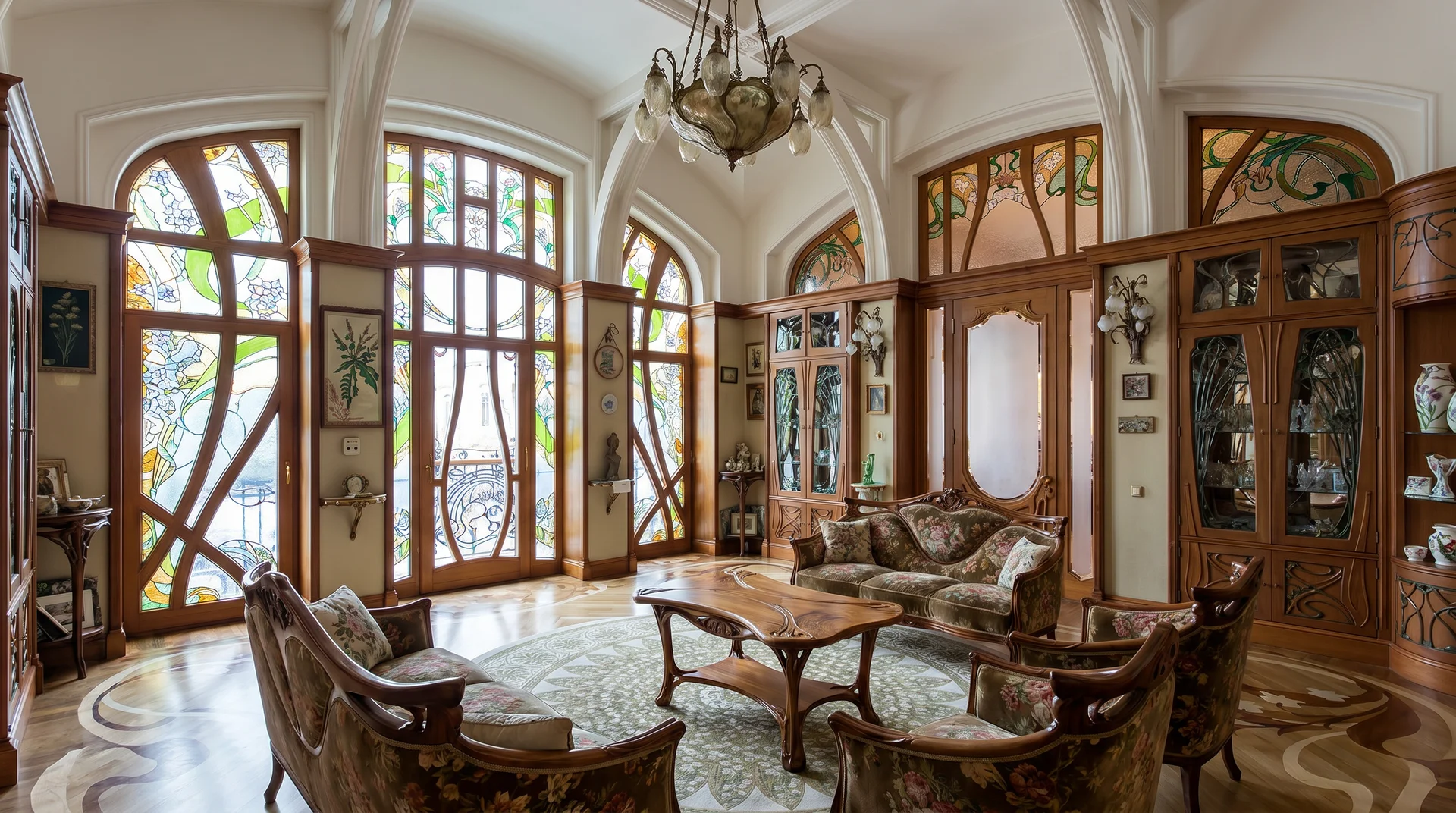
You walk into a room, and something feels different. The doorframe curves like a vine. The light coming through the window is amber and green, filtered through leaded glass.
The chair in the corner has legs that taper like roots. Nothing in the room is quite straight, and somehow, that feels intentional.
That is Art Nouveau interior design. It is one of those styles that does not announce itself loudly but stays with you.
This post covers what it is, where it came from, how to recognize its defining characteristics, and how to actually bring it into your home today.
What Is Art Nouveau Interior Design?
Art Nouveau interior design is a style that emphasizes organic forms, flowing lines, and nature-inspired motifs.
Emerging in the late 19th century, it transforms interiors into harmonious, handcrafted spaces where every detail, from door handles to ceiling plaster, reflects careful artistry. Common features include botanical patterns, stained glass, carved wood, and warm metal finishes.
The term “Art Nouveau,” meaning “new art” in French, describes a movement that peaked between 1890 and 1910 across Europe and the United States, celebrating craftsmanship and the beauty of natural forms.
A Brief History of Art Nouveau
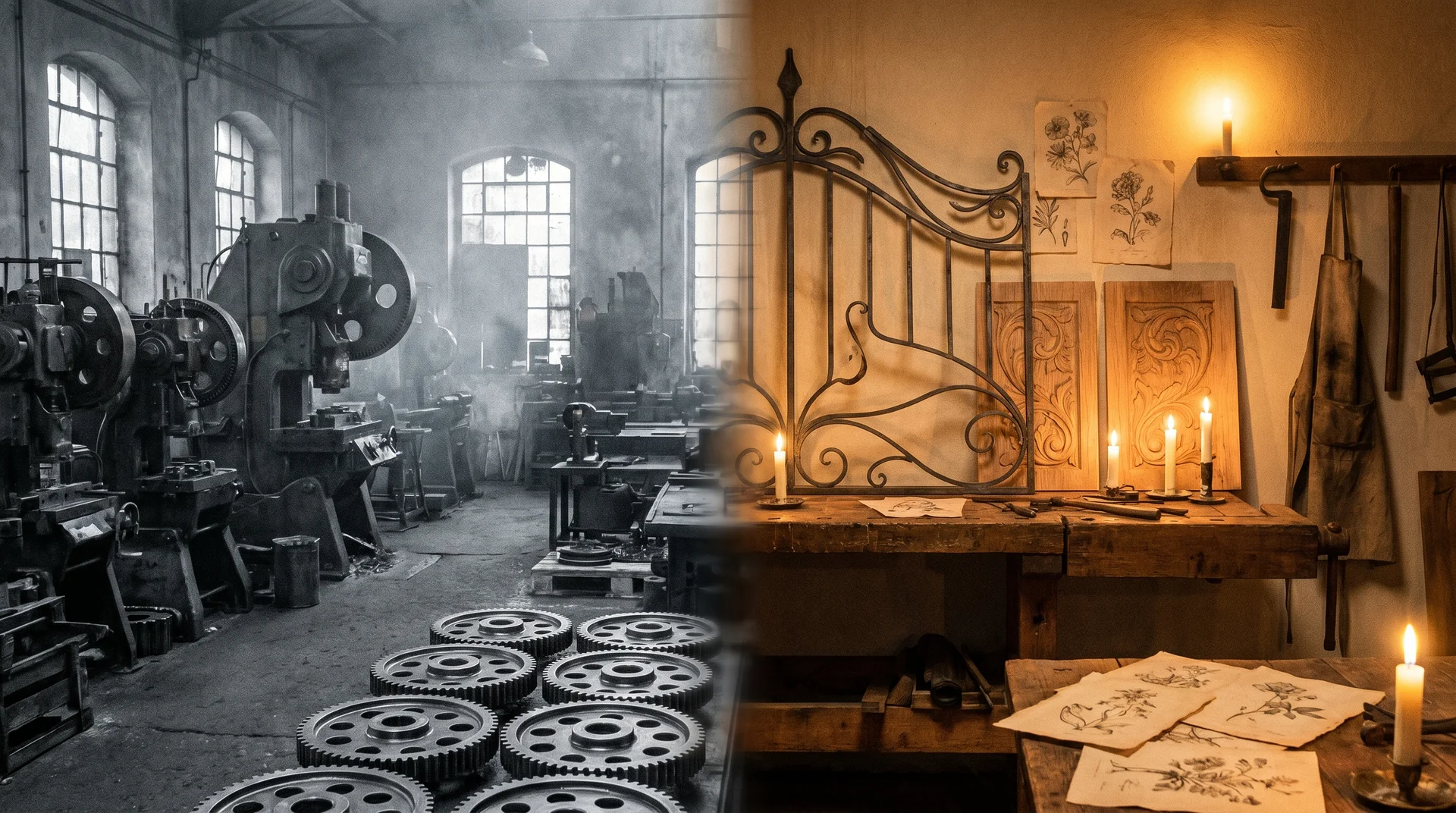
Art Nouveau emerged as a reaction to the Industrial Revolution, which had replaced skilled handicraft with mass-produced goods. Designers, artists, and writers sought to restore artistry to everyday objects, emphasizing careful craftsmanship and organic forms.
- 1834–1896, William Morris: English designer William Morris critiqued industrialization for undermining craftsmanship. Advocating handmade production and botanically inspired designs, he laid the groundwork for the Arts and Crafts Movement, which influenced Art Nouveau.
- 1884, The Term Appears: The Belgian publication L’Art Moderne first used “Art Nouveau” to describe artists such as James Ensor and Théo van Rysselberghe, highlighting organic beauty, nature-inspired forms, and craftsmanship.
- 1895, Maison de l’Art Nouveau: Siegfried Bing’s Paris gallery popularized the name. Simultaneously, regional variations appeared: Jugendstil in Germany, Modernisme in Catalonia, Stile Liberty in Italy, and Secession in Austria. These labels represent the same visual language, widening sourcing options.
- 1890–1910, The Peak: Art Nouveau became a fully developed style in interior and architectural design. Victor Horta’s Hôtel Tassel in Brussels, Hector Guimard’s Paris Métro entrances, Louis Comfort Tiffany’s glasswork, and Antoni Gaudí’s unique forms in Barcelona exemplify the movement.
- Post-1910, Decline and Legacy: World War I ended the economic conditions supporting handicraft. Art Deco, with its geometric and industrial-friendly designs, replaced Art Nouveau. Yet it endured in architectural salvage, tile archives, and collections favoring handmade artistry. Today, its appeal lies in the detailed, human touch it brings to contemporary interiors.
Art Nouveau is back in conversation now, and the reason is not nostalgia so much as fatigue with the alternative. A lot of contemporary interiors look like they came from the same source: flat surfaces, cold metal finishes, no evidence of a maker’s hand. Art Nouveau offers something different: the feeling that someone thought carefully about every detail.
Art Nouveau Interior Design Characteristics
Art Nouveau has a visual fingerprint that most people recognize before they know what to call it. Once you understand what produces that feeling, you can apply it deliberately rather than by accident.
- Flowing, organic lines: Every curve in Art Nouveau traces back to a plant, a root, a tendril, or moving water; straight lines appear only where a curve physically cannot.
- Botanical and nature-based motifs: Lilies, irises, dragonflies, peacocks, and winding vines are not decorative additions here; they are the primary visual language of the style.
- Stained and art glass: Glass is structural, not ornamental, appearing in windows, transoms, lampshades, and cabinet panels, always in deep greens, amber, soft violet, or cobalt.
- Handcraft and material honesty: Carved wood, wrought iron, bronze, and ceramic tile were the expected materials, and brush marks or casting lines were left visible because they proved something was made by hand.
- Asymmetry and visual movement: Art Nouveau rooms deliberately avoid mirroring; the goal is rhythm across the space, not a formal center point.
- The Gesamtkunstwerk principle: Borrowed from composer Richard Wagner, this is the idea that every element in a room, door handle, light fixture, floor tile, wallpaper, should speak the same visual language as one unified whole, which is what separates an actual Art Nouveau interior from a room that is merely vintage-inspired.
Art Nouveau Color Palette
The colors in Art Nouveau interiors are drawn entirely from the natural world. The palette stays in muted, earthy territory: sage green, olive, warm ochre, terracotta, dusty rose, ivory, and soft gold form the base. broader accents come in forest green, cobalt blue, plum, and burnt sienna.
Walls usually carry the quieter tones, with depth and saturation arriving through patterned elements, wallpaper, tile, and textiles, rather than bold paint. Metal finishes stay warm throughout: bronze, aged brass, patinated copper, and burnished gold.
Chrome, brushed nickel, and stainless steel are entirely at odds with this palette. Stained glass introduces the most saturated color in a room, always within a framed or structured context that keeps it from overwhelming the space.
If you are looking for paint reference points, Farrow and Ball’s older ranges and Benjamin Moore’s Historical Colors collection both contain strong candidates for period-accurate base tones.
Art Nouveau Room by Room
Knowing the style in theory and knowing how to apply it room by room are two different things. The following section deals with the second problem.
1. Entryway
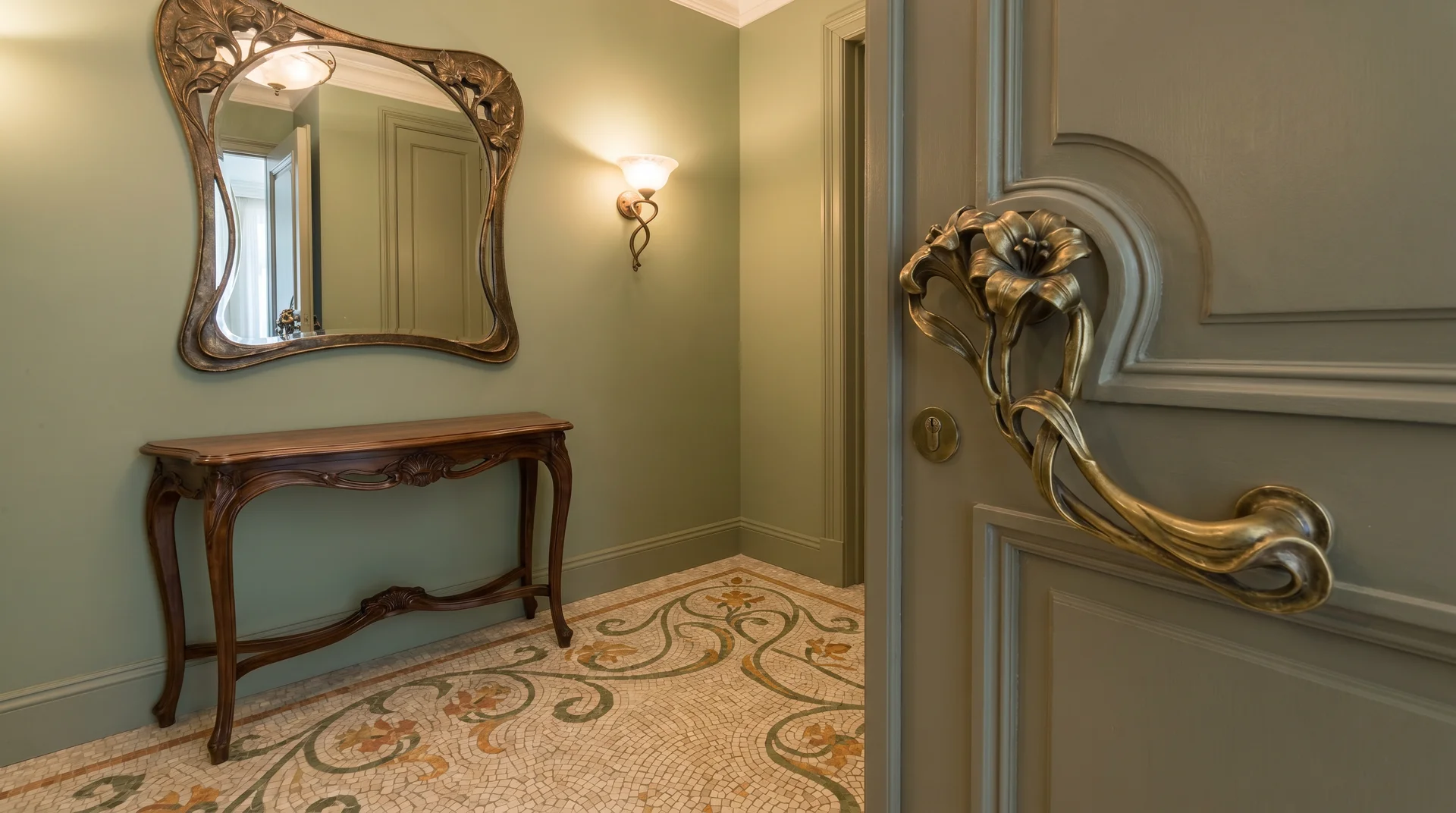
The entry is where Art Nouveau has the most immediate impact for the least cost. A mosaic or encaustic tile floor with a botanical pattern sets the tone before a visitor even reaches the first room.
Pair that with a carved-wood console, aged brass hardware on the front door, and, if the architecture allows, a stained-glass panel in the door or sidelights. Even a single piece of curved iron hardware on a plain door meaningfully shifts the feeling of the space.
2. Living Room
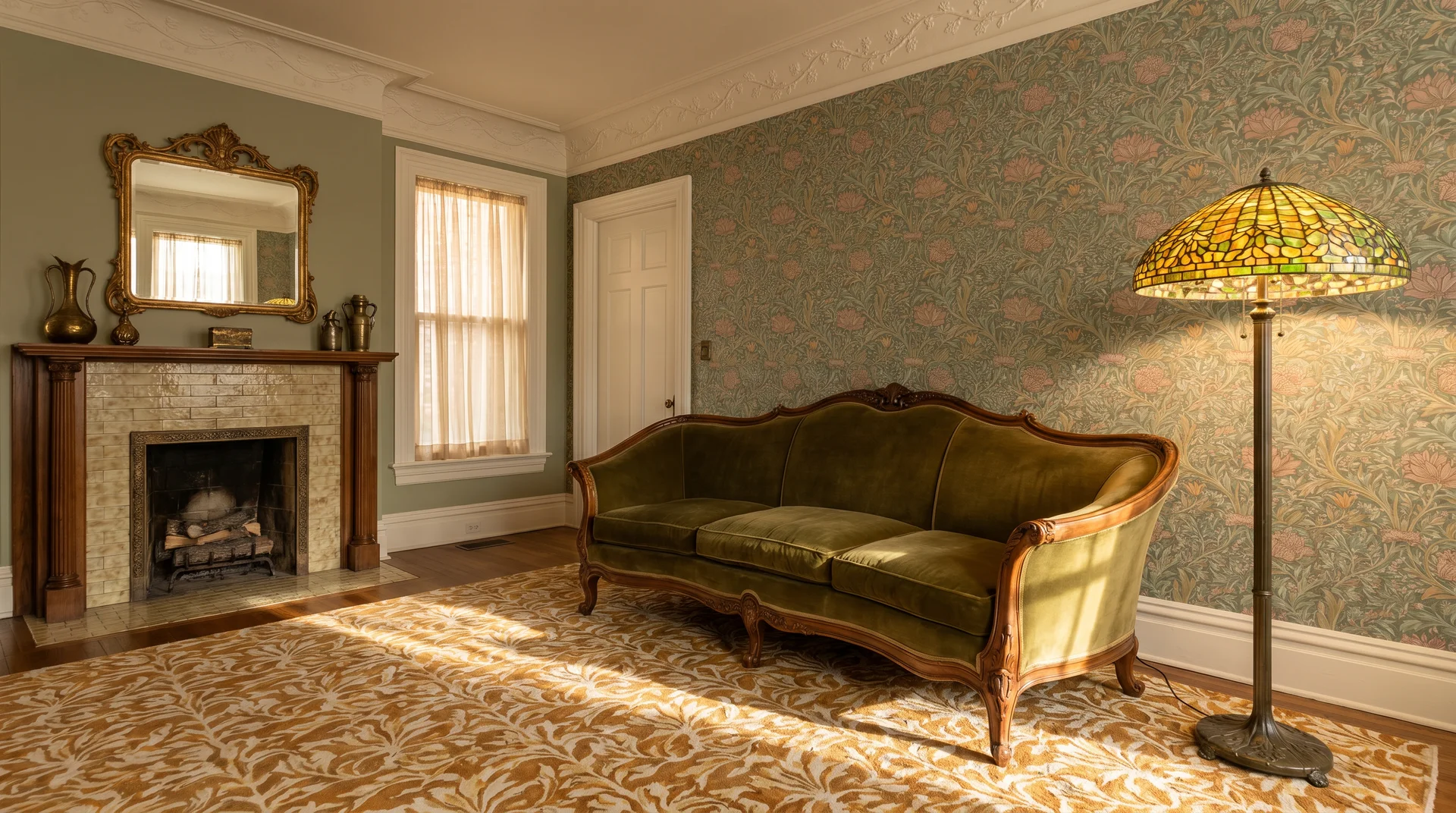
The living room is where most people want to spend their decorating budget, and it rewards investment in Art Nouveau. A curved settee or sofa with botanical upholstery is the obvious anchor piece.
From there, a Tiffany-style table lamp or an art glass pendant adds the right quality of light. A botanical wallpaper on one feature wall, kept quiet on the other three with muted paint, brings in pattern without making the room feel busy.
A carved or gilded mirror above the fireplace, and an area rug in warm earth tones with an organic pattern, pull everything together without requiring structural changes.
3. Bedroom
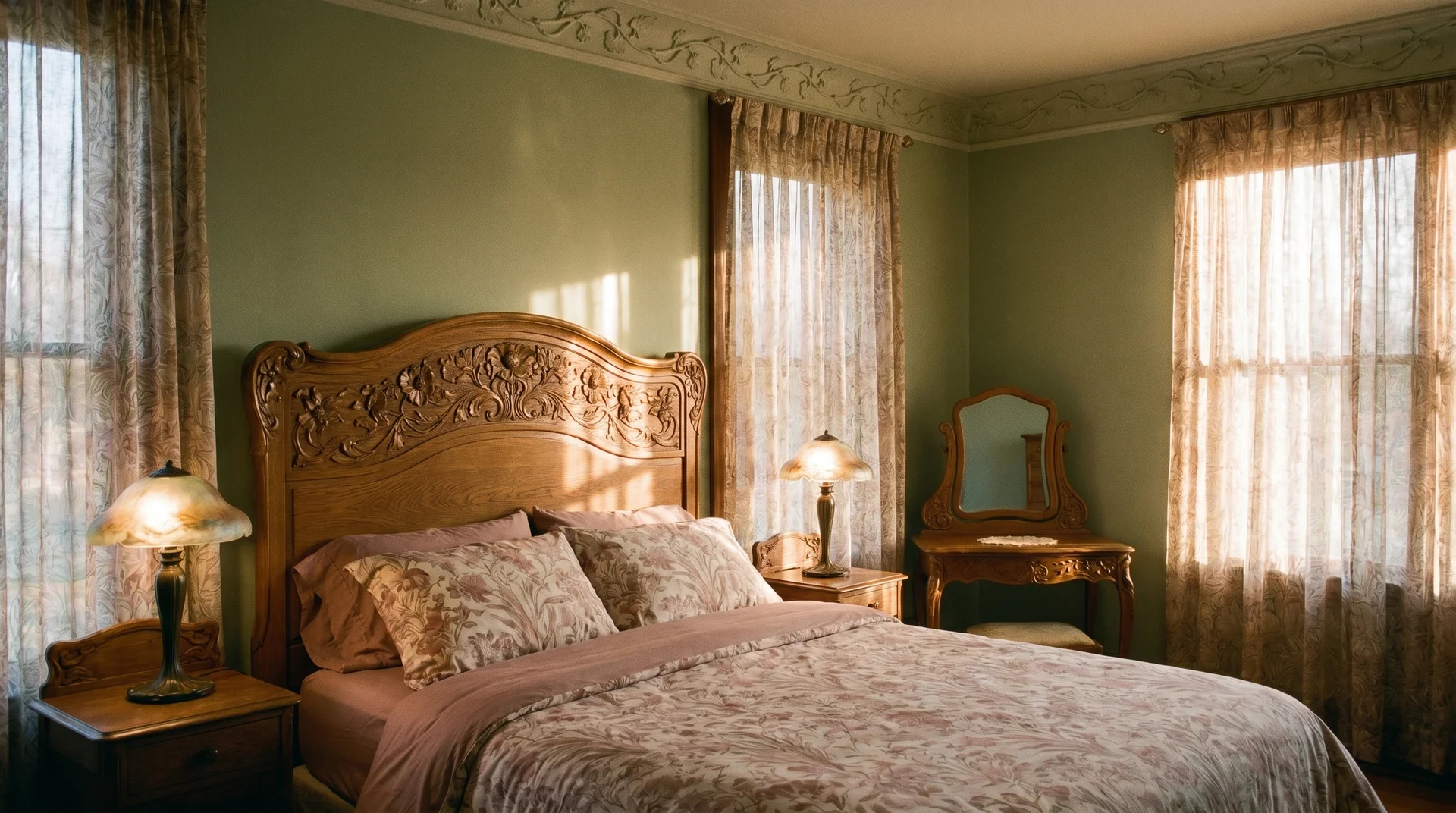
The bedroom is consistently skipped or handled vaguely in most design content on this style, which is a missed opportunity because it is one of the most comfortable rooms to work with.
A carved headboard in oak or walnut with floral relief is the primary piece. Soft botanical print bedding in sage, dusty rose, or ivory reinforces the palette without dominating it.
If the windows allow, sheer patterned curtains that filter light warmly do more for the room’s atmosphere than any artwork. Bedside lamps with glass shades and bronze or brass bases complete the picture without overcomplicating it.
3. Kitchen
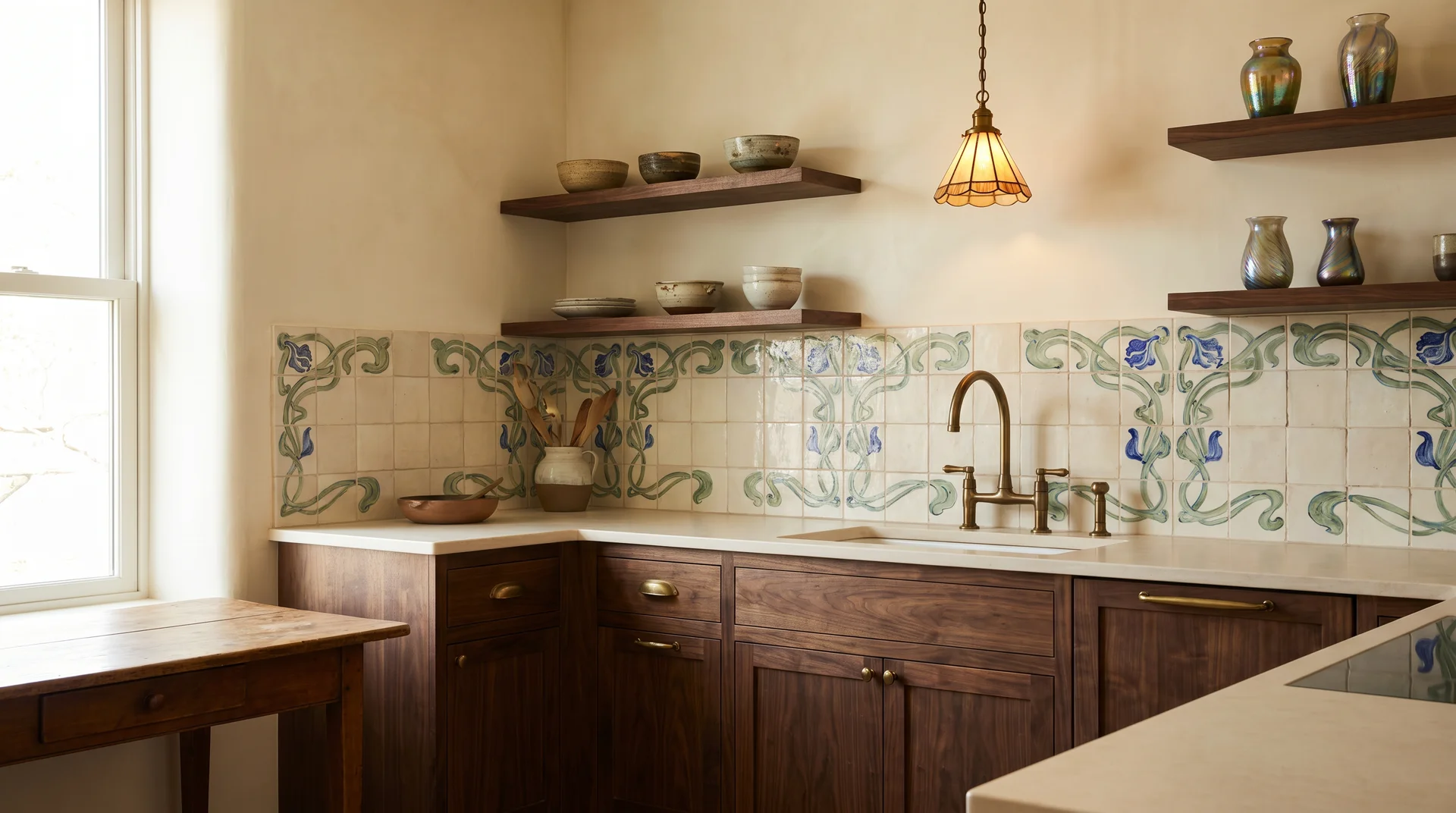
The kitchen application is more restrained but no less effective. A handmade ceramic tile backsplash with botanical or geometric-organic patterning is the highest-impact change available.
Hardware in aged brass or bronze, drawer pulls, cabinet hinges, faucet fixtures, replaces cold modern finishes with something that actually fits the material language of the style.
Open shelving in dark-stained wood, used to display ceramics and glassware, adds warmth without requiring a cabinet replacement.
Art glass pendant lights over an island or dining nook elevate the aesthetic.
4. Bathroom
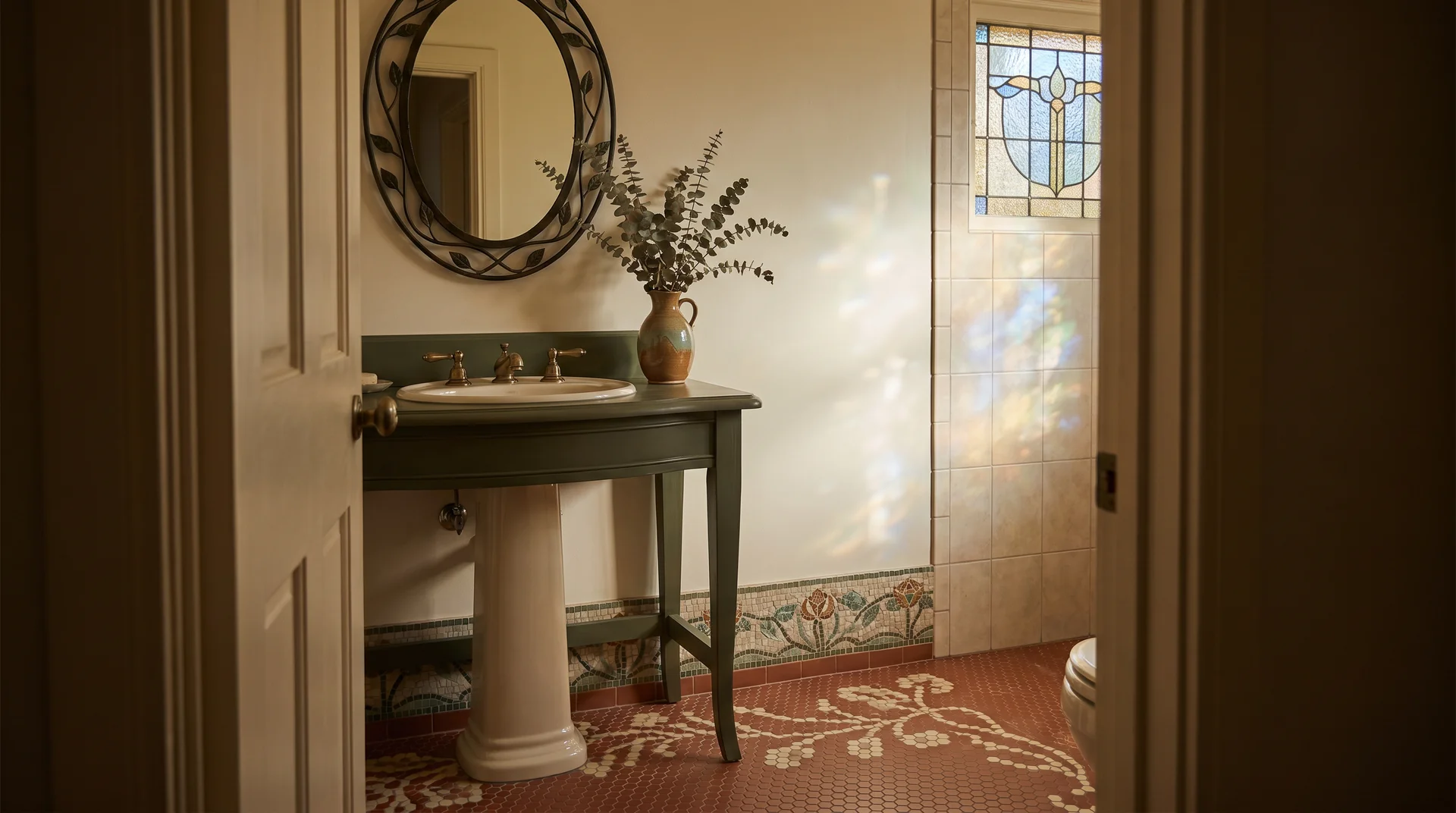
The bathroom is arguably the most achievable room in an Art Nouveau context, and the one where a modest budget goes the furthest.
Small-format encaustic or mosaic tile on the floor with a botanical pattern sets the foundation. A vanity, carved in wood or painted in a period-appropriate tone with aged brass fixtures, ties the surfaces together.
A wrought-iron or carved-wood mirror frame with an organic silhouette handles the wall above the sink. If privacy is not a concern, a stained glass window or panel transforms the quality of light in the room in a way no other single element can match.
Art Nouveau vs Art Deco Interior Design
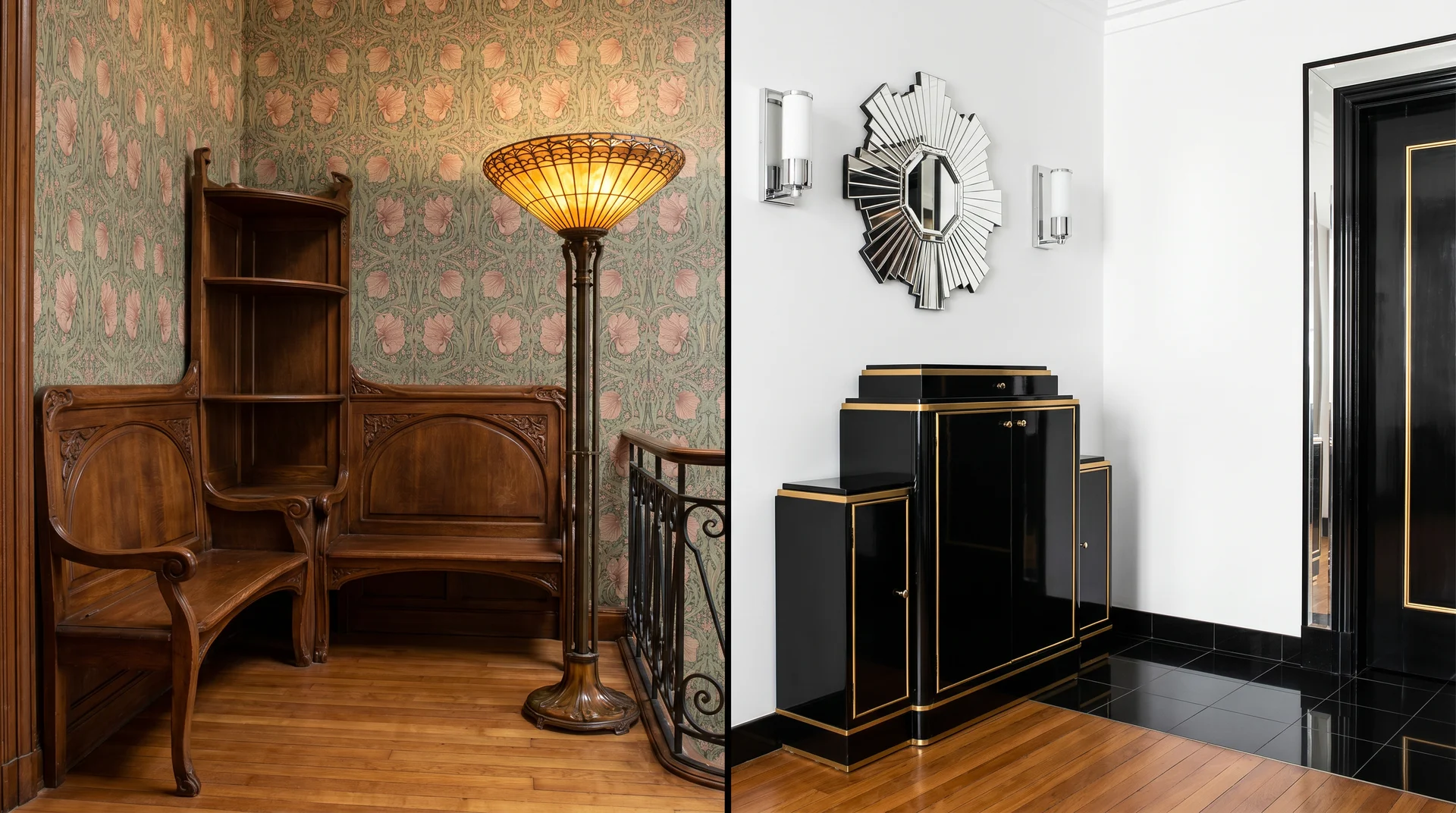
These two styles are frequently confused or conflated, partly because they emerged in roughly the same era and share some material overlap. Knowing the actual differences helps you make deliberate choices rather than accidentally mixing two aesthetics that do not sit comfortably together.
Both Art Nouveau and Art Deco valued craftsmanship, used rich materials, and represented reactions against the dominant aesthetic of their moment. The similarities mostly stop there.
| Element | Art Nouveau | Art Deco |
|---|---|---|
| Lines | Curved, sinuous, organic | Geometric, angular, symmetrical |
| Motifs | Flowers, insects, vines, flowing hair | Sunbursts, chevrons, stepped forms, abstract geometry |
| Color palette | Muted, earthy, nature-derived | Bold, high-contrast, strong metallics |
| Era peak | 1890 to 1910 | 1920 to 1940 |
| Mood | Romantic, handcrafted, organic | Glamorous, modern, machine-age |
| Key materials | Carved wood, wrought iron, ceramic, art glass | Lacquer, chrome, mirror glass, marble |
| Symmetry | Deliberately avoided | Central to the aesthetic |
Choose Art Nouveau if warmth, organic texture, and a handcrafted quality matter more to you than drama. Choose Art Deco if you want high-contrast, geometric boldness, and a more polished finish. They can exist in adjacent rooms, but mixing them heavily in a single space creates visual noise rather than tension.
How Surfaces, Materials, and Architecture Define the Look
The surfaces in an Art Nouveau interior are where the style either comes together or falls apart. Wallpaper patterns draw from William Morris’s botanical designs, repeating organic prints rather than geometric repeats, always within the muted natural palette.
Tile work appears in kitchens, bathrooms, and entryways using hand-painted relief tiles with floral motifs or encaustic patterns in earth tones.
Furniture takes carved, curvilinear forms in oak, walnut, or fruitwoods with velvet or tapestry upholstery. On the architectural side, Art Nouveau style architecture integrates structure and ornament directly, curved facades, iron-and-glass construction, ceramic tile cladding on exteriors, and large windows with asymmetrical glazing.
The Paris Métro entrances by Hector Guimard and Victor Horta’s Hôtel Tassel in Brussels (a UNESCO World Heritage Site) remain the most cited architectural references for how the outdoor and indoor language of the style operates as one continuous system.
Conclusion
Art Nouveau interior design rewards patience. It is not a style you assemble in a single shopping session.
The best rooms in this style are built piece by piece, with attention to palette coherence and material quality at every step.
Start with the room where one change would have the most visible impact. Often, the entryway or living room, and let the rest follow.
The style’s enduring appeal is straightforward: it looks like someone cared about every detail. In a market saturated with identical fast furniture and cold, generic spaces, that quality is genuinely rare.
That is why Art Nouveau interiors still feel relevant today, more than a century after the style first appeared.