Outdoor Living Is Scaling Up, and So Are the Technical Demands Behind It

Outdoor living has moved well beyond the backyard. Across boutique hotels, mixed-use developments, private residential parks and high-end commercial exteriors, landscape and outdoor design has become a discipline in its own right, one where the scale, the budget and the technical expectations have very little in common with a home garden project. As these spaces grow larger and more ambitious, the infrastructure beneath them has to grow with them. Nowhere is that more true than in drainage.
For landscapers, architects and developers working at this scale, drainage is rarely the most visually interesting part of a brief. It is, however, one of the parts most likely to determine whether a project performs well over its first decade of use, or requires costly rework within its first winter.
Why Drainage Is the First Thing That Fails in Large-Scale Outdoor Design
Large exterior projects concentrate hard surfaces, plazas, pool decks, motor courts, event lawns, parking areas, at a scale that residential drainage components were never designed to handle. A trench or channel sized for a single-family driveway will be overwhelmed almost immediately by the runoff generated across a hotel forecourt or a community park.
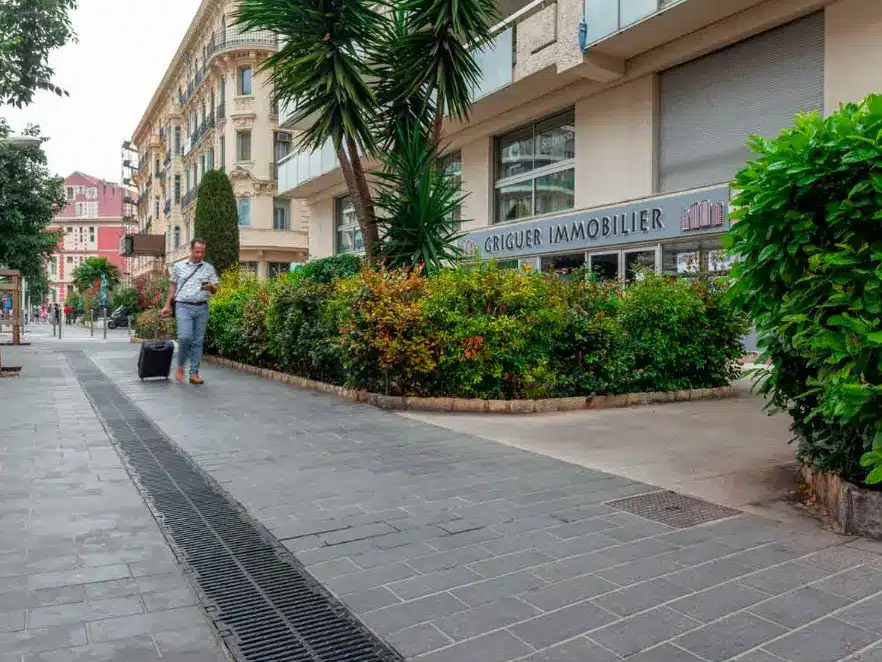
The failure pattern is consistent: standing water at low points, erosion along planting beds, and, in colder climates, freeze-thaw damage to paving that was never properly relieved of surface water. Once a project is built and landscaped, correcting a drainage shortfall means tearing up finished hardscape, by far the most expensive way to solve a problem that a correct specification would have prevented at the design stage.
Load Classes and Hydraulic Capacity: What Changes When a Project Isn’t Residential Scale Anymore
Two variables separate a professional-grade drainage specification from a residential one: load class and hydraulic capacity.
Load class describes the weight a drainage system can bear without deforming or cracking, and it is defined by a scale that runs from light pedestrian traffic up through heavy vehicular and industrial loads. A private garden path might only ever need the lowest end of that scale. A hotel drop-off lane, a delivery route through a public park, or a parking structure serving a mixed-use development sits much further along it, and needs to be specified accordingly, not assumed.
Hydraulic capacity is the second variable, and it is a function of channel geometry, slope and the surface area being drained. A system that looks visually similar to a smaller one but has a shallower profile or a flatter invert will move noticeably less water per linear metre. On a large paved plaza during a heavy storm event, that difference is the gap between water clearing in minutes and water pooling for hours.
This is also where material choice matters. Polymer concrete, denser, lighter and more dimensionally stable than traditional cast concrete, has become the material of reference for professional-grade channels, precisely because it holds tighter tolerances at the larger cross-sections and heavier load classes that big projects require.
Trench Drains as the Professional-Grade Solution
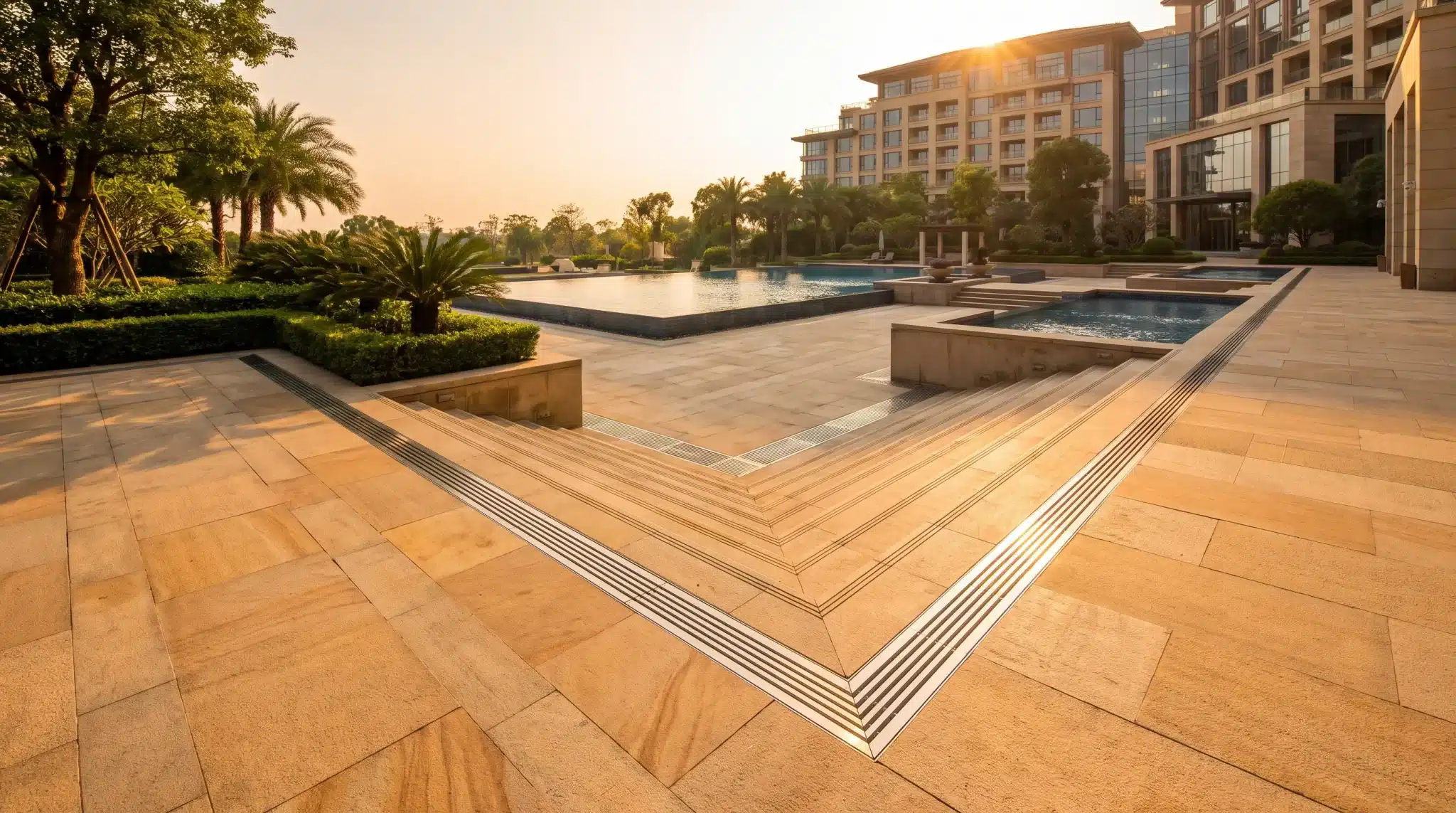
For projects operating at this scale, trench drains engineered in polymer concrete, with a built-in slope and a load class matched to the actual traffic the surface will see, have become the standard reference point. Rather than treating drainage as a hidden utility line item, specifiers increasingly integrate it into the design itself: continuous slot channels along the edge of a pool deck, linear grates that follow the geometry of a plaza, or heavy-duty systems concealed beneath a motor court that still needs to carry service vehicles.
The advantage of a properly engineered trench drain system over an assembly of smaller, ad hoc components is consistency: a single specified product line, with documented load classes and hydraulic performance, that an architect or engineer can size once and trust across the entire project rather than re-evaluating at every junction.
Aesthetics and Function Don’t Have to Compete
One reservation designers sometimes have about drainage infrastructure is visual: a channel running across a plaza or along a pool edge can read as utilitarian if it isn’t chosen deliberately. In practice, this is no longer a trade-off. Grate finishes now range from stainless steel and galvanised steel to composite and cast-iron options, and channel widths can be matched to paving joints so the drainage line reads as part of the surface pattern rather than an interruption to it.
This matters more at large scale, not less. A single visible channel is a detail; a drainage line that runs the length of a hotel forecourt or wraps an entire plaza is a design element in its own right, and it is worth specifying with the same care given to paving material, lighting or planting.
Maintenance and Long-Term Performance
Large exterior spaces are also judged on how little they demand of a maintenance team once they are handed over. A trench drain system specified with removable grates, adequate access points and a slope that keeps sediment moving rather than settling will need periodic clearing, not periodic replacement. Systems undersized for their load or hydraulic demand tend to show the opposite pattern: cracking at the edges, grates that deform under repeated heavy traffic, and channels that require more frequent intervention as the surrounding paving settles around them.
For a property manager or facilities team inheriting a finished project, that difference shows up years later as either a minor line item or a recurring capital expense, which is precisely why the specification decisions belong at the design stage, not after the fact.
What to Specify Before Breaking Ground on a Large Exterior Project
A few decisions, made early, prevent the vast majority of drainage problems on large-scale outdoor projects:
- Confirm the load class against actual use, not assumed use, a pedestrian plaza that occasionally sees a service vehicle needs to be specified for that vehicle, not for pedestrians alone.
- Size hydraulic capacity to the drained surface area and local rainfall intensity, not to a channel width chosen for aesthetic reasons.
- Choose a material, polymer concrete rather than standard cast concrete, that will hold its tolerances under the loads and freeze-thaw cycles the site will experience.
- Plan the drainage line as part of the design layout from the start, rather than retrofitting it once hardscape and planting plans are finalised.
- Work from a manufacturer’s technical documentation and project references at comparable scale, rather than a generic residential product range.
Outdoor spaces designed at this scale are judged over years of use, not on opening day. A drainage system specified correctly at the outset, sized to its real load, matched to its real hydraulic demand, and built in a material that will hold its performance over time, is what allows the visible design above it to actually last.