How to Fix a Wobbly Chair Proven Method for Every Chair Type

You sit down. The chair rocks. You shift your weight. It rocks again. You’ve been tolerating it for weeks, and at some point, you start wondering if the chair is slowly going to give out under you because it probably will.
A wobbly chair almost never fixes itself. The movement puts stress on already-loose joints, and over time, those joints fail completely.
The good news: most wobbly chairs can be fixed in under an hour without calling anyone.
This covers every common scenario, including wooden chairs, dining chairs, office chairs, and patio chairs, along with the exact tools and materials you need for each fix.
No guessing, no vague advice.
Why Do Chairs Get Wobbly?
Before grabbing tools, it helps to know what you’re actually dealing with. The fix depends entirely on the cause.
- Loose or stripped screws: Daily use vibrates fasteners loose over months and years; a screw that spins freely indicates a stripped hole.
- Dried glue in wood joints: Common in older chairs; seasonal wood expansion and contraction can break the glue bond.
- Uneven or worn-down legs: One leg may be shorter due to manufacturing or wear, causing the chair to rock front-to-back or diagonally.
- Loose dowels or spindles: Seen in older Windsor-style chairs; round tenons shrink over time, leaving gaps in socket holes.
- Damaged base or frame: Common in office or RTA furniture; plastic bases can crack, and metal frames can bend.
- Uneven flooring: Chairs may rock even if intact; always test on a flat surface before taking the chair apart.
- Brand-new chairs wobbling: Ensure all legs are fully seated, and fasteners tightened; RTA furniture often requires a firm hand.
Tools and Materials You’ll Need for DIY
Get these together before you start. Nothing is worse than having a chair half-apart with wet glue and realizing you don’t have a clamp.
Tools Required
- Phillips and flathead screwdrivers
- Allen wrench set (hex keys)
- Rubber mallet or deadblow hammer
- Bar clamps or a ratchet strap (for clamping joints while the glue dries)
- Cordless drill (needed for the L-bracket method)
- Sandpaper in 80, 120, and 220 grit
- Carpenter’s level or measuring tape
Materials You Will Need
- Titebond II wood glue
- Hide glue specifically for antique chairs;
- Chair-Lok
- Wooden toothpicks or a small wooden dowel
- Metal L-brackets
- Wood shims or furniture wedges (Wobble Wedges) for uneven legs
- Adjustable furniture levelers
- Felt pads
- Wood filler
- Thread-locking adhesive (Loctite)
Step-by-Step Guide to Fixing a Wobbly Chair
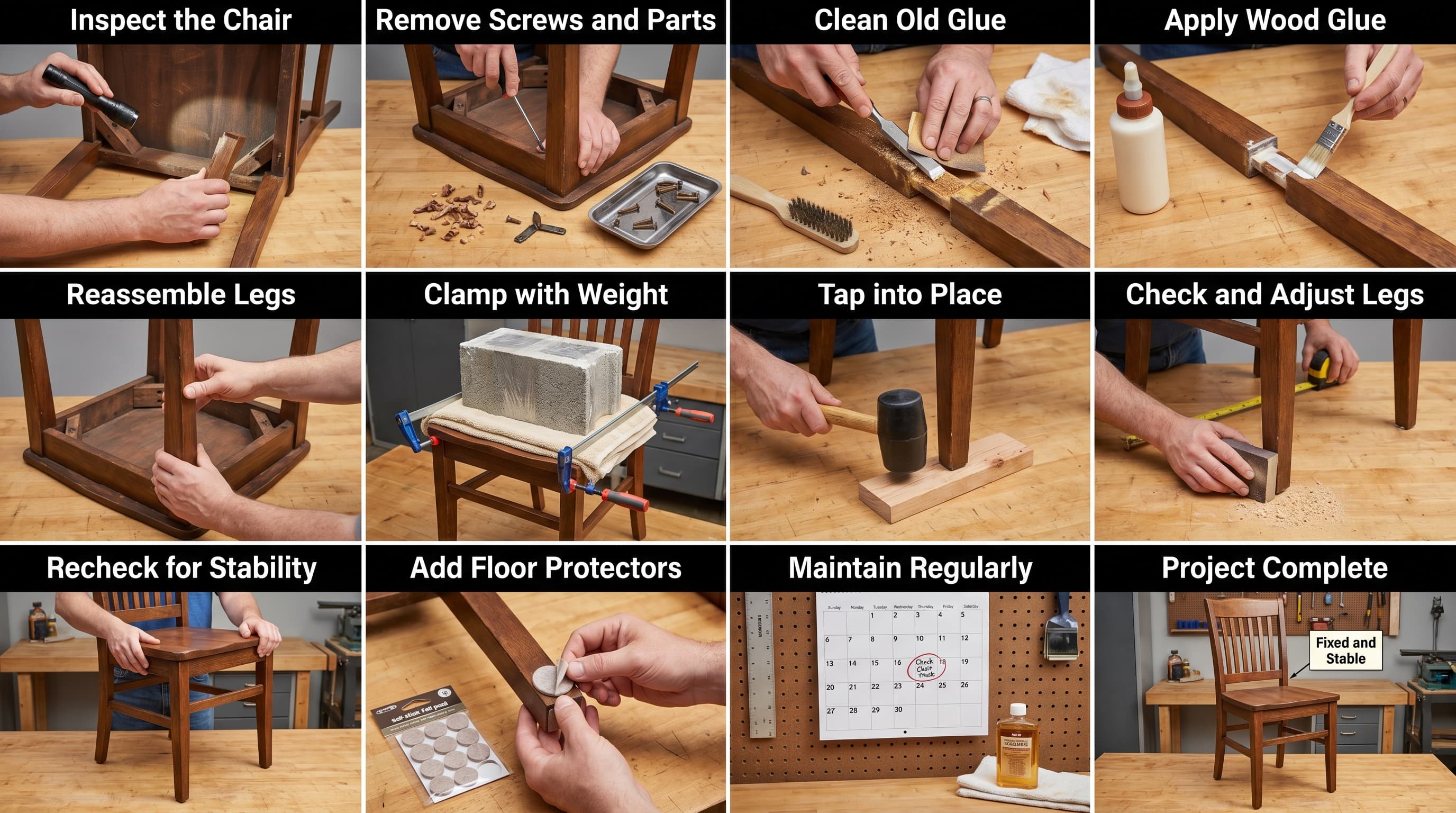
Fixing a wobbly chair is often simpler than it seems. Most chairs become unstable due to loose screws, worn glue, or uneven legs.
By carefully inspecting the chair, properly cleaning and gluing joints, and ensuring a tight assembly, you can restore stability and extend the life of your furniture.
Step 1: Inspect the Chair
Flip the chair over and examine the underside. Identify any loose joints or DIY repairs, like screws that may be causing instability.
Step 2: Remove Old Screws and Parts
Take out all screws, especially any metal ones, and carefully remove the legs and other connected parts. Label parts if necessary to ensure correct reassembly.
Step 3: Clean Old Glue and Residue
Use a chisel or utility knife to remove dried glue, paint, and debris from the joints. Sand the inside of holes and surfaces with 120-grit sandpaper to expose bare wood.
Step 4: Apply Wood Glue Properly
Use a brush to apply wood glue evenly to all joint surfaces, covering the edges thoroughly. Avoid just putting glue at the bottom of the hole.
Step 5: Assemble the Chair Legs
Insert the legs, starting with the angled back legs. Ensure all glued surfaces meet properly.
Seat the legs using a rubber mallet if necessary to align them correctly.
Step 6: Apply Clamping Pressure
Stand the chair upright, place padding on the seat, and add weight on top to create pressure. This ensures a tight bond as the glue dries.
Step 7: Allow to Dry and Test
Leave the chair to dry fully, allowing the glue to reach its set-up time. Once dry, check that the chair is stable. A proper glue job can last decades.
Video Tutorial
Special thanks to Fixing Furniture for providing valuable insights in their video, which I referenced while creating this guide.
How to Fix a Wobbly Office Chair
Office chair wobble comes from a different set of problems than wooden chair wobble. Here’s how to work through them.
Loose bolts: Flip the chair and tighten all bolts on the seat plate, armrests, and base using a cross pattern. Apply Loctite to prevent loosening.
Bad casters: Lift the base and spin each wheel. Replace any worn, clogged, or cracked casters; most 7/16” stem casters swap out in under a minute
Gas lift cylinder failure: If the chair sinks or wobbles vertically, remove the pneumatic cylinder with a rubber mallet and press in a replacement; no tools are needed
Cracked base: Inspect the five-star base for cracks; replace cracked plastic or severely damaged metal bases. Do not glue
Uneven floor: If the chair wobbles only in one spot in the room, a chair mat levels minor floor irregularities and prevents the casters from digging into the carpet or flooring.
How to Keep Chairs from Getting Wobbly Again
Fixing a wobbly chair once is fine. Fixing the same chair every six months is annoying.
- Check and tighten all screws every few months during routine cleaning before they get loose enough to rattle.
- Keep indoor humidity between 40–60%. Wood joints loosen significantly in dry winter air as the wood contracts.
- Lift chairs instead of dragging them. Dragging puts lateral stress on leg joints every single time.
- Apply a thin finish coat to the joints of wooden chairs once a year; it slows moisture absorption and reduces seasonal movement.
- For office chairs: apply Loctite to bolts during any reassembly and replace casters before they fail, not after.
Conclusion
A wobbly chair is rarely the end of the furniture. In most cases, it’s a loose screw, a dried-out joint, or one leg sitting slightly shorter than the rest, problems that take less than an hour to fix with the right materials.
The key is diagnosing before doing. Get the cause right, match it to the correct fix, and the repair holds for years. Ignore it, and the movement compounds until the joint fails completely, usually at the worst possible moment.
Wooden, dining, office, patio, the chair type changes the approach, but the principle stays the same: catch it early, fix it properly, and check the hardware every few months so you’re never back here again.
Frequently Asked Questions
How Much Does it Cost to Recane a Chair?
In the U.S., professional chair re-caning typically costs about $40–$150 per seat, depending on the chair style and material used.
How to Make a Chair More Stable?
To make a chair more stable, tighten all screws and bolts, re-glue any loose joints, and add rubber feet or levelers on uneven floors.
How to Fix a Wobbly Upholstered Chair?
Tighten all screws and bolts, re-glue any loose joints, reinforce the frame if needed, and level the legs with pads or shims to stabilize a wobbly upholstered chair