What Commercial Contracts Do for a Pressure Washing Operation That Residential Jobs Never Will

Most pressure washing operators are busy. Very few of them are building anything. There is a difference, and it lives entirely in where the revenue comes from. One residential job pays once. One commercial contract pays on a schedule, renews annually, and compounds into something that actually has enterprise value. That is the structural reality most operators in this space never stop long enough to see.
The Model Most Operators Are Trapped In
Residential pressure washing is not a bad service. It is a bad business model if it is your only model.
The revenue is transactional by nature. A homeowner books a driveway clean once, maybe twice a year if you are exceptional at follow-up. The average ticket is low, the decision cycle is price-sensitive, and the customer acquisition cost relative to lifetime value makes scaling it a treadmill. You grow volume, but you do not build leverage.
This is where the exterior cleaning business conversation needs to shift. The operators who have moved from six figures in revenue to genuine business equity are not the ones who got better at Facebook ads or neighborhood canvassing. They are the ones who restructured their revenue base around accounts that pay repeatedly without requiring a new sales conversation every time.
What a Commercial Contract Actually Changes
The obvious answer is predictability. But that undersells what is really happening structurally.
When a commercial property manager signs a maintenance agreement, they are not buying a one-time clean. They are offloading a facility responsibility. Fleet yards, logistics warehouses, retail strip centers, healthcare facilities, and mixed-use developments all carry ongoing exterior maintenance obligations. Grease buildup around loading docks, algae on walkways, gum and staining on retail frontage — these are not seasonal nuisances. They are liability and compliance issues that someone has to manage on a recurring basis.
That changes your position in the relationship entirely.
From Vendor to Facilities Partner
A residential customer sees you as a service provider they call when the driveway looks bad. A commercial facilities manager sees you as an operational dependency. When you hold a quarterly maintenance contract on a property, you are embedded in their workflow. Your invoice is a line item in their budget, not a discretionary spend. That shift in category is what creates pricing power, retention, and referral quality that residential work structurally cannot replicate.
The other thing commercial contracts do is change how you deploy equipment and labor. Instead of moving a crew across fifteen different residential addresses in a day, you are running extended jobs on single sites with higher ticket values. Fuel costs drop. Setup and breakdown time compresses as a percentage of billable hours. Crew efficiency increases. The margin profile of the same revenue looks completely different.
What This Looks Like in Practice
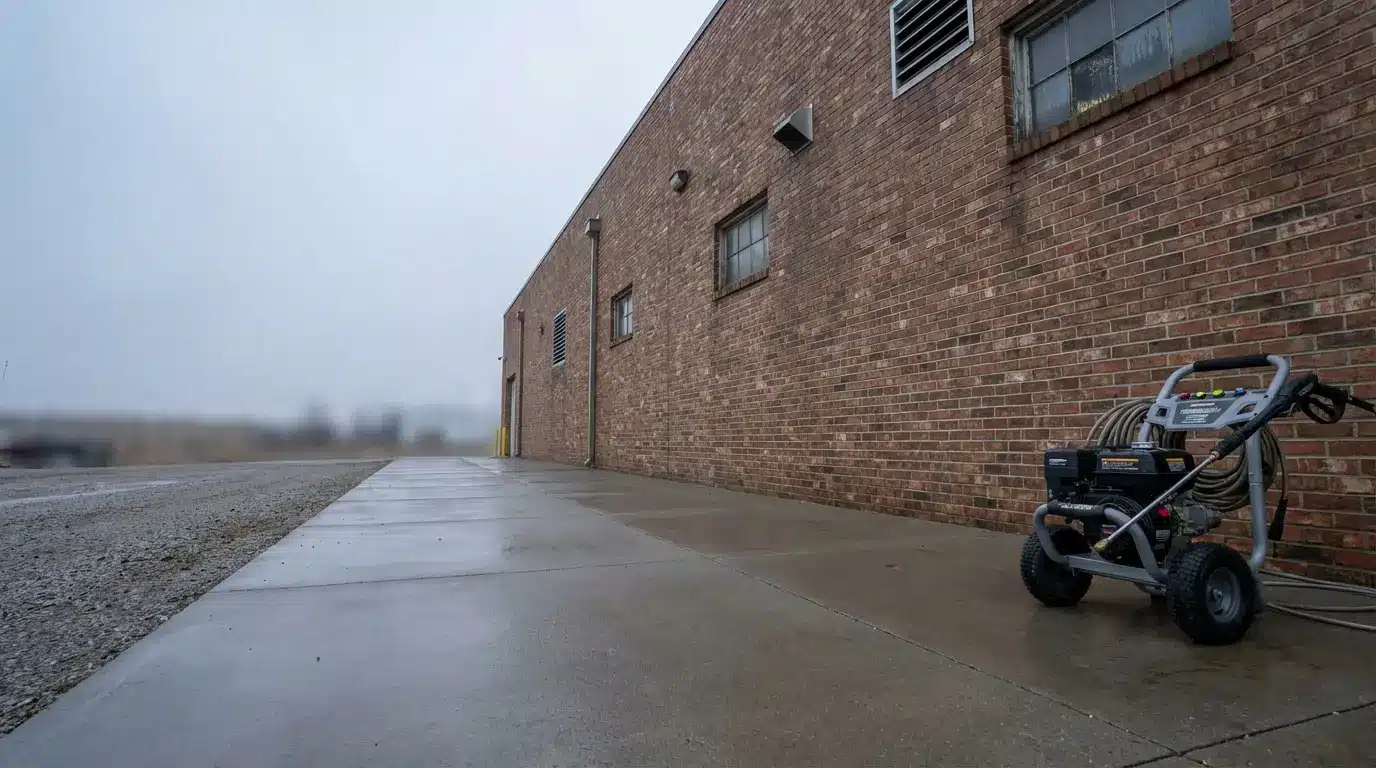
A pressure washing operator in a mid-sized metro signs a quarterly contract with a property management company overseeing six retail locations. The scope covers parking areas, building facades, dumpster enclosures, and entrance walkways across all six sites. The annual contract value sits at roughly $28,000 to $34,000 depending on scope, with the majority of the work concentrated in two scheduled service windows per quarter.
That one relationship generates more predictable revenue than forty to fifty residential jobs and requires a fraction of the sales effort after the initial contract is signed. The property manager renews because switching vendors carries operational risk for them. You retain the account because you show up consistently and document the work.
Multiply that by four or five commercial accounts and the business is not just busy. It has a revenue floor, a utilization plan, and something that can be valued if the operator ever wants to exit.
Where Operators Get This Wrong
The most common mistake is approaching commercial prospects the way you approach residential leads. A property manager or facilities director is not moved by before-and-after photos on Instagram. They are moved by liability reduction, compliance documentation, and evidence that you can manage a schedule without hand-holding.
Operators who pitch on price in the commercial space are also misreading the buyer. A facilities manager who is responsible for six properties and a maintenance budget does not want the cheapest vendor. They want the vendor least likely to create a problem for them. Reliability and documentation carry more weight than rate in commercial conversations.
The other gap is contract structure. Operators who do commercial work without a formal agreement are doing residential work with a bigger truck. The contract is not paperwork. It is what converts a job into an account.
Why the Exterior Cleaning Business Model Rewards This Shift
The exterior cleaning business category is broader than most operators treat it. It encompasses not just pressure washing but surface restoration, fleet washing, graffiti remediation, concrete sealing, and building envelope cleaning. Commercial contracts are the vehicle through which operators access the full scope of that category.
An operator holding a facility maintenance agreement has natural upsell pathways that a residential operator does not. The same property that needs quarterly pressure washing also needs annual concrete sealing, periodic graffiti response, and post-construction cleanup when a neighboring unit turns over. Every one of those needs flows to the vendor already trusted on site.
That is not upselling. That is scope expansion within an existing account relationship. The exterior cleaning business that structures itself around commercial contracts is not just selling cleaning. It is selling facility reliability, and that is a fundamentally different value proposition with a fundamentally different margin structure.
Where the Market Is Moving
Commercial property maintenance outsourcing is increasing. Facility management companies are consolidating vendor relationships to reduce administrative overhead, which means they are actively looking for operators who can handle multiple service lines across multiple properties under a single agreement.
That trend rewards operators who have built the systems, insurance coverage, and documentation capability to handle commercial scope. It penalizes operators who are still running the business like a series of one-off jobs with no infrastructure behind them.
The window to position ahead of this is not permanent. As more operators recognize the commercial opportunity, entry-level commercial contracts will become more competitive on price. The operators who move now, build the account base, and establish the referral network within property management circles will hold a structural advantage that latecomers cannot easily buy their way into.
Residential jobs will always have a place in the mix, particularly for cash flow in early-stage operations. But they are not a destination. The operators building real business value in this space have made a deliberate decision to treat commercial contracts as the primary revenue architecture, with residential work filling gaps rather than driving the model. That decision, made early enough, is what separates a business from a busy schedule.