
When a Fender Bender Throws Off Your Whole Week

The Tuesday Morning You Didn’t Plan For
You’re halfway through your coffee, mentally rehearsing the permission-slip conversation you forgot to have last night, when the Camry in front of you stops short at the Peachtree intersection and the SUV behind you doesn’t. The impact isn’t dramatic—more of a crunch than a crash—but your latte is now all over the passenger seat and your brain has gone into that weird slow-motion inventory mode. Permission slip. Carpool at 3:15. The chicken in the trunk for tonight’s dinner. Did I just bite my tongue?
The other driver gets out, apologetic, already talking about her insurance. You hear yourself saying “I’m fine” before you’ve even turned your head all the way to the right. You are fine, mostly. Your hands are shaking but that’s just adrenaline. Your neck feels—what? Tight? Off? You can’t tell yet. There’s a grocery bag that slid under the brake pedal and you need to text the carpool group to say you’ll be ten minutes late and honestly, processing what just happened to your body is somewhere around item nine on the list.
This is how it starts. Not with a hospital drama or a totaled car, but with the regular Tuesday morning you had planned colliding with the Tuesday morning you now have to deal with. You exchange information in the Publix parking lot while a line of annoyed commuters honks around you. You take a few photos with your phone. You do not call the police because it seems excessive for a dented bumper. You get back in your car, hands still trembling a little, and you drive your kid to school because what else are you going to do?
“I’m fine” becomes the mantra because the alternative—admitting that something might actually be wrong—means adding one more complicated thing to a week that was already full. So you don’t.
The First 48 Hours: Holding Your Routine Together While Your Body Keeps Score
Wednesday morning you wake up and your lower back has an opinion about yesterday. It’s not screaming pain, just a deep, specific ache that wasn’t there when you went to bed. You roll out from under the covers a little slower than usual. Your shoulders feel like someone replaced them with older, creakier shoulders overnight. There’s a headache sitting right at the base of your skull that coffee doesn’t touch.
You have 48 hours of this—powering through because the world didn’t stop when your car got hit and neither can you. There’s still dinner to make. Homework still needs supervision. The dog still needs to go out. You move a little stiffer, turn your whole torso instead of just your neck when someone calls your name from another room, and you tell yourself it’ll pass.
It might not.
Soft-tissue injuries are quiet liars. They wait. At the scene, adrenaline and shock do an excellent job of keeping you functional. Your body saves the invoice for later. Whiplash doesn’t always announce itself with a dramatic onset. Sometimes it’s just Wednesday’s stiff neck that becomes Thursday’s migraine that becomes Friday’s can’t-look-over-your-shoulder-to-back-out-of-the-driveway problem. The pain builds, and so does the distance between the crash and the moment you finally admit you need help.
Here’s the other thing building quietly in the background: insurance claim deadlines. Georgia gives you two years to file a personal injury claim, but your own insurance company wants to hear from you much sooner—sometimes within days. While you’re doing the mental math on whether you can skip yoga this week and still keep your sanity, the paperwork clock is ticking. Medical records need to connect your current pain to Tuesday’s rear-end collision, and that connection gets harder to prove the longer you wait.
This is exactly the moment when having someone else handle the insurance choreography stops being a luxury and starts being a necessity. You don’t need another tutorial on claims adjuster terminology or a second job learning liability thresholds. What you need is to keep your actual life moving while someone makes sure the legal and medical pieces don’t fall through the cracks. An Atlanta car accident lawyer can take over the paperwork circus—dealing with insurance companies, making sure your medical visits are documented correctly, and tracking the details you’re too overwhelmed to track—while you focus on getting your kid to soccer practice and yourself to a place where turning your head doesn’t hurt.
The mistake isn’t that you’re trying to hold your routine together. The mistake is thinking you have to do all of it alone, or that taking the crash seriously somehow means abandoning everything else. It doesn’t. But ignoring your body because you’re busy is a plan that fails in slow motion.
What “Getting Checked Out” Actually Looks Like (and Why Your PCP Isn’t Enough)
Your family doctor is great at strep throat and referrals and that annual physical you keep rescheduling. They are not set up to handle the biomechanics of what happens when two vehicles occupy the same space at the same time and your spine absorbs the energy. The tools and training required to diagnose a collision-related injury are just different.
A standard checkup involves a stethoscope, maybe some bloodwork, a few questions about your sleep and stress levels. A post-accident workup involves X-rays, range-of-motion testing, and a provider who knows how to document that your cervical spine now has less mobility than it did last Monday. That documentation matters—not just for your treatment plan, but for any insurance claim down the line. If your pain three months from now needs to connect back to Tuesday’s fender bender, the medical record has to show the thread.
This is why people end up at specialized injury clinics instead of their PCP’s office. You need someone who sees crash patients regularly, who knows what whiplash looks like in week one versus week six, and who can get you in quickly. Most metro Atlanta options offer same-day or next-day appointments because they understand that waiting two weeks to see your regular doctor means two weeks of untreated inflammation and two weeks further from the event that caused it. For example, an Atlanta accident injury clinic provides same-day access to chiropractors and physical therapists trained specifically in auto-injury treatment—and they know how to write notes that connect your symptoms to the collision, which becomes key if your claim ever needs that proof.
And yes, you can do this without derailing the kids’ schedule. Many of these clinics run early-morning or evening appointments precisely because their patient base is people like you—people who can’t just take a sick day and disappear into medical appointments all week. You can get evaluated at 7 a.m. and still make the school drop-off. You can book a 6 p.m. slot after your partner gets home. The logistics are solvable. The part that’s harder is giving yourself permission to prioritize this when seventeen other things are also screaming for your attention.
The Small Comforts That Keep You Steady While Everything Else Is Up in the Air
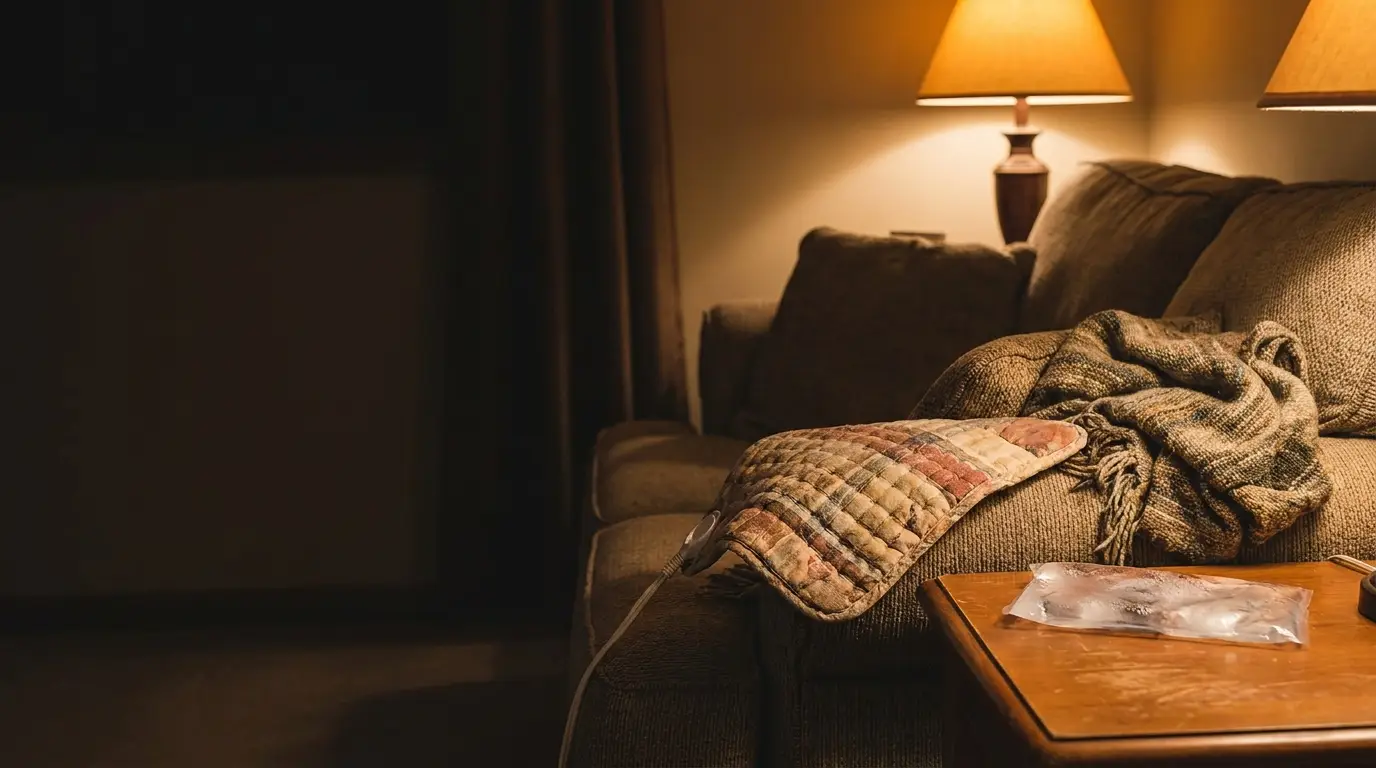
Let’s talk about the heating pad you’ve been stealing from the linen closet. The one that lives on your lower back during Netflix time now, the one that makes it possible to get through a full episode without shifting position every four minutes. That heating pad is doing more work than it should have to because you haven’t fully admitted this is a thing yet.
Ice packs help too—twenty minutes on, twenty minutes off, the bag of frozen peas you’ve repurposed because who actually eats frozen peas. The Epsom salt bath you take after everyone’s asleep, door locked, phone on silent. These aren’t indulgences. They’re the minimum scaffolding holding you upright while your body tries to repair itself and your brain tries to manage everything the crash disrupted.
Give yourself permission to slow down for 48 to 72 hours. Not forever. Not a full shutdown. Just enough to let your nervous system catch up. Ask your partner or a trusted neighbor to cover one morning’s drop-off. Let someone else handle the Tuesday dinner you had planned. The world will not collapse if you serve bagels and cream cheese for dinner one night, or if you detour through the Chick-fil-A drive-through instead of cooking. No one is grading you.
Here’s the thing about meal-train pragmatism: it works. Rotisserie chicken from Costco. The freezer lasagna your mom sent home with you last month. Cereal for dinner. A loaf of good bread and some hummus. You’re not failing at anything by lowering the bar for a few days. You’re making space for your body to heal and your brain to process the fact that Tuesday didn’t go as planned.
And while you’re leaning into small comforts, keep a small paper trail. It feels like homework, and it is, but it saves you from chaos later. Take photos of the car damage before you get it fixed. Screenshot the text exchange with the other driver. Start a simple note in your phone: how you feel each day, what hurts, what you couldn’t do that you normally can. If your back spasms and you have to cancel a work meeting, write it down. If you pay out of pocket for ibuprofen or a neck brace or an extra babysitter because you can’t lift your toddler, keep the receipt.
You’re not building a legal case in your head. You’re just refusing to let the details vanish into the fog of a busy week. Because if this does turn into something that needs more than ice packs and deep breaths, you’ll be glad you kept track.
What to Actually Do This Week
Here’s a short, practical roadmap. Not everything at once. Just the steps that matter most, in the order that makes sense.
Day 1—right after the collision:
- Take photos of all vehicle damage, the intersection, the license plates, the other driver’s insurance card.
- Swap contact and insurance information. Get names, phone numbers, policy numbers.
- File a police report even if the damage looks minor. Some insurance companies require it; Georgia law requires it if there’s injury or significant property damage. A report also creates an official record that the crash happened, which becomes useful if your pain worsens later.
Days 1 to 3—the adrenaline-fog window:
- Get a full-body check at a qualified injury clinic, even if you feel “okay-ish.” Whiplash and soft-tissue injuries are sneaky. What feels like mild stiffness today can become chronic pain by next month if it’s not treated early.
- Call your own car insurance to report the collision. You’re not admitting fault; you’re starting the claim.
Week 1—before the details blur:
- Call someone who handles the insurance back-and-forth for you. You don’t need to become fluent in claims adjuster-speak while packing lunches and answering work emails. Let a professional deal with liability arguments and medical billing codes.
- Keep one running list of collision-related expenses: co-pays, prescription pain meds, the rideshare you took because driving hurt too much, the neighbor you paid to cover carpool. Everything adds up, and you’ll forget half of it if you don’t write it down now.
- Don’t give a recorded statement to the other driver’s insurance company without talking to someone first. They’ll call and sound very friendly and ask how you’re feeling, and anything you say can box you in later.
Ongoing—for as long as symptoms last:
- Attend every medical appointment. If your chiropractor or physical therapist says come back in three days, go back in three days. Gaps in treatment give insurance companies room to argue you weren’t really hurt.
- Document missed work. If you use a sick day or leave early because your back is in spasm, note it. Lost wages are part of the picture.
- Don’t sign anything or accept any settlement check until you’re genuinely better and someone has reviewed the offer. Early settlements are often low, and once you sign, you’re done. If your injury turns out to be worse than you thought, you can’t go back and ask for more.
Life Doesn’t Pause for Paperwork—But Neither Should Your Recovery
There’s a version of this story where you ignore the stiff neck, skip the clinic visit because you’re too busy, and assume ibuprofen and time will fix it. That version ends six weeks later with a pain that’s worse, not better. Your friend who rear-ended someone on I-285 last year and never got checked out? The one who still gets tension headaches and can’t do her usual Saturday morning run? That’s what happens when you treat a car crash like a bad night’s sleep.
Here’s the permission you might need to hear, because no one else is going to say it clearly enough: protecting your health and protecting your family’s routine are not competing priorities. They’re the same project. You can’t show up for the people who need you if your body is quietly falling apart. You can’t make dinner or help with algebra homework or drive anyone anywhere if turning your head sends a spike of pain down your shoulder.
Taking the accident seriously in week one means you don’t have to take it catastrophically in week twelve. It means getting the medical care that actually helps, not just the over-the-counter band-aids. It means letting someone else handle the insurance fight so you’re not learning liability law at 11 p.m. when you should be asleep. It means giving yourself the same care and attention you’d insist on for anyone else you love.
The paperwork will get done. The claim will move forward. The car will get fixed. But your body only gets one chance at early intervention, and the gap between “I’m a little sore” and “I can’t turn my head without wincing” is shorter than you think. You didn’t plan for Tuesday’s crash, but you can plan for what happens next. That planning starts with admitting that this matters, that you matter, and that getting back on track means more than just crossing items off a list. It means actually healing.