That Big Ugly Rectangle Is Dragging Down Your Entire House

I fix garage doors for a living. Have for 14 years, mostly around the Chicago suburbs. And I’m going to tell you something your neighbor is too polite to say: your garage door is probably the ugliest thing on the front of your house. I write about this kind of stuff over at https://firstlinegarage.com/ because I see it constantly — homeowners who pour money into every part of their exterior and then just… skip the garage door. Like it doesn’t exist.
But it does exist. It takes up a third of your home’s face. Sometimes closer to 40% on ranch-style homes with those wide two-car front-loaders. More square footage than your front door, your windows, and your porch put together. And it’s just sitting there. Faded. Dented. Builder-grade white from 2004.
Let that sink in.
The One Stat That Shuts Down Every Argument
Garage door replacement returns around 194% ROI at resale. That number comes from the Cost vs. Value Report, not from me. It’s the single highest return of any home improvement project they track. Kitchens don’t come close. Bathrooms don’t come close. That fancy deck everybody wants? Not even in the same conversation.
Four thousand dollars on a new garage door. Seventy-five hundred back in home value. Show me another project with those numbers. I’ll wait.
A realtor I know in Arlington Heights — she’s been selling houses out there for twenty-something years — told me she can basically predict a home’s appraisal within five grand just by looking at the garage door. I thought she was exaggerating. She wasn’t.
You Don’t See It Anymore. Everyone Else Does.
This is the part that gets people. You walk past your garage door twice a day. Morning, evening. Every single day. And your brain just… erased it. Same way you stopped noticing that scuff on the hallway wall or that one cabinet handle in the kitchen that’s been loose since Obama was president.
Other people see it, though.
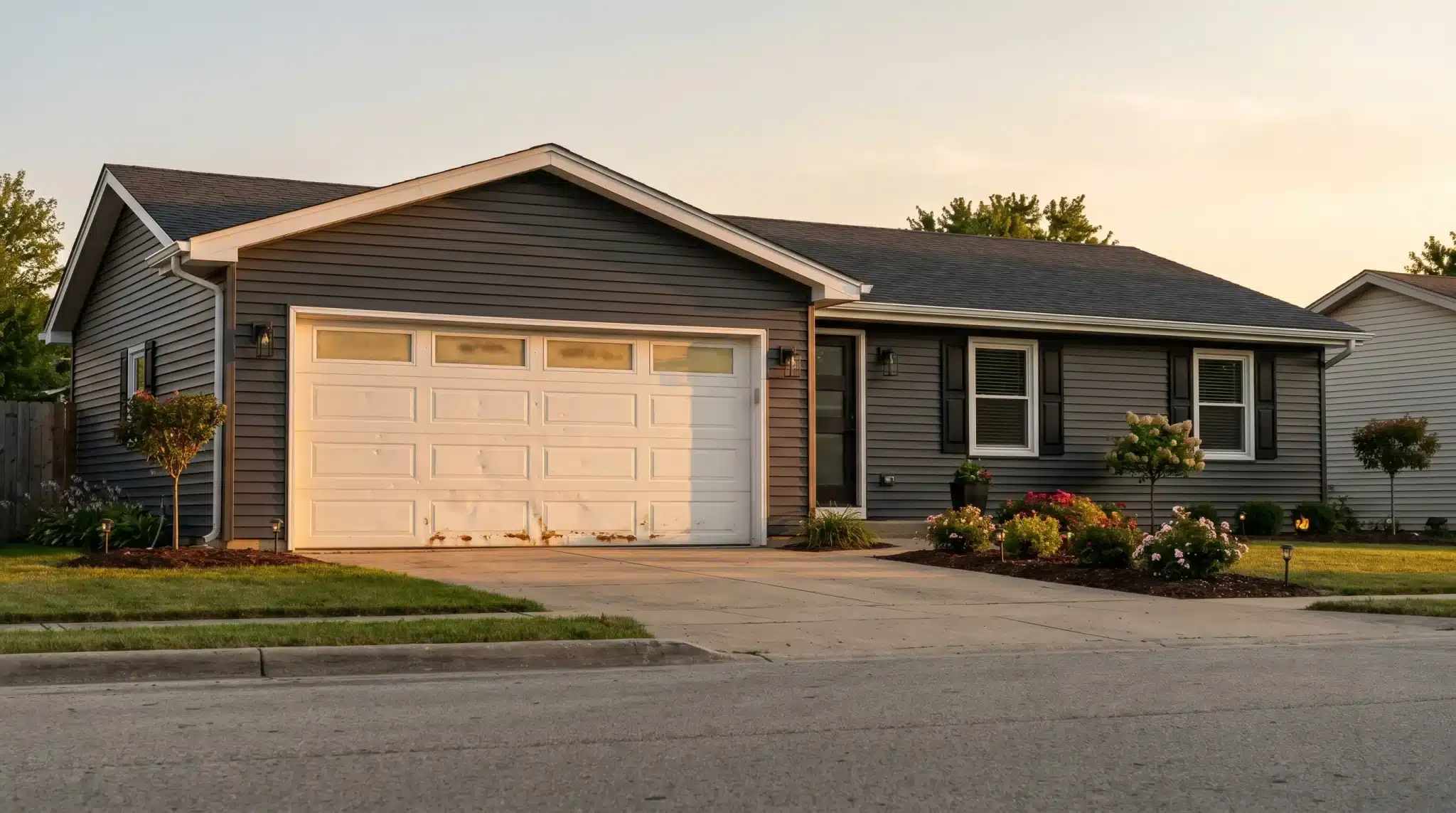
They see the bottom edge where the paint’s been bubbling for three years because moisture keeps creeping in from the driveway. That dent on the second panel — the one from 2017, right? Somebody tapped it backing out. Small dent. But at 4 PM when the sun hits it at an angle, it’s the only thing visible from the street. And those little rectangular windows across the top row? They went from clear to this sad yellowish haze that makes everything look neglected.
I had a job in Palatine last spring that perfectly sums this up. Homeowner had done a full exterior renovation — James Hardie siding in iron gray, black shutters, new landscape lighting, the works. Must have been $45K easy. The garage door? Original. White raised-panel steel, slight dent on the left, faded hardware. Her neighbor finally mentioned it. She was mortified.
Eighteen months of renovations. Walked past that door every single day. Never once thought about it.
(We put in a Clopay Canyon Ridge in dark walnut. She literally said, “Why didn’t I do this first?” I hear that a lot.)
Doors Are Actually Interesting Now. Seriously.
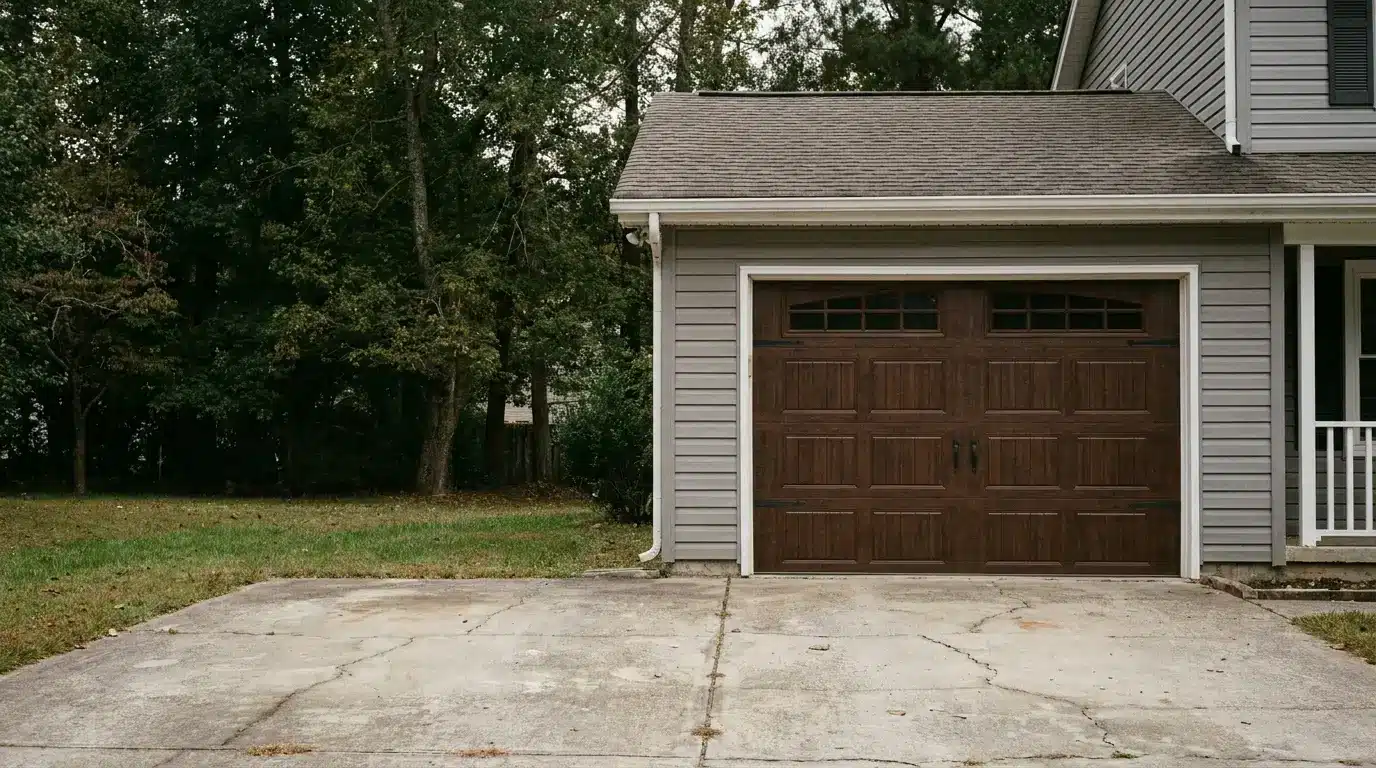
Ten years ago the garage door market was painfully boring. White raised-panel. Almond raised-panel. Maybe sandstone if you were feeling adventurous. Pick your shade of beige and move on.
That’s completely different now.
Clopay’s Canyon Ridge collection — I install these regularly — looks like real stained wood. Not “kind of” like wood. Like, people touch it and go “wait, this isn’t wood?” It’s steel and composite underneath. Won’t rot. Won’t warp. Won’t need refinishing every other year the way actual cedar does. And in Chicago, real wood garage doors are a gamble. I’ve watched beautiful cedar carriage doors start cracking and splitting after three freeze-thaw winters. Three. That’s a $5,000 door lasting maybe four years before it looks rough. Composite gives you the same look and laughs at the weather.
The other big trend is full-view aluminum and glass. Dark bronze frames, frosted panels. Very modern. Amarr’s Vista series does it well. Looks unbelievable on the right house — mid-century ranch, modern farmhouse, contemporary new build. On a colonial or a traditional two-story? Absolutely not. I’ve talked three or four homeowners out of it. One guy was ready to order and I said, “Look, it’s going to look like you attached a car dealership showroom to your house.” He thanked me later.
What most people actually want — and what I recommend probably 60% of the time — is an insulated steel carriage-house door. Three-layer construction: steel skin, polyurethane foam core, steel back. R-values from R-12 to R-18. In Chicago, where January nights can drop to negative ten, that insulation does real work. Keeps the garage 20-plus degrees warmer than outside. If your garage shares a wall with your kitchen, you feel the difference on your heating bill. Thirty, forty bucks a month in the dead of winter, easy.
And here’s something nobody thinks about until they experience it: insulated doors are quiet. Like, dramatically quieter. That rattling, shaking thunder at 6 AM when you leave for work and the kids are still sleeping? Gone. The foam core absorbs the vibration. My wife noticed the difference in our own garage before I even mentioned it.
Pick the Right Color or Don’t Bother
Everyone goes white because their trim is white. Safe. Boring. And white shows absolutely everything — mud splash from the driveway, grass clippings from the mower, handprints, water spots. Eighteen months in, it looks dingy. You’ll be out there with a bucket and a brush twice a year trying to keep it clean.
Here’s what I tell people after watching hundreds of color combinations go up on real houses. Treat the garage door like an accent piece. Not a matching piece. Your siding is light gray? Go charcoal on the door. Dark creates depth. It looks intentional, like somebody actually designed the facade instead of just defaulting to “match everything.”
Brick house? Something with a warm wood-grain texture. The contrast between warm tones and cool masonry is genuinely beautiful. Way better than white-on-red-brick, which is what every tract home in America does.
Black doors are everywhere right now. I understand the appeal — they look sharp. But I need to be honest. Black steel facing west absorbs brutal heat in summer. I’ve measured surface temperatures above 150 degrees on black doors in direct afternoon sun. That cooks the weatherstripping. Accelerates fading on cheaper finishes. If your garage faces west or southwest, go very dark charcoal instead. Street-level, nobody can tell the difference. Surface temp drops 15–20 degrees. Your weatherstripping lasts two extra years.
Hardware — don’t skip it. Decorative strap hinges and ring pulls bolted onto a flat door add dimension that completely changes the look. Most homeowners don’t realize those are add-on pieces. They think doors come that way. Black hardware is my default recommendation on everything except white doors, where oil-rubbed bronze gives you more warmth and richness.
Nobody Maintains Their Garage Door. That’s the Problem.
Beautiful door goes up. Homeowner loves it. Then it sits there untouched for five years until something breaks.
Twice a year. That’s all it takes. Wash it with dish soap and a soft brush in spring and fall. Check the bottom weatherstripping for cracks. Hit the hinges and rollers with silicone spray — NOT WD-40. I cannot stress this enough. WD-40 on garage door springs is one of those things everybody does and everybody shouldn’t. It collects dust, turns into this sticky black paste, and actually shortens the spring life. I’ve pulled springs off doors that had a quarter-inch of gunk caked on from years of WD-40. Nasty.
And when something breaks — a panel cracks, a spring snaps, a cable frays — deal with it immediately. One damaged panel on an otherwise gorgeous door is the only thing anyone will ever notice. It’s a chipped front tooth. Doesn’t matter what else is going on. That’s where the eye goes.
Go Outside Right Now
I mean it. Walk across the street. Turn around. Look at your house the way a buyer would. The way your mother-in-law does. The way that couple walking their dog sees it every evening.
If the garage door is the weak link — and on a lot of houses it honestly is — that’s actually good news. Because this isn’t a three-month kitchen remodel or a roof that takes a week. One morning, old door. One afternoon, totally different house. Different price bracket, honestly.
Seen it happen hundreds of times. Still gets me.