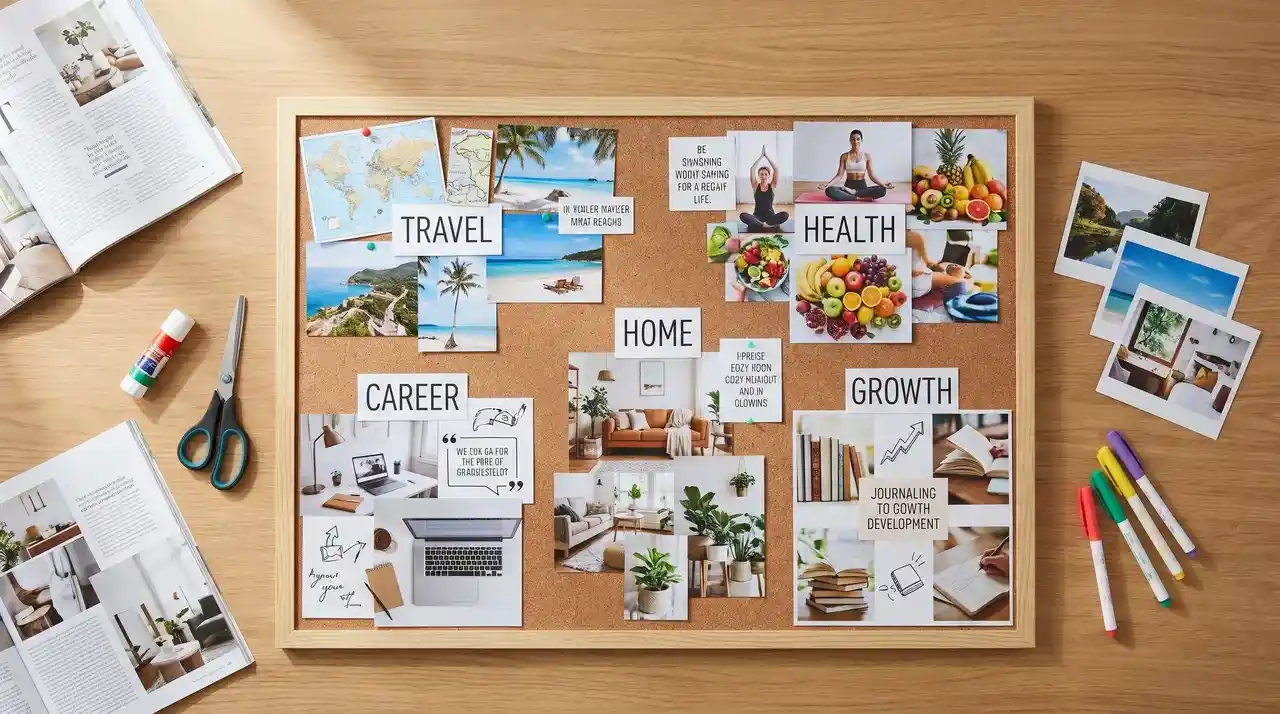
How to Make a Vision Board That Actually Works

You spend an afternoon cutting images and gluing them to a board. You hang it up and feel genuinely good about it.
A week later, you walk past it without looking. Two weeks later, it blends into the wall.
The problem is not the tool. It is the process. A vision board works when you build it with focused goals and place it somewhere you see it every day.
This post covers it all from start to finish. You will find what a vision board is and what to include. You will also find how to build one step by step and how to use it every day.
What Is a Vision Board?
A vision board is a visual goal-setting tool made up of images, words, and affirmations. Together, they represent the goals and the life you want to build.
Also called a dream board or goal board, it can be physical or digital. A physical board uses poster board and magazine clippings. A digital board is built in Canva or saved as a phone wallpaper.
Why Vision Boards Work:
When you see images connected to your goals every day, your brain begins to notice related opportunities. This happens through the reticular activating system (RAS). The RAS filters what you pay attention to based on what you repeatedly focus on.
Research published in the Journal of Research in Personality found that clear personal visions create positive emotions around goals. People who define what they want stay more motivated to act on it consistently.
The practical takeaway is this: what you consistently see, you start moving toward.
Physical vs. Digital Vision Board:
Both formats are effective. The right one depends on your lifestyle and where you spend your time.
| Feature | Physical Board | Digital Board |
|---|---|---|
| Best for | Hands-on creators | Remote workers, phone users |
| Tools needed | Poster board, magazines, glue | Canva, Pinterest |
| Cost | $0–$20 | Free |
| Where you see it | Wall, desk, mirror | Phone wallpaper, desktop |
| Emotional connection | Stronger (hands-on process) | Easier to update |
The best choice is the one you will actually see every day. A beautiful board in a room you rarely enter does not work.
Materials You Need to Make a Vision Board
Gather everything before sitting down to build. Stopping mid-process to find supplies breaks your focus.
For a physical vision board:
- Poster board, corkboard, or foam board
- Old magazines or images printed at home
- Scissors and a glue stick
- Markers or paint pens for handwriting
- Washi tape or stickers (optional)
- Pins or tape if using a corkboard
A corkboard base lets you rearrange and swap images as goals change over time. Boho bulletin boards work especially well as a base. They mix natural textures with personal elements, making the board feel like a deliberate part of your room rather than an afterthought.
For a digital vision board:
- Canva (the free version works completely)
- Pinterest for collecting inspiration images
- Google Slides or PowerPoint as simpler alternatives
How to Clarify Your Goals Before You Start?
This is the step that separates a focused board from a random collage. Without clarity of goals, you grab images that look appealing but have no real meaning to you.
Ask yourself three questions:
- What do I want more of in my life right now?
- What does a genuinely good day look like for me?
- What have I been putting off that I know matters?
Narrow your focus to 3–5 life areas:
- Career or business
- Health and fitness
- Relationships
- Financial goals
- Personal growth
Limiting yourself to five areas keeps the board meaningful. More than five categories spread attention too thin and make the board harder to connect with on a daily basis.
Write goals in the present tense. Instead of “I want to be healthy,” write “I am healthy and strong.” This shifts the language from wishful to intentional and ties directly into how affirmations build belief.
How to Make a Vision Board Step by Step
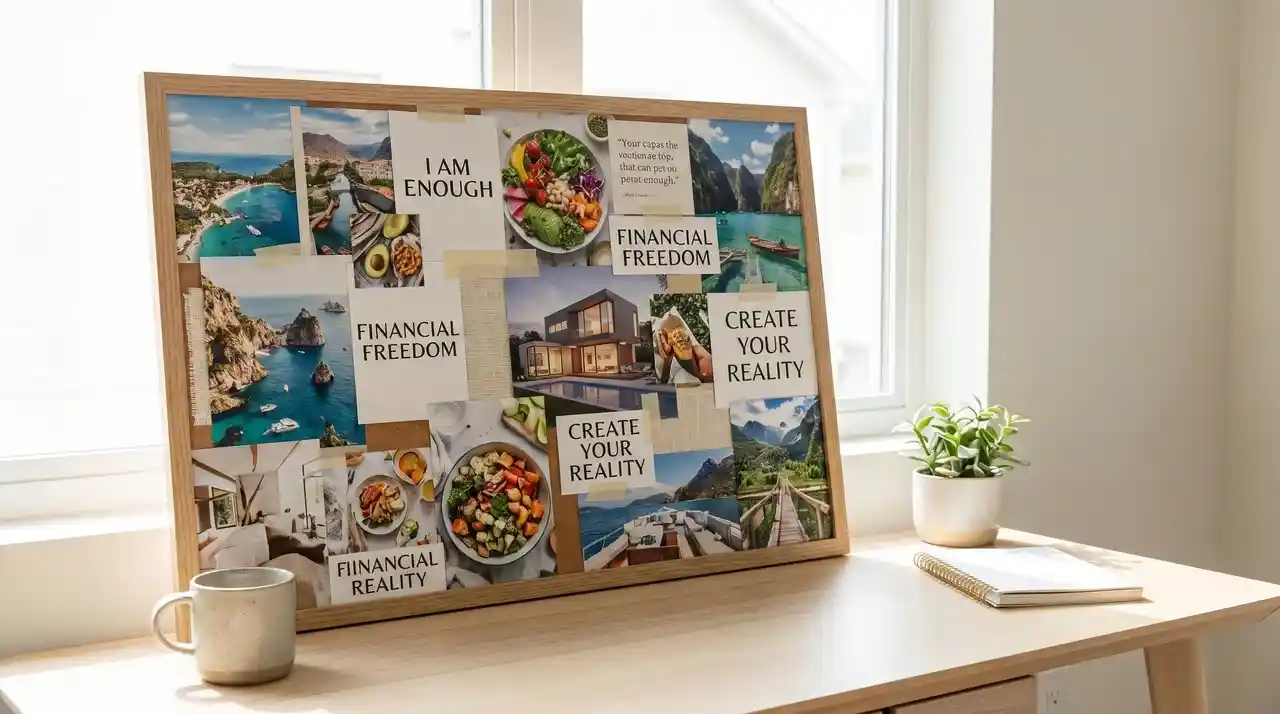
Here is the actual build process, clear, in order, with no steps left out.
Step 1: Clear Your Space
Set up a flat surface with all materials within reach before you start. Make the time feel deliberate, not rushed. Put on music that matches the mood you want to feel as you look at the finished board.
Step 2: Collect Images Freely
Go through magazines or browse online. Cut or save anything that pulls at you immediately. Do not stop to analyze each piece at this stage. Build a pile first and edit later.
Step 3: Filter Your Selections
Review everything you collected. Keep only the images that match real goals and feel personally meaningful. Remove anything that you picked because it “looked nice” but does not connect to a specific goal.
Step 4: Arrange Before You Stick
Place everything on the board without gluing. Try different layouts: group by life area, build outward from a central image, or arrange by feeling. Leave open space so the board stays readable and not visually crowded.
Step 5: Secure Everything in Place
Once the layout feels right, glue or pin items down. Work from the center outward for balance. If using a glue stick, press firmly and hold briefly before moving on.
Step 6: Add Words and Affirmations
Fill the remaining space with handwritten phrases or printed words. Use present tense: “I am building a life I love.” These connect your visuals with clear intention and give the board a point of view.
Step 7: Step Back and Assess
Look at the finished board from a distance. Does it feel like your life? Does it excite you? If something feels off, remove it. Your gut reaction to the finished board is data.
How to Make a Vision Board on Canva?
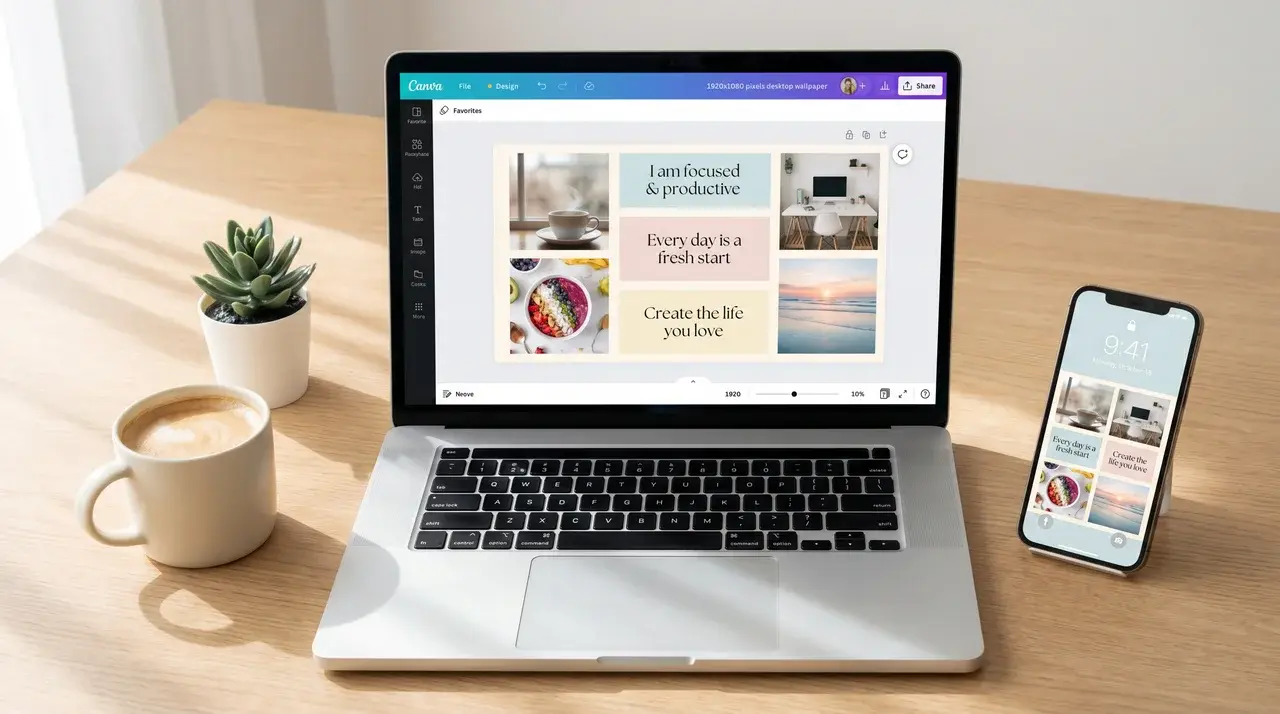
Digital boards are just as useful as physical ones and far easier to update when your goals shift.
- Go to Canva.com and create a free account
- Click “Create a design” and choose a custom size. Use 1920 x 1080 pixels for desktop wallpaper or 1080 x 1920 for phone wallpaper
- Search for images using goal-related terms: “morning routine,” “healthy food,” “home office,” “travel”
- Upload personal photos under the Uploads tab to make the board more specific to your life
- Add text boxes for affirmations and short goal statements. Keep fonts clean and readable
- Stick to 2–3 colors across the board for a consistent look
- Click Download and save as a PNG file
- Set it as your phone lock screen or desktop background for daily exposure
Pro tip: You can print a finished Canva board at a local print shop. Walgreens, Staples, and FedEx all offer large-format printing for a full-size physical version. No cutting or gluing required.
Where to Put Your Vision Board So You Actually Use It?
The images and words on your board should represent specific goals, not general inspiration you found appealing in the moment.
Images to include:
- Photos that show your goal in real life, not just as a symbol
- Personal photos from moments that felt aligned with the life you want
- Scenes from environments where you want to spend more time
Words and phrases to include:
- Affirmations in present tense: “I am,” “I have,” “I do”
- Short phrases that state your goal directly
- One or two words per life area that capture how you want to feel
What to leave out:
- Images you picked because they looked good, but do not connect to a specific goal
- Quotes that sound motivating but have no personal meaning to you
- Goals that belong to someone else’s version of a successful life
Keep the board personal. It should reflect your goals, not a curated collection from someone else’s inspiration feed.
Vision Board Ideas by Category
Focused boards are built around specific life areas. Here are ideas to get started in each one.
Career and Business:
- Your ideal workspace or work environment
- Words like “promoted,” “launched,” or “published”
- A specific income goal or business milestone written as a number
Health and Fitness:
- An activity or training style you want to commit to
- Foods and meals that reflect how you want to eat
- Words like “strong,” “consistent,” or “well-rested”
Relationships:
- Family values or moments that matter most to you
- Words describing how you want to show up for the people around you
- Places you want to go with people you care about
Finances:
- Your savings target is written as a specific number
- Images that show what financial stability looks like for you
- Words like “debt-free” or “building toward ownership”
Personal Growth:
- Books you want to read this year
- A skill you want to build in the next six months
- A quality you want to develop, stated as one clear word
Where to Place Your Vision Board
Placement decides whether the board functions as a daily tool or fades into the background. The goal is to put it somewhere your eyes already go without trying.
- Bedroom wall: First thing you see in the morning and last at night
- Desk area: Stays visible during work hours without being distracting
- Bathroom mirror: One of the most effective spots since it is part of your daily routine without any extra effort
- Phone lock screen (digital board): Every time you pick up your phone, your goals appear
- Laptop wallpaper: Visible during breaks and between tasks throughout the day
Bedroom wall placement works especially well when the room itself feels calm and personal. A well-arranged cozy bedroom naturally draws the eye to the walls, giving your board better daily visibility without competing against visual clutter.
Common Mistakes to Avoid When Making a Vision Board
Even a well-designed vision board can lose its impact if it is not created with intention. These are the most common mistakes people make that turn an inspiring tool into just wall decoration.
| Mistake | Why does it hurt your vision board |
|---|---|
| Using too many random images | Creates confusion instead of focus |
| Setting vague goals | Makes visualization ineffective |
| No emotional connection | Reduces motivation and daily impact |
| Overcrowding the board | Makes it visually overwhelming |
| Never updating it | Disconnects it from your current life goals |
How to Use Your Vision Board Daily
The build is the starting point. Daily contact with the board is what creates results over time.
Daily habit:
- Spend 30 seconds looking at the board each morning
- Connect at least one goal to something you plan to do that day
Weekly habit:
- Check progress in each goal area
- Notice whether anything feels outdated or no longer personally relevant
Every 3–6 months:
- Remove goals you have reached. Take a moment to recognize each one
- Replace them with the next step in that area of life
- Update visuals if your direction has shifted significantly
The board itself does not create results. Your brain, reminded daily of what matters, shapes the small decisions that add up over time. The action still comes from you.
Does a Vision Board Actually Work?
Yes, when it is paired with clear goals, daily visibility, and consistent action.
Without follow-through, a vision board is a reminder with no output. With it, the board becomes a focus system that reinforces direction every single day.
You choose the healthier meal over the faster option. You open the work file instead of scrolling. The board is not making those choices. Your brain, reminded daily of where you want to go, is.
Research published in the Journal of Research in Personality found that people who hold a clear personal vision feel more positive about their goals. They also stay more motivated to act on them over time.
Think of creating a vision board as building a visual reminder system for your goals, not a shortcut to having them.
Conclusion
Making a vision board is a real, practical step toward your goals, but only if the board stays visible and your goals stay specific.
A cluttered collage of pretty images does not move the needle. A focused, personal board placed where you will see it every single day does.
Start with clarity. Pick 3–5 life areas that genuinely matter to you right now. Use specific images and words, not generic inspiration. Build something that feels like your life, not someone else’s highlight reel.
Then put it somewhere unavoidable. Revisit it every few months. Update what has changed. Celebrate every goal you have hit. The best vision board is the one you actually look at.
Which area of your life are you starting with?
Frequently Asked Questions
How Long Does It Take to Make a Vision Board?
A physical board takes 1–3 hours from start to finish. A digital board on Canva can be done in 30–60 minutes, depending on how much time you spend selecting images.
Can I Make a Vision Board for Free?
Yes. Use magazines you already have, a cardboard sheet, tape, and a marker. Digital boards are free on Canva, Pinterest, or Google Slides.
How Often Should You Look at Your Vision Board?
Daily is ideal. Even 30 seconds of focused attention each morning is enough to keep your goals top of mind.