
Creative Landscape Lighting Designs for Omaha Backyards

Most Omaha homeowners think about outdoor lighting as a practical afterthought, something to add a little safety along a walkway or a floodlight over the garage. But your backyard deserves more than that.
The right lighting design turns an ordinary outdoor space into something you actually want to spend time in after dark. Here are five creative outdoor lighting designs for Omaha backyards that go well beyond the basics.
Layered Uplighting on Trees and Mature Plantings
Uplighting is one of the most dramatic techniques available for an Omaha backyard, and the region’s established hardwoods and ornamental trees make it especially effective. The idea is straightforward: you place low-voltage fixtures at ground level and aim them upward into the canopy, which creates pools of light, shadow, and texture that no overhead fixture can replicate. The result feels cinematic. It makes a 40-year-old oak look like something out of a magazine spread.
Where most designs go wrong is treating all trees equally. A mature silver maple needs a different approach than a columnar arnica or a Japanese zelkova. The fixture angle, beam spread, and color temperature all shift depending on the tree’s shape and the density of its canopy. For an authentic layered effect, pair uplighting on anchor trees with softer accent lights on lower shrubs beneath them, so the ground layer doesn’t fall into complete darkness. LED fixtures with a color temperature around 2700K to 3000K produce the warm, inviting glow that reads well against Nebraska’s deep summer greens.Homeowners comparing different lighting styles can also look at outdoor lighting companies like https://www.midwestlightscaping.com to see how layered lighting is incorporated into residential landscape designs.The layered approach rewards planning. Rushing the fixture placement, especially around tree roots, causes long-term headaches.
Pathway Lighting That Actually Guides Without Glaring
Pathway lighting sounds simple. Most installations get it badly wrong, though. Fixtures packed too close together produce a runway effect, while anything aimed near eye level creates glare that makes guests squint instead of feel at ease. What you’re actually trying to light is the path surface, not the hardware itself. A well-executed system should nearly disappear as individual units; what registers is the illuminated ground beneath your feet, not the fixtures creating it.
Omaha backyards tend to feature irregular stone or paver paths winding through garden beds, and that’s a genuine design opportunity. Skip the standard bolt-in bollard every four feet and try alternating sides of the path instead, spacing fixtures six to eight feet apart. That staggered layout kills the runway look and gives the whole installation a more natural, organic character. Fixtures that direct light downward with a frosted or amber lens keep illumination right where it belongs. For paths cutting through dense plantings, smaller low-profile units built into the edging are far less obtrusive than tall post-style alternatives. Nebraska’s climate demands fixtures rated at least IP65 to survive summer storms and the freeze-thaw cycles that hit Omaha every winter. Brass and marine-grade aluminum hold up far better than the powder-coated zinc alloys you’ll find in big-box lighting kits.
Silhouette and Shadow Effects on Fences and Walls
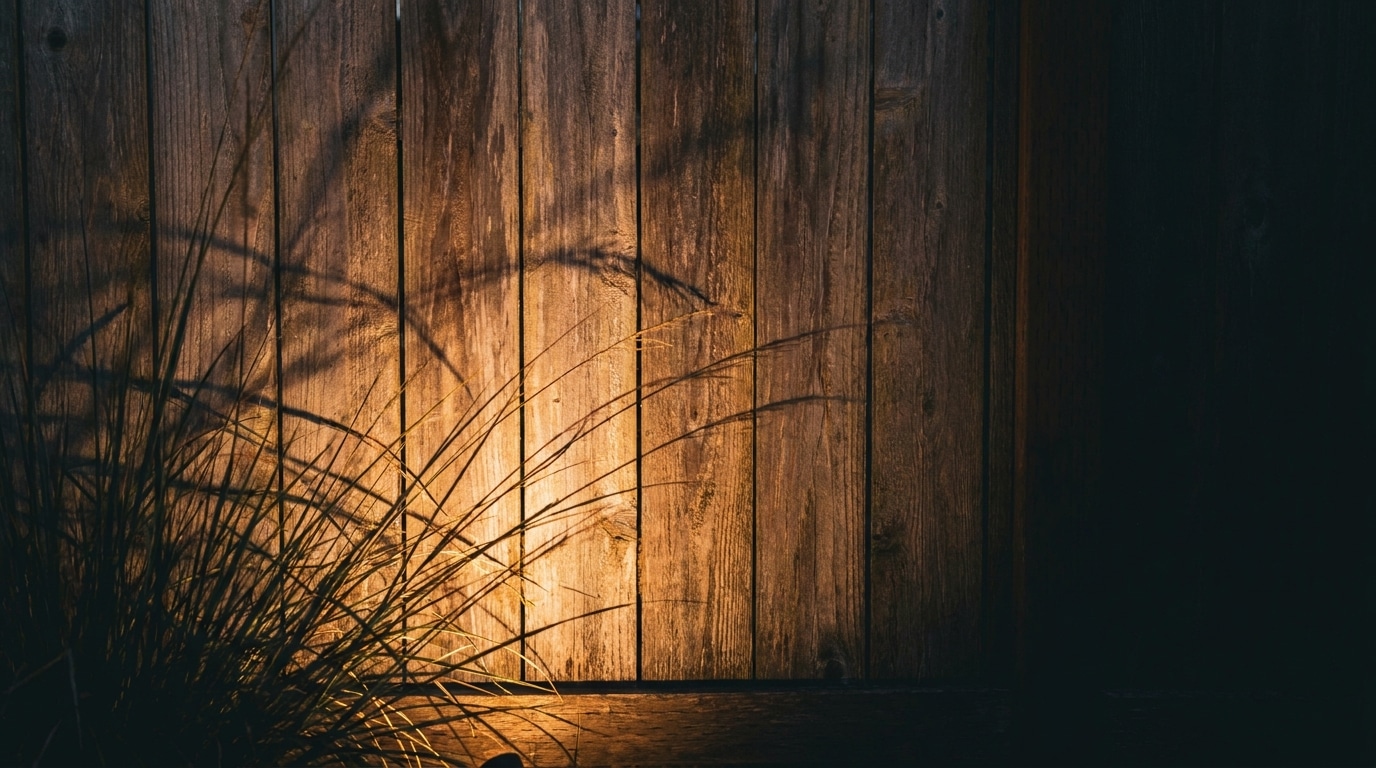
This technique is genuinely underused in residential design, yet it’s one of the most visually arresting options for backyards with privacy fencing, stone walls, or architectural screens. It works by positioning a light source between a plant or ornamental object and the flat vertical surface directly behind it. The object intercepts the light and throws a shadow onto the wall, a living, wind-responsive pattern that shifts all evening long. Ornamental grasses are especially effective here, because even a slight breeze sends the shadow dancing across the surface.
In Omaha, cedar privacy fences are nearly universal, and they make excellent shadow canvases. A wide-beam fixture placed 12 to 18 inches in front of a tall ornamental grass clump, with the fence six to eight feet behind, produces a shadow spread that can cover several feet of vertical surface. For walls with texture, brick or stacked stone, the technique works in reverse: a grazing light placed parallel to the wall’s surface catches every ridge and recess and turns ordinary masonry into something architectural. The important variable is distance. Move the light source too close to the wall, and you lose the shadow effect entirely. Move it too far, and the shadow becomes diffuse and weak. A test session with a portable work light before committing to permanent fixture placement saves a lot of frustration later.
Deck and Patio Accent Lighting for Outdoor Living Spaces
Omaha summers are short. They’re best spent outside, which makes a deck or patio that goes dark at sundown a real loss; you’re surrendering a big chunk of the season’s best evening hours. The fix isn’t a single bright overhead fixture. It’s a layered approach that builds ambiance rather than a spotlight effect, turning the space into a genuine room extension rather than a utilitarian platform.
Step lights built into deck risers deliver safety without overhead glare. Post-cap lights on railings define the structure’s perimeter. Low-profile under-bench lighting transforms ordinary seating walls into something that reads as intentional. String lights, despite being most homeowners’ default move, work better as a complement to these integrated sources than on their own; alone, they produce uneven brightness and cast unflattering downward shadows on faces. A smart lighting system that lets you dim and group zones from your phone adds real flexibility: bright for family gatherings, dialed down for quiet evenings. On patios with a pergola or overhead structure, recessed downlights or pendant-style fixtures create a ceiling plane that anchors the space psychologically, making the outdoor room feel defined rather than exposed and unresolved.
Water Feature and Focal Point Illumination
If your Omaha backyard has a water feature, a sculptural element, or even a standout garden bed centerpiece, you’ve got an untapped opportunity sitting right there. Lighting a focal point after dark does something daytime landscaping simply can’t: it directs the eye with intention. Natural light hits everything equally during the day. At night, you decide exactly what the viewer sees first.
Submersible LED fixtures inside a pond or fountain push light upward through the water, and the effect shifts depending on how the surface moves. Still water turns reflective like a mirror; a pump churning the surface scatters the light into unpredictable, dynamic patterns. Both are appealing in different ways, and the right choice comes down to whether you want drama or calm. For sculptures or decorative urns, narrow-beam spotlights set at a 30 to 45 degree angle from the side reveal form and dimension far better than a head-on beam, which tends to flatten the object. Color temperature matters more here than anywhere else in the yard; a warm 2700K source feels inviting against organic shapes like stone or wood, while a slightly cooler 3000K suits metal or glazed ceramic better. One practical note: any fixture used in or around water needs a waterproof transformer and proper GFCI protection, both for safety and because Omaha’s electrical inspection standards require it.
Conclusion
Creative outdoor lighting designs for Omaha backyards go well beyond a few path lights and a floodlight bolted to the garage. Layered uplighting, deliberate pathway placement, shadow and silhouette effects, integrated deck lighting, and focal point illumination each solve a distinct problem while adding real visual depth to an outdoor space. These techniques stand on their own, but they produce the most satisfying results when they work together as a coordinated system. Good lighting design starts with understanding what your yard already offers, then building a plan around those assets rather than dropping in a generic template. Take time to read your space before committing to fixture placement; do that, and the results will far outlast the initial investment.