How to Care for Quartz Countertops (Without Damaging Them)

Your quartz countertop is tough. It holds up against scratches, spills, and daily kitchen use. But “tough” does not mean damage-proof.
Using the wrong cleaning product, even once, can permanently dull the surface. Harsh chemicals break down the resin that binds quartz together. Hot pans leave lasting marks. Spills left sitting turn into stains.
Caring for quartz countertops is straightforward. A few consistent habits keep surfaces looking clean and bright for years.
This post covers daily cleaning, safe stain removal, what to avoid completely, and how to protect your surfaces long-term. You will also find a quartz vs. granite comparison, a full stain-removal chart, and answers to the most common questions about quartz care.
What Are Quartz Countertops?
Quartz countertops are engineered stone surfaces made from about 90–95% crushed natural quartz combined with resins and pigments. This process creates a strong, non-porous surface that resists stains, scratches, and bacteria.
Unlike granite or marble, quartz does not need sealing. It comes in a wide range of colors and finishes, making it a popular choice for kitchens and bathrooms.
- Non-porous surface, liquids do not soak in
- No sealing or polishing required
- Strong resistance to staining and bacterial growth
- Available in many colors and patterns
The resin component makes quartz sensitive to high heat and harsh chemicals. Knowing what to avoid matters as much as knowing what to use.
One important note: Quartz and quartzite are often confused, but they are very different materials. Quartzite is a natural stone that requires sealing and different care methods. If you have quartzite countertops, the cleaning process is different from the for quartz.
Why Caring for Quartz Countertops Matters
Quartz is low-maintenance, but “low-maintenance” is not the same as “no maintenance.” The resin binder that makes quartz strong is also the part most likely to be damaged by the wrong products or habits.
Good care habits pay off in real ways:
Key reasons to master quartz countertop care:
- Investment protection: Prevents costly repairs and replacement
- Extended lifespan: Maintains original appearance for decades
- Cost savings: Avoids expensive professional services
- Home value preservation: Enhances property resale appeal
- Peace of mind: Handle spills and maintenance with confidence
How to Clean Quartz Countertops Daily
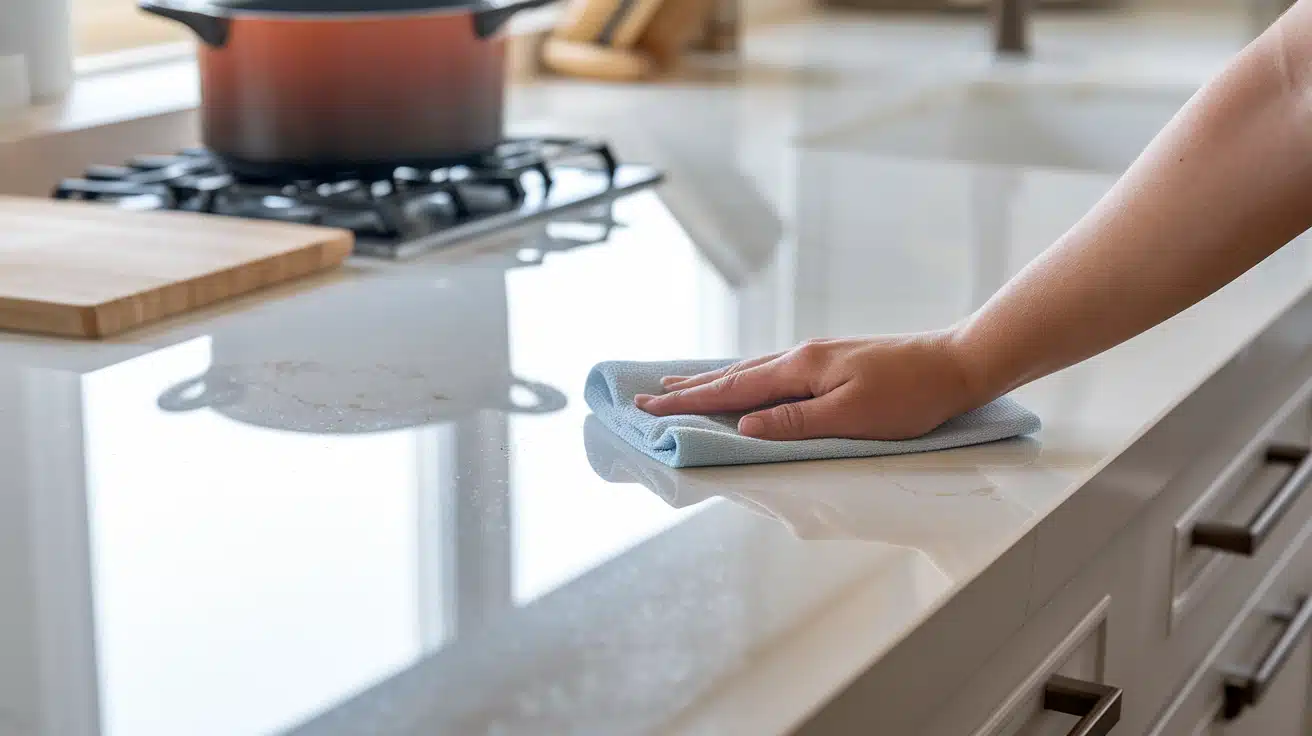
For everyday care of quartz countertops, you need just three things: warm water, mild dish soap, and a soft cloth.
- Remove crumbs and loose debris first.
- Mix a few drops of mild dish soap with warm water.
- Wipe the surface using gentle circular motions.
- Rinse with clean water to remove all soap residue.
- Dry right away with a microfiber cloth.
Why drying matters: Water left sitting on the surface causes dull water spots. Always dry after cleaning.
Wipe up spills right away. Pigmented liquids like coffee, wine, turmeric, tomato sauce, and fruit juices can leave marks if left to sit, even on quartz.
Weekly and Monthly Quartz Maintenance Routine
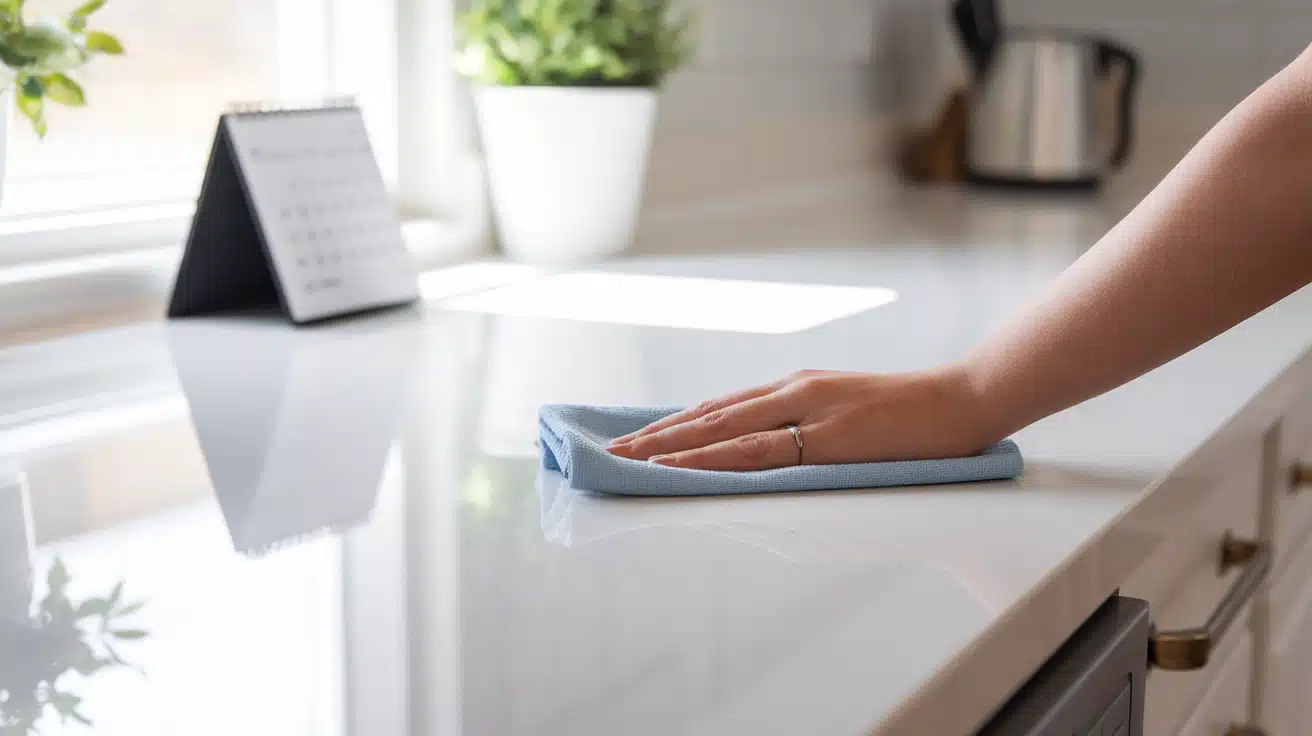
A simple three-tier routine is all you need to keep quartz in top condition. There is no need to follow a strict daily plan.
Daily (2–3 Minutes)
- Wipe up spills right away, especially pigmented liquids
- Do a quick wipe-down after cooking if grease or food landed on the surface
Weekly (10–15 Minutes)
- Full surface clean with mild soap solution
- Pay extra attention to the area around the sink and stove
- Remove any grease buildup from the week
- Clean edges carefully near the sink
Monthly
- Check for dull spots or residue buildup
- Use a quartz-safe deep cleaner if needed
- Inspect edges near the sink and dishwasher for any chips
What Never to Use on Quartz
These products cause lasting damage to quartz surfaces. Do not use them, even in small amounts.
Cleaning Products to Avoid
- Vinegar or lemon-based cleaners, acidic, break down the resin binder
- Bleach: repeated use degrades the surface over time
- Ammonia-based sprays
- Oven cleaners contain lye, which etches and permanently discolors quartz. Oven cleaner causes serious surface damage on all countertop types, not just quartz.
- Products containing waxes or silicones leave a film that dulls the finish
Tools to Avoid
- Steel wool or metal scour pads
- Abrasive scrub pads
- Metal blades or knives for scraping
If you need to scrape dried food or gum, use a plastic scraper at a low angle. Never use metal.
How to Remove Stains from Quartz Safely
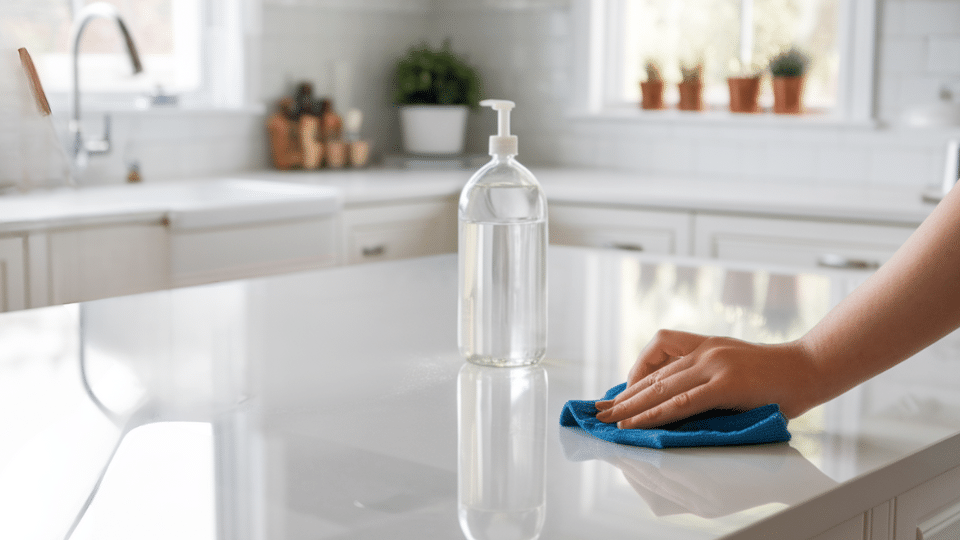
Quartz resists staining well, but spills can still leave marks if not treated quickly. Here is a stain-by-stain removal chart based on the type of mess.
| Stain Type | Safe Removal Method |
|---|---|
| Grease or oil | Mild dish soap + warm water |
| Coffee or tea | pH-neutral quartz cleaner |
| Wine or fruit juice | Wipe immediately, then use a mild soap solution |
| Turmeric or food coloring | Act fast; mild quartz cleaner and a gentle cloth, the longer it sits, the harder it sets |
| Ink or marker | Isopropyl alcohol, dabbed gently, do not rub |
| Hard water marks | Quartz-safe descaler or non-abrasive stone cleaner; do not use vinegar |
| Dried food or gum | Plastic scraper at low angle, then mild soap |
| General buildup | Non-abrasive quartz cleaner with soft cloth, circular motion |
Pro tip: For stubborn stains, make a paste from baking soda and water. Apply it gently, let it sit for a few minutes, then rinse well. Always test any new product on a small hidden area first.
Heat, Scratch, and Chip Prevention
Quartz is heat-resistant, not heat-proof. There is an important difference.
Protecting from Heat
- Always place a trivet or hot pad under hot pots, pans, and baking dishes
- Do not put electric skillets, crockpots, or griddles directly on the surface
- Avoid sudden temperature changes, and do not place a frozen item on a very warm surface
Protecting from Scratches
- Always use a cutting board when chopping or slicing
- Do not drag heavy appliances across the surface
- Use a plastic scraper, not a metal blade, to remove dried residue
Protecting from Chips
- Edges near sinks and dishwashers are the most chip-vulnerable spots on quartz
- Avoid dropping heavy pots or pans near the countertop edge
- Handle heavy cookware carefully around corners
How to Disinfect Quartz Countertops Safely NEW
Regular cleaning removes dirt and food residue. Disinfecting kills bacteria and germs.
The safest way to disinfect quartz is with 70% or higher isopropyl (rubbing) alcohol. Apply it to the surface, let it sit for five minutes, then wipe clean with a soft cloth.
Ethanol-based surface disinfectants approved for stone surfaces also work well.
Do not use these for disinfecting:
- Products containing bleach
- Quaternary ammonium (quat) compounds
- Ammonia-based disinfectants
These break down the surface over time, even when used correctly.
Quartz vs. Granite: Key Care Differences
Quartz and granite are both popular countertop choices, but they need different care. Here is how they compare.
| Feature | Quartz | Granite |
|---|---|---|
| Sealing required | No | Yes, every 1–2 years |
| Stain resistance | High | Moderate |
| Heat resistance | Moderate, use trivets | High handles direct heat better |
| Daily cleaning | Mild soap + warm water | pH-neutral stone cleaner |
| Disinfecting | Isopropyl alcohol | Stone-safe disinfectant |
| Outdoor use | Not recommended, fades in UV | Suitable for outdoor use |
Quartz wins on day-to-day convenience. Granite wins on heat tolerance. If you are still deciding between countertop materials, kitchen countertop types can help you choose.
For those switching from granite to quartz, keep in mind that granite surfaces need a different cleaning and sealing routine. What works for one will not always work for the other.
Troubleshooting Common Quartz Problems
If something looks wrong with your quartz surface, the fix is often simple. Here is what the problem usually means.
| Problem | Likely Cause | Fix |
|---|---|---|
| Dull or cloudy surface | Soap or cleaner residue buildup | Rinse with clean water, buff dry with a microfiber cloth |
| Sticky surface | Cleaning product film left behind | Rinse thoroughly, then wipe with diluted isopropyl alcohol |
| Water spots | Hard water mineral deposits | Quartz-safe descaler, not vinegar |
| Dull patch near stove | Heat damage to the resin layer | For minor dullness, use a quartz polish; for cracks, contact a professional |
Long-Term Quartz Countertop Maintenance Tips
Quartz countertops are built for durability, but long-term beauty depends on consistent, gentle care. With the right maintenance habits, you can keep their surface polished, stain-free, and looking new for years.
- Protect from Direct Sunlight NEW: Quartz is not designed for outdoor use. Prolonged UV exposure causes the surface color to fade and can weaken the resin binder. If your kitchen gets strong direct sun, use window coverings to reduce exposure near your countertops.
- No Sealing Needed: Unlike granite or quartzite, quartz never needs resealing. The non-porous surface is locked in during manufacturing. Skip any product that claims to “seal” or “condition” quartz.
- Handle Edges with Care: Quartz edges, especially around sinks and dishwashers, are the most vulnerable areas. Heavy objects dropped near an edge can chip the surface. Handle large cookware carefully near the countertop border.
- Inspect Monthly: A quick monthly check can catch small chips, dull spots, or residue buildup before they worsen. Look at the edges near the sink first; that is where damage usually starts.
- Avoid Prolonged Sun Exposure Near Windows: For countertops near large windows, use blinds or UV-filtering window film to reduce direct sun. This is a simple step that protects the color and finish over the long term.
Conclusion
Caring for quartz countertops comes down to a few core habits. Use mild soap and warm water for daily cleaning. Wipe up spills quickly, especially coffee, wine, and turmeric. Always use a trivet under hot pots and a cutting board when chopping.
The rules for what to avoid matter just as much. Skip the vinegar, bleach, and all-purpose sprays. Protect edges near the sink. Limit sun exposure near windows. These steps protect the resin layer that gives quartz its strength and stain resistance.
Quartz does not need sealing, polishing, or professional upkeep for regular care. A two-minute daily routine is enough to keep your surfaces clean and bright for years.
Keep your quartz countertops looking flawless for years with simple daily care and the right protection habits.