What Serious Golfers Should Actually Look for When Buying a Home Near a Golf Course

Most buyers drawn to golf course properties focus on the view. They want greens outside the window and the sound of a well-struck approach drifting across the garden. These are reasonable priorities, but they are not the ones that separate a satisfactory golf property purchase from a genuinely good one.
For golfers who play regularly, the gap between a house near a golf course and a home built into the fabric of one is significant. Before committing to either, there are several questions that rarely appear in standard property guides but that serious buyers need to ask first.
Before signing on any luxury property near a golf course, check four things:
- Whether golf club membership is included in the purchase, and on what terms
- The global standing and course quality, not just its proximity to the front door
- What practice infrastructure exists beyond the main 18 holes
- Whether the broader community works for the whole household, including non-golfers
The Membership Question Is the One Most Buyers Get Wrong
A home overlooking a golf course and a home that grants full access to it are not the same product. Many golf-adjacent developments sell on the visual appeal of a course without including meaningful membership. Access may be restricted to off-peak windows, subject to additional annual fees, or capped at a fixed number of rounds per year.
For a golfer who plays four times a week, this distinction is everything. The right question is not whether a property is close to a golf club, but what membership that property actually provides.
Three questions to put in writing before exchanging contracts:
- Is a full private club membership bundled into the purchase price, and is it a lifetime or time-limited benefit?
- Is the membership tied to the property title deed, or is it a personal benefit that lapses when the resident leaves?
- Does the membership carry reciprocal access to any affiliated clubs in other countries?
The developments that deliver on the golf lifestyle treat membership as a standard part of the package, not an optional extra. Some ultra-luxury communities have taken this further by linking residential purchases to international reciprocal access, meaning a resident can play at a partner club in London or Beijing on the same basis as at home.
How to Judge the Course Itself
Not all private courses are equal, and the quality and prestige of the course is part of what buyers are paying for. A poorly maintained layout with no competitive history will not deliver the lifestyle the address promises.
When evaluating a course attached to a residential development, the following factors matter:
|
Factor |
What to check |
|
Designer pedigree |
Courses by Jack Nicklaus, Greg Norman, or Pete Dye carry independent credibility. Design name recognition signals investment in quality from the outset. |
|
Tournament history |
A course that has hosted regional or international professional events has been built and maintained to a demonstrable standard. |
|
Awards and nominations |
Independent nominations from organisations such as the World Golf Awards provide third-party validation of course quality and standing within the regional golf community. |
|
Practice infrastructure |
A driving range, short-game area, and a separate par-3 course matter as much as the main 18 holes for a resident who plays daily. |
|
Coaching programme |
An on-site professional academy removes the friction of driving elsewhere for instruction. For golfers who want structured improvement, this is a material difference. |
What the Rest of the Community Needs to Offer
A decision to buy near a golf course often involves one person who plays seriously and others who do not. The long-term success of a luxury residential purchase depends on whether the broader community works for the whole household, every day of the week.
Golf-only developments tend to function well as weekend retreats. For a permanent family home, the surrounding infrastructure needs to be more complete: international school access for families with children in education, wellness and sports facilities for residents who want more than one activity, dining and retail within the community rather than requiring a long drive for daily needs, and enough social programming to make the address genuinely liveable.
For buyers with multi-generational households, the calculus extends further still. The golf course anchors the community, but what surrounds it determines whether the purchase holds up as a family home over a decade rather than becoming a property used mainly at weekends.
Where This Level of Integration Currently Exists Near Bangkok
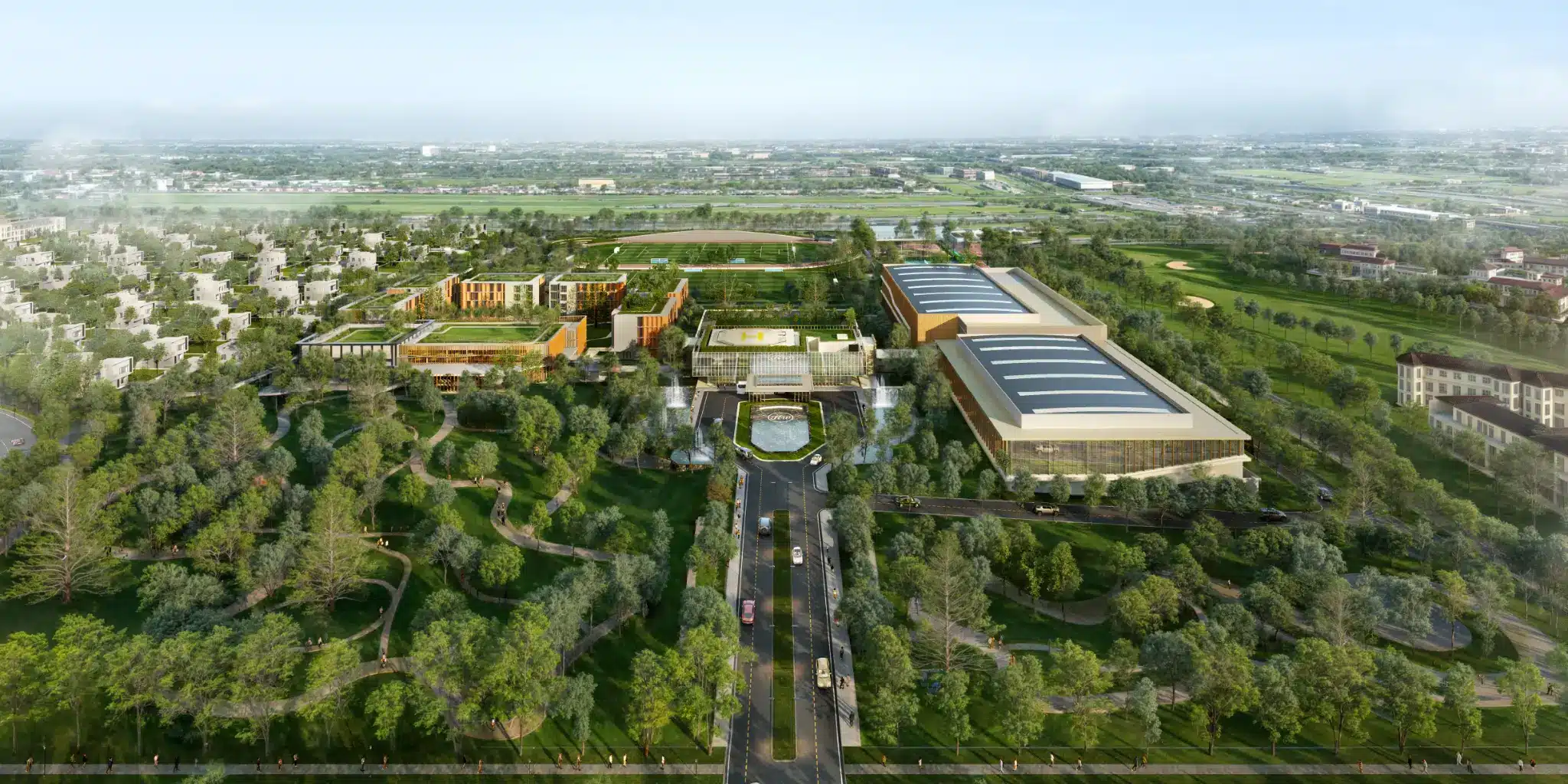
Greater Bangkok has a number of established private golf clubs, but very few residential communities where the course is genuinely built into the architecture of a full-service township rather than sitting adjacent to a standard housing estate.
Reignwood Park is one of the few genuine examples of luxury property near golf course living at scale in the Bangkok region. The Robinswood Golf Club, an 18-hole private championship course at the centre of the development, was nominated at the World Golf Awards 2026. Its developer also owns Wentworth Club in Surrey, England, one of the most storied private clubs in Europe and home of the BMW PGA Championship, as well as Reignwood Pine Valley in Beijing. Full membership at Robinswood is included as a standard benefit in all residential purchases, not treated as an optional extra.
The development extends beyond the course across 2,000 rai north of Bangkok, and includes KIS International School, a full IB curriculum campus from early years to Grade 12, an onsen and spa, a 10km walking and running track, and a cultural heritage estate. For a household where the golfer is one member among several, the breadth of the offering addresses the non-golf question directly.
Further details on the Robinswood Golf Club, including membership options and course information, are available at robinswoodclub.com.
The Question Worth Asking Before Anything Else
The most important question in any golf property search is not how close the house is to the first tee. It is whether the course, the membership terms, and the community together constitute a life that works for everyone who will live there.
Proximity to a fairway is the starting point, not the finish line. Buyers who get this right are the ones who ask harder questions early: what the membership actually includes in writing, how the course stands against international benchmarks independently, and whether the community surrounding the club is built for living in every day, not just for the days when the clubs come out.