

How to Create a Specialized Care Plan for a Senior Recovering From a Stroke

When a doctor first suggests discharge planning for your parent after a stroke, it’s normal to feel anxious and overwhelmed. Most families would have preferred another week or two in the hospital to sort through all the answers to “What now?” but they’ve hit the time limit, so they pack up a lifetime’s worth of both medical knowledge, therapeutic training, and emotional support and head out. They trust it will be enough.
Work the Discharge Process, Don’t Just Show up for It
Hospital discharge planners are among the most neglected figures in post-stroke care. They are the ones who can ensure the transfer of medical records, order the necessary equipment (and make sure it arrives before your family member does), and ascertain which, if any, of the many therapies have been ordered for continuation at home. Ask to have a sit-down with the planner and your family at least 48 hours before the planned discharge date.
Homework specifics: make sure to ask what, if any, therapy has been ordered. Physical therapy, which works on restoring mobility and rebuilding balance and strength. Occupational therapy, which addresses the skills of daily living, how to dress, bathe, and maneuver through your environment. Speech-language pathology, which treats disorders of communication and swallowing. Most stroke survivors need some of all three, and the home care plan needs to specify exactly what’s been ordered and how often.
Build the Home Into the Recovery Plan
Recovery doesn’t take a break when you leave the hospital. It continues back at the house and is in fact where most of the hard work is put in. Neuroplasticity, or the ability of the brain to form new neural connections after injury, is reliant on repetitive, consistent practice. So the exercises a therapist leads your loved one through in a facility should also be repeated daily in the home.
First, ensure you have a dedicated spot in the home for therapy work. It doesn’t need to be fancy, just a cleared space with good lighting and a steady chair should suffice along with any of the therapy tools prescribed. The key is that you and other caregivers know which exercises to assist with and how to perform them safely. Do not let the occupational therapist see you off with just a quick demo, ask for a written protocol before discharge.
Second, a home safety assessment might be wise to conduct before your loved one even arrives. Grab bars, cleared paths, non-slip mats, and ramps all around can prevent the kind of falls that undo weeks of progress. Some hospitals will even refer you to an occupational therapist who can visit your home and assess what should be done even before your loved one is discharged.
Finally, while everyone’s initial reaction is to do everything on their own, obtaining in-home care services Philadelphia PA is the best bet for managing physical transfers, medication schedules, and hands-on ADL support in those critical first months of recovery. They know how to assist with transfers without injuring one or both of you in the process, something you can’t say most family members are prepared for.
Treat Swallowing and Nutrition as a Safety Issue, Not Just a Comfort One
Many stroke survivors experience swallowing difficulty (dysphagia). It sounds relatively benign, but drinking something as seemingly harmless as water isn’t for a stroke survivor with dysphagia. Liquids can go down the wrong pipe, the trachea, and cause aspiration pneumonia, a leading cause of death in stroke survivors. “You’re best off drinking this substance that’s like cheap hair gel” isn’t an arbitrary or insignificant choice. Your loved one’s life has literally been entrusted to your hands. Don’t bristle at odd instructions from the hospital or rehab staff. If SLP has told you nectar-thick liquids only, minced and moisture-free meals only, there’s a good reason for it.
Build Secondary Stroke Prevention Into the Daily Structure
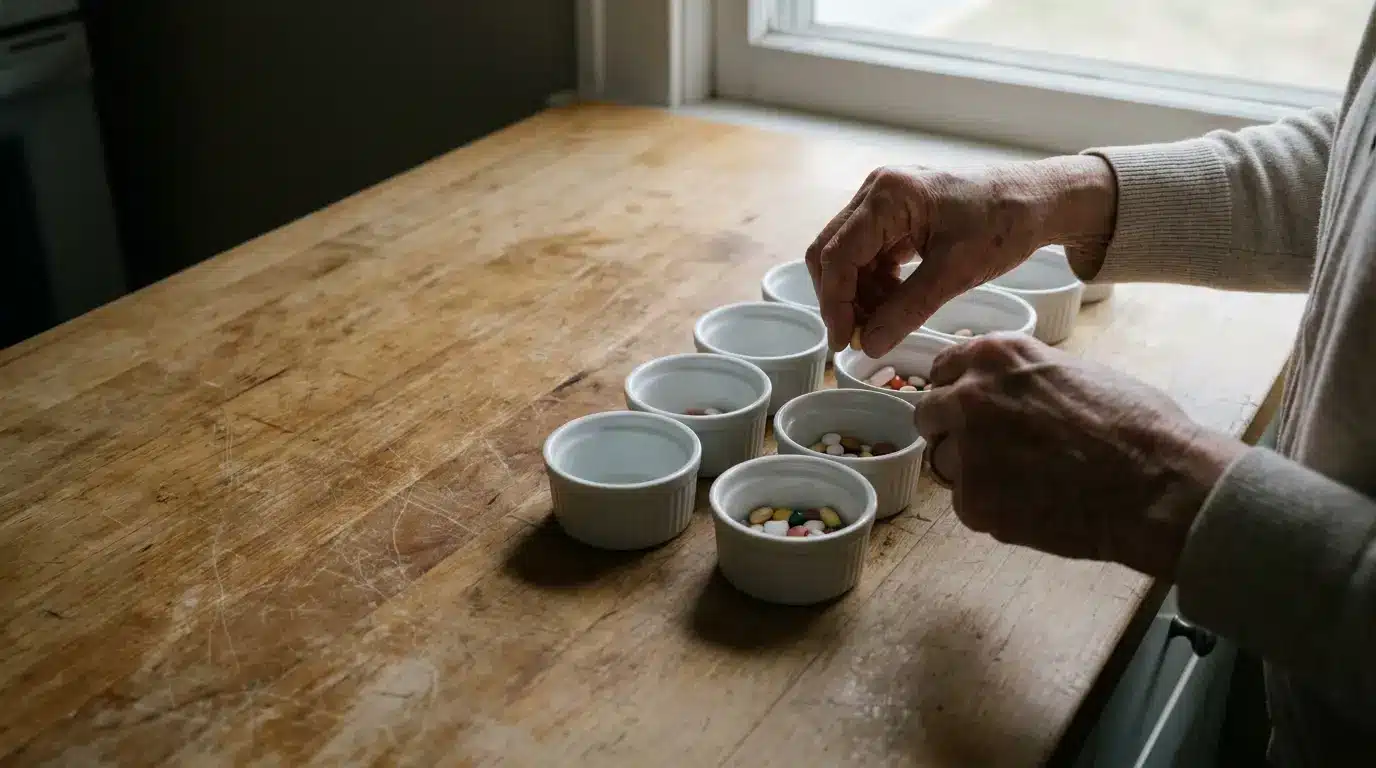
It may be possible to prevent up to 80% of second strokes through proactive management (American Stroke Association). This shows prevention must be part of the daily care routine, and not something that is only discussed with the neurologist.
Taking medication is the most important aspect of this. Blood thinners, antihypertensives, and cholesterol-lowering drugs must be taken every day, at the right time, in the right quantity. The simplest way to ensure this happens is for a caregiver to oversee this in the early weeks. A weekly pillbox filled by a caregiver each week, and checked daily to ensure the pills are taken, can make this easy. What doesn’t work is leaving it up to the survivor to remember, in the early weeks particularly, strokes can affect memory and executive function in ways that are not immediately obvious.
In addition to medication, regular check-ups with the doctor, daily monitoring of blood pressure, and, if indicated, checking blood sugar should become part of the routine. Record the readings in a book. If readings consistently head outside the target range, note that to report to the professional at the next appointment.
Schedule Relief for the People Providing Care
Many family caregivers do not set limits for themselves and reach those limits quicker than they anticipate. Caregiver burnout is a real thing, and when the caregiver suffers, the quality of care goes down. A good care plan will actually plan professional caregiver shifts in advance, not as a backup, but as part of the structure. Overnight monitoring, weekends, and professional support for the kind of hygiene help that can be exhausting for family members are all places where professional caregivers both decrease risk and family exhaustion.
Stroke recovery is not a process of tragically heroic sprinting back to baseline. It’s months of deliberate work with a steady, incremental resurgence. Those families who view the house as the central rehab environment with professional caregivers as a key part of that environment will make those sluggish early gains go much farther in the long run.