
What Top Game Design Schools Actually Teach Students

Spoiler: It’s Not a Four-Year Gaming Session
Nobody signs up for a game design degree expecting to read Aristotle. And yet – there’s a moment, usually around week three, when students realize this path is equal parts psychology, engineering, visual art, and deadline survival. Not exactly what the campus tour suggested.
The short version? Game design schools teach storytelling, systems thinking, code, art fundamentals, audio theory, and how to ship something under pressure – all tangled together. It’s messier and richer than most people expect going in.
So what does an actual week look like? What fills those hours between enrollment and graduation?
Where It All Starts: Theory Nobody Warned You About
Here’s the thing about game design education – it begins somewhere most applicants don’t anticipate. Not in Unity. Not in Photoshop. In a classroom, picking apart why games feel the way they do.
Why does Celeste make dying feel motivating rather than crushing? What’s the invisible architecture behind Stardew Valley’s loop that keeps players farming at midnight? These aren’t fan-forum debates. They’re serious design problems with documented frameworks behind them.
Students dig into MDA theory (Mechanics, Dynamics, Aesthetics), Bartle’s player taxonomy, and Csikszentmihalyi’s concept of flow – that sweet spot where challenge and skill meet and time dissolves. As Dr. Jesse Schell, author of The Art of Game Design, once put it: “A game is a problem-solving activity, approached with a playful attitude.” The playful part comes naturally. The problem-solving part? That gets trained.
Core theory modules typically cover:
- Player motivation and core loop design
- Narrative structure built for interactivity (not just borrowed from film)
- The flow channel – balancing challenge against reward without breaking immersion
- Ethics baked into mechanics (loot boxes didn’t design themselves)
- Genre conventions – and the specific logic of when to ignore them
Engines, Code, and the Beautiful Chaos of Prototyping
This is where the abstract gets loud. Fast.
Top game development courses drop students into Unity or Unreal Engine within weeks – sometimes days – of starting. The expectation isn’t mastery. It’s contact. Build something broken. Figure out why it’s broken. Fix it. Repeat.
Coding is non-negotiable, even for students whose focus skews toward narrative or level design rather than engineering. C# for Unity. Blueprints visual scripting for Unreal. The reasoning is practical: a designer who can read code – or write a rough version of it – communicates better with developers, catches problems earlier, and earns trust faster on a team.
Vancouver Film School and other top game design schools bake this cross-disciplinary fluency into the program structure from day one. Students don’t just document what a level should feel like – they prototype it. Break it. Redesign it. That cycle – sometimes 4 to 6 prototypes in a single semester – mirrors production rhythms at real studios more closely than any lecture ever could.
Fail fast. Iterate faster. It’s a cliché in the industry because it actually works.
The Parts Most Students Don’t Expect: Art, UI, and Sound

Ask any second-year student what surprised them most, and the answer tends to cluster around two things: how much visual communication matters, and how underestimated audio is everywhere outside of school.
Game design skills in visual development aren’t about becoming a concept artist – they’re about literacy. Color theory, composition, UI hierarchy, iconography – a designer who can’t sketch an idea or critique a UI layout is a bottleneck on any team. Programs worth attending treat visual fundamentals as core, not elective.
Audio is weirder and more important than most people realize going in. That specific thwack when a sword connects? Designed intentionally, tested obsessively. The held silence before a boss encounter that makes hands sweat? Also deliberate – sometimes the result of weeks of iteration. Research from the Journal of the Audio Engineering Society found that well-integrated game audio increases player immersion by up to 30%. Thirty percent. That’s the margin between a game that feels inhabited and one that feels like a tech demo with placeholder assets.
Spatial audio, dynamic soundscapes, audio as feedback rather than atmosphere – serious programs cover all of it.
Capstone: Shipping Something Real, With Real People, Under Real Pressure
No serious game design program ends with a final exam. It ends with a shipped game.
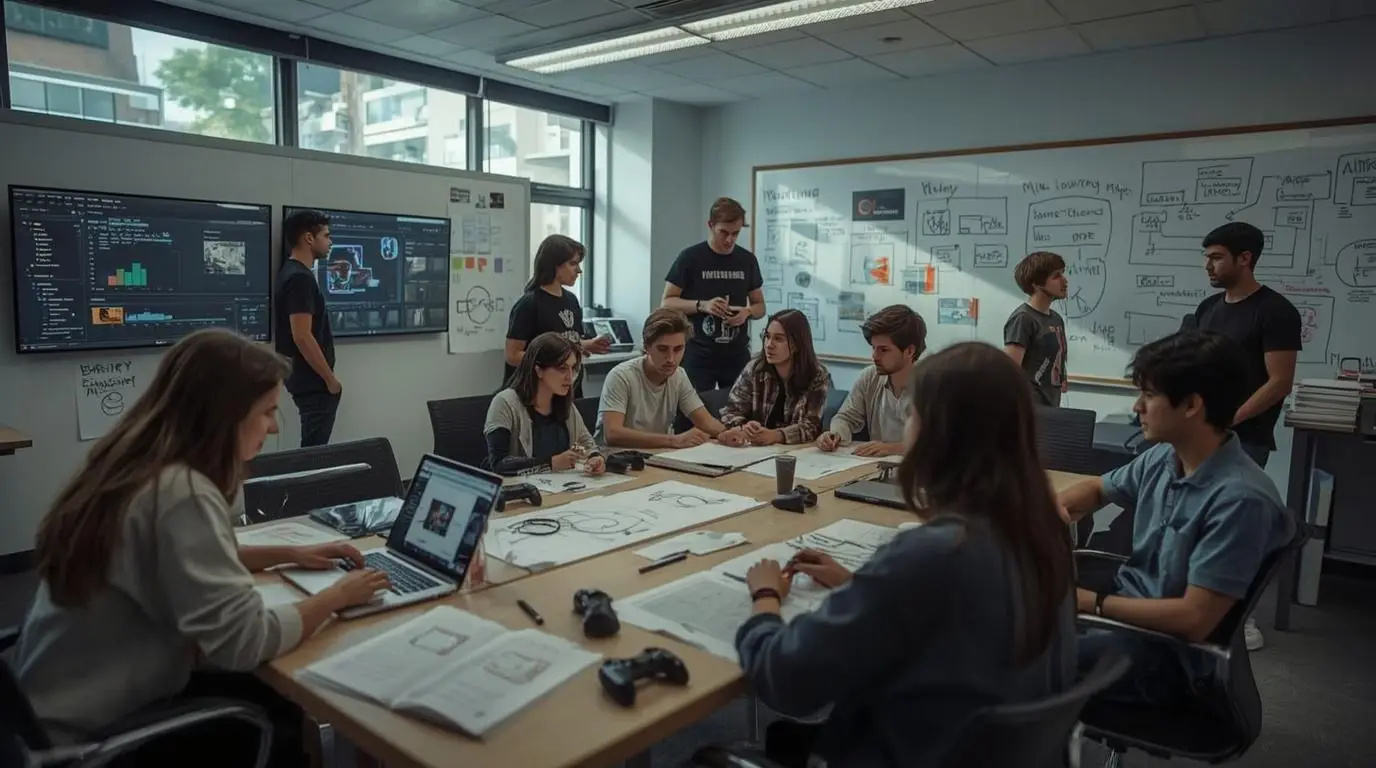
Not a prototype. Not a design document. A finished, playable product – built in teams of four to eight people across disciplines, with rotating leadership roles, actual deadlines, and the kind of creative friction that can’t be simulated in a solo assignment.
Students run sprint cycles. They use version control. They write post-mortems. They give feedback that stings and receive feedback that stings worse – and learn, eventually, to separate the criticism of the work from the worth of the person who made it. That last skill, honestly, takes longer than anything technical.
Hiring managers at studios like Ubisoft, Riot Games, and Electronic Arts are consistent about one thing: shipped work matters more than transcripts. A playable capstone project – one that demonstrates game designer career readiness through actual decisions made under pressure – is worth more in an interview than any GPA.
What Makes a Program Worth Attending
Not all game design programs operate at the same level. The gap between a strong program and a weak one isn’t always visible in the brochure.
The markers worth looking for:
- Instructors with active industry credits, not just academic titles
- Real software licenses and current hardware – not last-generation tools
- Alumni networks with actual hiring pipelines into studios
- Curriculum that’s been updated recently (AI-assisted tools like Midjourney and GitHub Copilot are now part of real workflows)
- A culture that rewards honest critique over comfortable encouragement
Programs still teaching pipeline workflows from 2020 aren’t preparing students for 2026 studios. The industry moves – good schools move with it.
A Few Honest Closing Thoughts
Learning game design at a serious institution isn’t a shortcut to making the games rattling around in someone’s head. It’s a structured dismantling of assumptions followed by a slow, occasionally frustrating rebuild. The students who get the most out of it aren’t necessarily the most talented – they’re the ones who stay curious when things break, which is often.
The curriculum isn’t glamorous in the way the industry’s marketing suggests. It’s rigorous, collaborative, and deeply practical. Understanding what’s actually inside a program – before signing anything – is the single most useful thing a prospective student can do. The schools doing this right are worth the investment. The ones coasting on reputation alone, well – that’s what campus visits and alumni LinkedIn profiles are for.