The Business Benefits of a Well-Planned Office Design and Build

Office design has quietly shifted from a “nice-to-have” to a measurable lever for performance. The reason is simple: today’s workplaces have to do more than house people. They need to help teams focus, collaborate, learn, recover, and feel connected—often within the same day.
A well-planned office design and build brings structure to that challenge. It turns a messy set of preferences (“more meeting rooms,” “better lighting,” “can we add phone booths?”) into a coherent environment that supports how your organisation actually operates. Done properly, it can reduce costs, increase productivity, improve retention, and even strengthen your brand in ways that are hard to replicate with perks or policies.
Design as a Business Tool, Not an Aesthetic Exercise
Most office redesign conversations start with visuals—finishes, furniture, colour palettes. But high-performing workplaces begin with decisions: What work happens here? Who needs to be together, and when? What’s the balance between individual focus and group problem-solving? What does “a good day at work” look like for different roles?
Aligning the Space With How Work Really Happens
A common failure mode is copying what looks good on social media while ignoring operational reality. For example, an open-plan layout can be efficient, but if your teams spend hours in concentrated work or handling sensitive calls, you’ll pay for it in distractions, stress, and meeting-room overload.
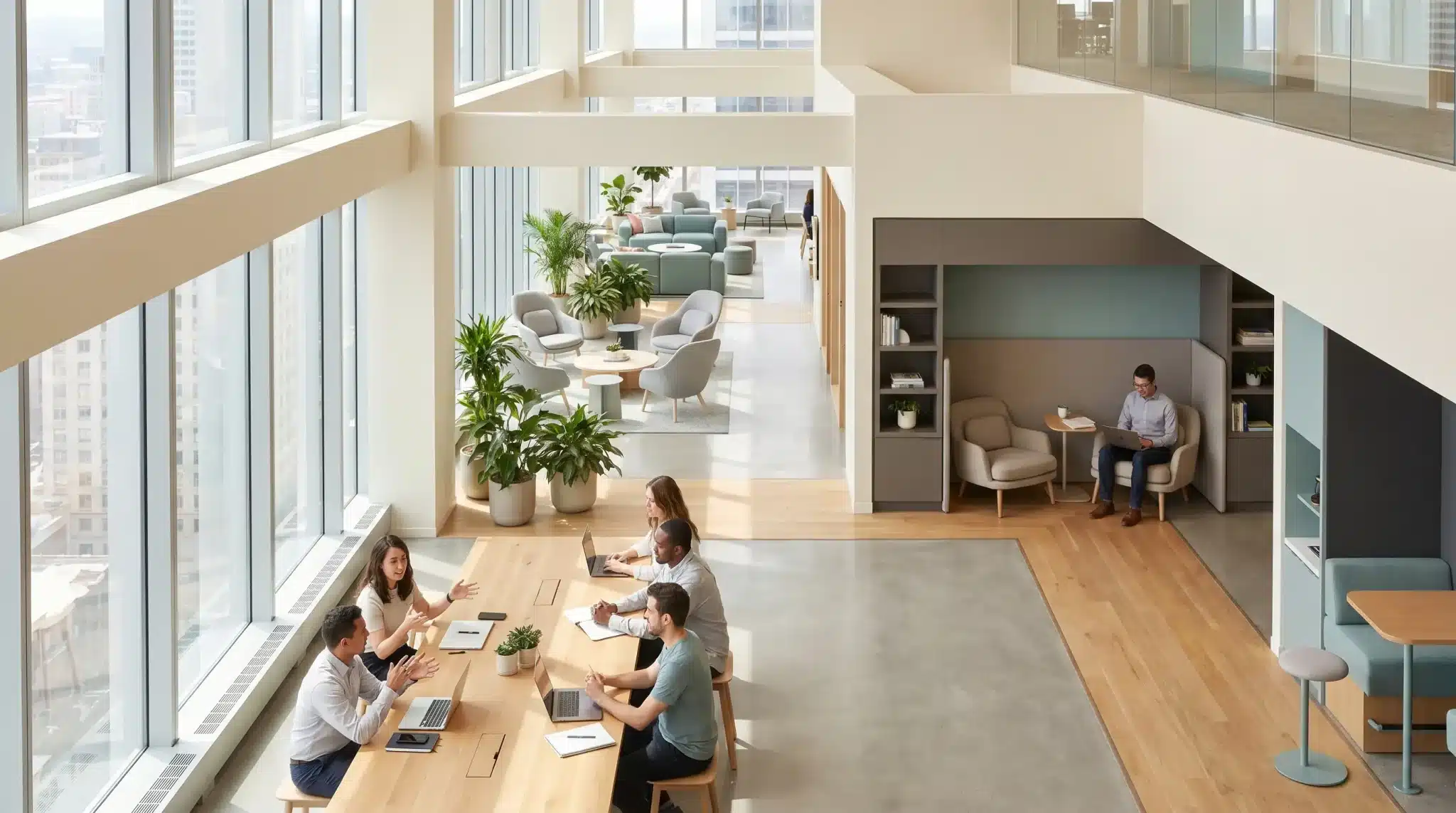
The better approach is to map workflows and match them to zones. That might mean fewer desks overall but more choice: quiet rooms, project spaces, touchdown areas, and properly equipped meeting rooms. When you plan from the inside out—starting with tasks and behaviours—design choices become much easier to justify and much harder to regret.
Productivity Gains Come From Reducing Friction
Productivity in offices isn’t about squeezing more people into less space. It’s about removing the “tiny taxes” that drain time and attention: hunting for a room, taking calls in corridors, wrestling with AV, or being stuck under harsh lighting for eight hours.
Better Layout, Better Decisions
A thoughtful design and build considers adjacencies (who sits near whom), circulation (how people move), and acoustics (where noise should—and shouldn’t—travel). This is especially important for hybrid teams. If people are coming in two or three days a week, the office has to be reliably useful. Otherwise, attendance drops and the space becomes a cost centre rather than a strategic asset.
Around this stage, it’s often helpful to look at examples of teams who specialise in translating business needs into physical space—particularly when you’recreating bespoke work environments that need to balance culture, flexibility, and practical constraints like leases, building services, and timelines.
The Hidden ROI of Comfort and Usability
Ergonomics, daylight, ventilation, and thermal comfort rarely get the spotlight, yet they influence energy levels and decision-making all day long. Even modest upgrades—better task chairs, adjustable lighting, or zoning that prevents hot-and-cold battles—can have an outsized effect on how people feel and perform. If your team is regularly uncomfortable, you’re effectively paying for underperformance.
Talen
Talent, Retention, and the “Commute Test”
ybrid world, the office has to earn the commute. People will make the trip when the workplace gives them something they can’t get at home: easier collaboration, stronger social connection, better tools, and a clear sense of belonging.
Design That Supports Culture Without Forcing It
Culture isn’t a mural. It’s the repeated experience of how work gets done. Office design can reinforce that experience by making desired behaviours easier. Want more cross-team collaboration? Provide informal project spaces near key departments. Want deeper focus? Ensure quiet zones are genuinely protected from noise and interruptions.
The biggest retention wins often come from addressing friction points employees have learned to tolerate—lack of privacy, not enough meeting space, insufficient storage, or messy hot-desking systems. When those issues disappear, people notice.
Cost Control Through Smarter Planning (Not Just Cheaper Finishes)
A design-and-build project can look expensive on paper, but the cost of not planning is usually worse: variations, delays, rework, and a space that needs fixing six months later.
Optimising Space and Reducing Long-Term Waste
With many organisations shrinking or reconfiguring footprints, the goal is rarely “more space.” It’s better space. That might mean:
- Reducing underused desk areas and reallocating square footage to collaboration and focus zones
- Designing modular layouts that can adapt as teams grow or restructure
- Specifying durable materials where wear is high (reception, breakout areas) and saving elsewhere
That last point matters. A well-planned office doesn’t overspend everywhere; it spends deliberately where it reduces maintenance, replacement, and churn.
Fewer Surprises During Delivery
The “build” part is where budgets can unravel—especially in older buildings where power, ventilation, and fire safety constraints show up late. Proper surveys, coordinated drawings, and clear decision-making early on are what keep a project predictable. It’s not glamorous, but it’s the difference between a smooth move-in and weeks of disruption.
Brand Credibility You Can Feel
Clients, candidates, and partners read your workplace the way they read your website: as a signal of how you think and operate. The office doesn’t need to be flashy. It does need to be coherent.
Trust Is Built in the Details
A reception that’s confusing, meeting rooms with unreliable tech, or poorly considered accessibility sends a message—even if no one says it out loud. On the other hand, a space that’s intuitive, welcoming, and functional communicates competence.
This is particularly relevant for businesses that host workshops, pitches, or stakeholder sessions. When your space supports smooth interactions—good sightlines, clear wayfinding, reliable acoustics—you remove friction from high-stakes moments.
How to Approach an Office Design and Build Without Getting Overwhelmed
The process is easier when you treat it like any other business transformation: define outcomes, gather input, test assumptions, then execute with discipline.
Start With These Practical Steps
Keep it simple at first. Before you debate finishes or furniture, get clarity on:
- The top three outcomes you need the office to deliver (e.g., collaboration, focus, client experience)
- How different teams use the space today—and what’s not working
- Your non-negotiables: budget range, timeline, compliance needs, and IT requirements
From there, you can build a brief that designers and contractors can actually deliver against, rather than a mood board that leads to compromises.
The Bottom Line: Good Workplaces Reduce Drag and Amplify Intent
A well-planned office design and build is ultimately about alignment—between space and strategy, environment and behaviour, cost and value. It reduces the daily friction that quietly drains performance and replaces it with an experience that supports how your people work best.
If you’re investing in the office at all, it’s worth doing with intention. The businesses that treat workplace design as a strategic tool—not a cosmetic refresh—tend to see the difference not only in how the space looks, but in how the organisation runs.