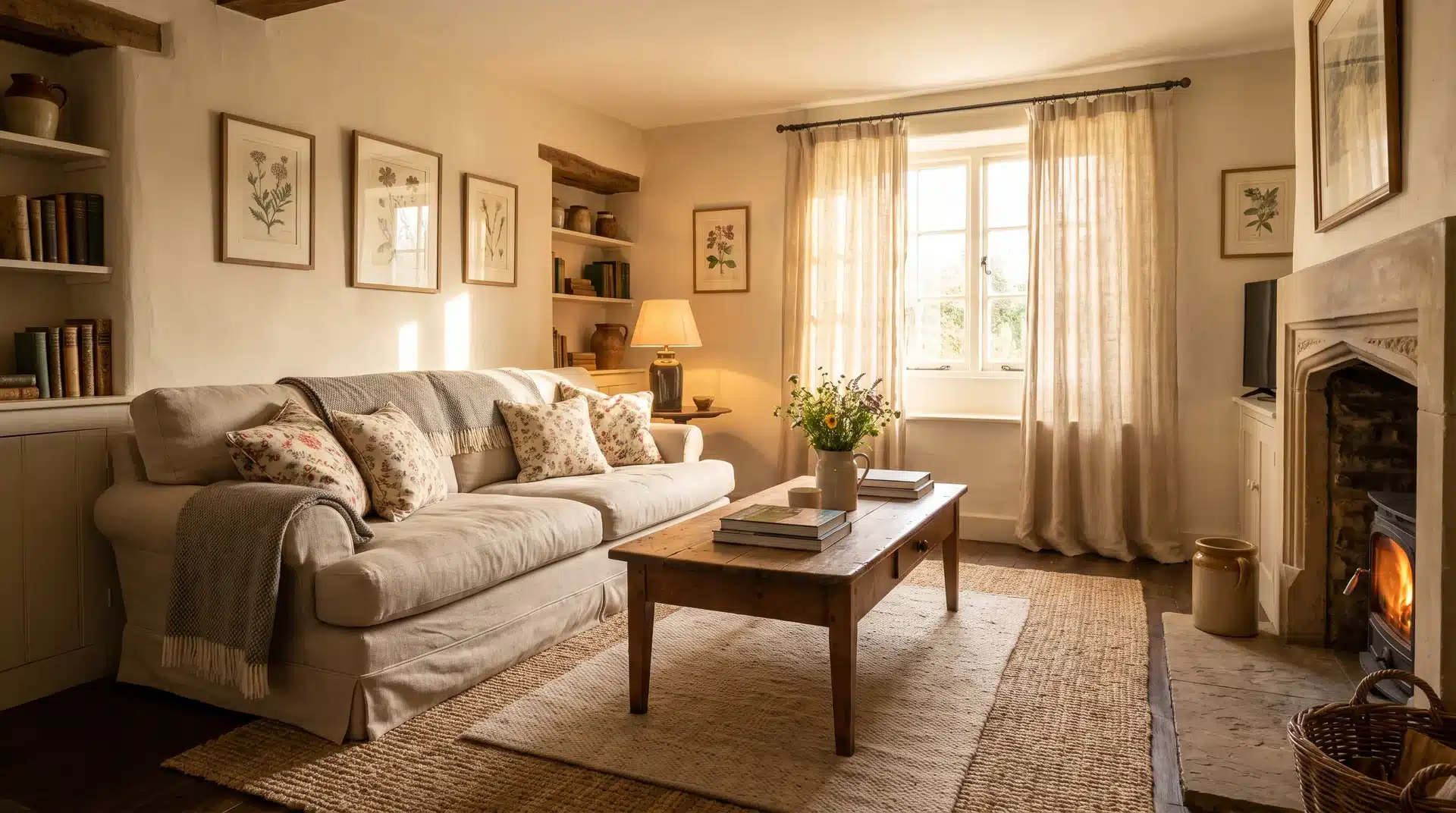
13 Cottage Living Room Ideas that Feel Warm and Cozy

Nobody walks into a cottage living room and thinks, “that is well-decorated.” They think, “I want to stay.”
The best cottage living rooms are not built around a mood board. They are built around comfort, layered with things that feel personal rather than purchased.
Linen upholstery that softens with time, a rug worn to the right degree, a windowsill with something growing in it. The style has a name, but what it produces is a feeling.
These cottage living room ideas range from paint decisions to furniture choices to the specific way light moves through a room.
All of them are practical. All of them work in real US homes, at a range of budgets, in rooms of every size.
What Is a Cottage Living Room?
A cottage living room is a relaxed, comfortable space inspired by countryside homes, coastal cottages, and rural interiors. It focuses on warmth through natural materials, soft colors, vintage details, and layered textures.
Unlike highly polished rooms, cottage style embraces slight imperfections. A worn wooden table, a linen sofa with natural creases, or a stack of old books adds more character than brand-new matching furniture ever could.
The goal is not to make the room look untouched. It is to make it feel lived in. English cottage living spaces take this further with florals, built-in shelving, and painted furniture. But the core principle stays the same across every sub-style: comfort first, decoration second.
Cottage Living Room Color Palette Reference
Color is the decision that ties every other element together. Get the palette right, and the room coheres. Here is a quick reference for the most common US cottage living room color directions:
| Palette | Base Color | Accent | Best For |
|---|---|---|---|
| Classic Cottage | Warm white or cream | Dusty blue, sage green | Traditional cottage with florals and vintage pieces |
| Modern Cottage | Warm oat or stone | Natural linen, matte black accents | Cleaner, more restrained cottage with organic textures |
| Country Cottage | Soft terracotta or warm yellow | Olive green, chocolate brown | Warmer, earthier cottage with natural wood and wicker |
| Coastal Cottage | Pale blue or sea glass | White, natural rattan | Light-filled cottage rooms near water or with good natural light |
| Dark Cottage | Deep sage, navy, or forest green | Warm cream, brass | Moody, cozy cottage for rooms with limited natural light |
If you want more detail on warm white paint options for cottage rooms, this review of Ballet White paint covers how a warm-based neutral performs across different lighting conditions.
Cottage Living Room Ideas That Bring Warmth to Any Space
Cottage style builds from the inside out. Start with the surfaces, add the furniture, layer the textiles, and finish with the details. The ideas below follow that sequence, moving from the biggest decisions toward the most adjustable ones.
1. Build Your Cottage Living Room Around a Soft Color Palette
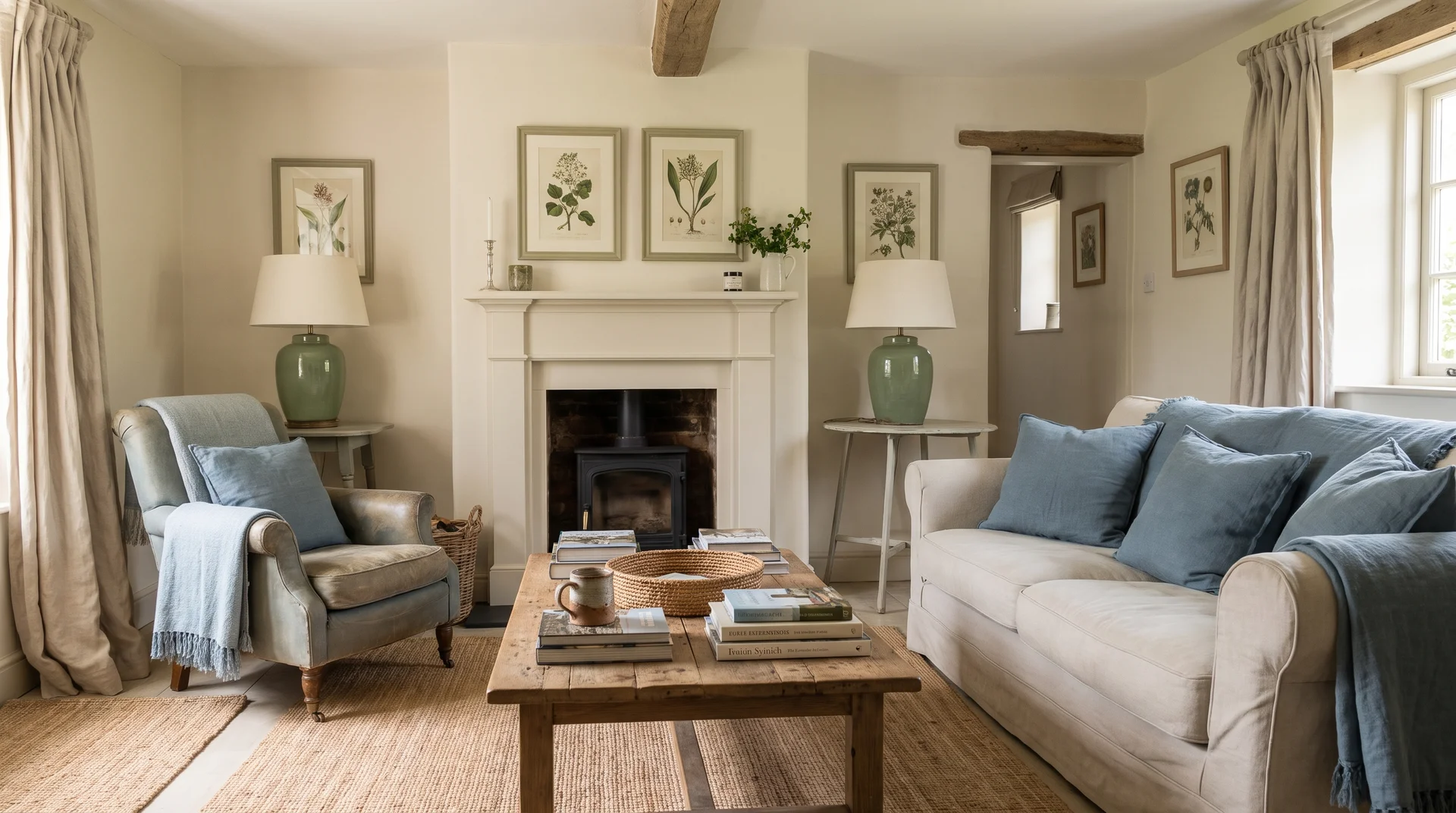
The foundation of a cottage living room is a muted, warm color palette. Cottage colors run the gamut from warm white, cream, and soft sage green to dusty blue, pale blush, warm oat, stone, and soft terracotta.
What you want to avoid is a stark, cool white. It reads as clinical rather than cozy. Cottage white has warmth in the undertone, and that undertone is what holds the rest of the room together.
They sit on the warm side of white without reading yellow, which is the balance the style needs.
2. Add Wall Treatments
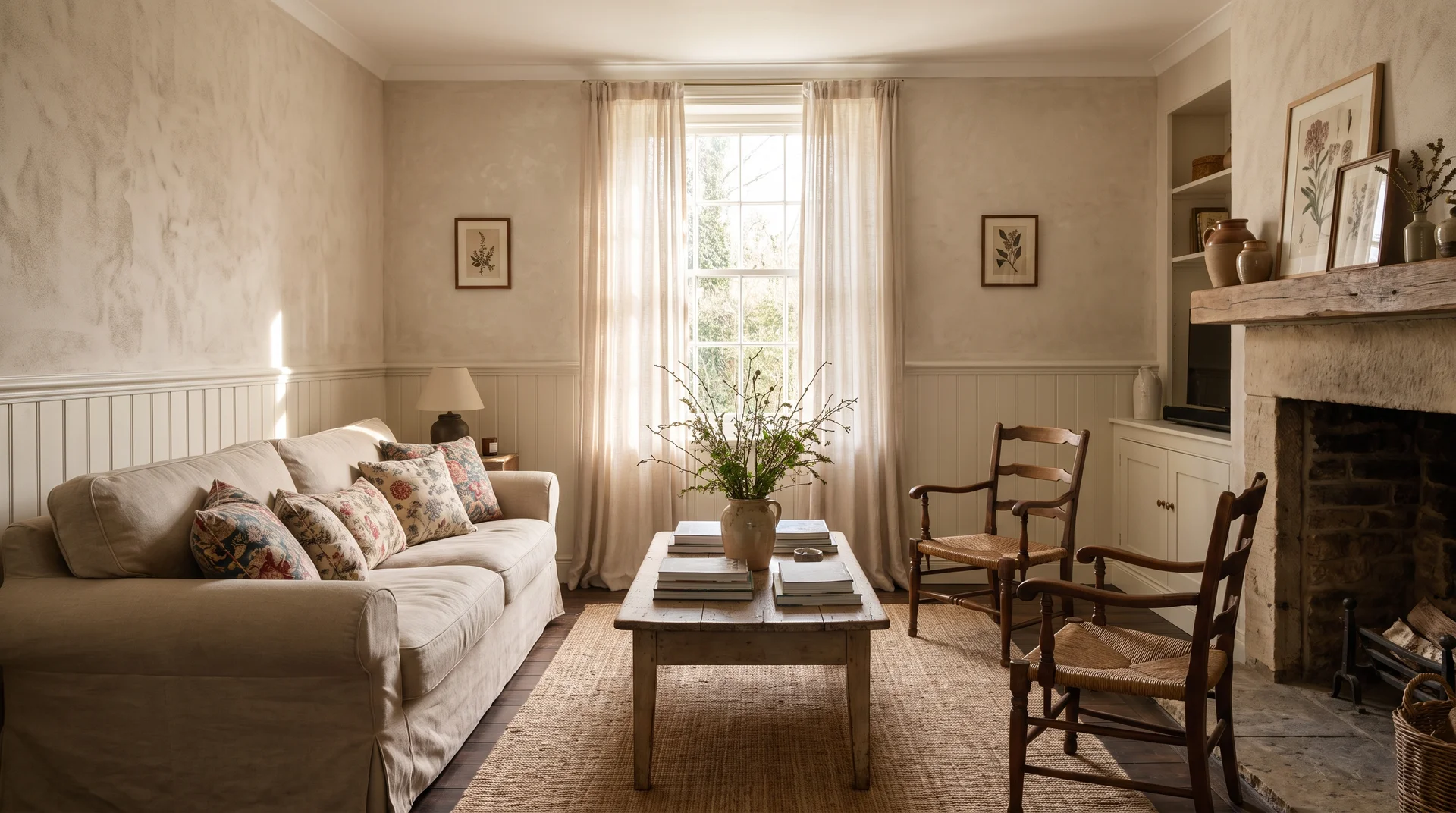
A flat drywall room will not read as a cottage living room, no matter how good the furniture is. Wall treatments are the fastest way to add architectural interest and tactile character to a plain room.
Beadboard below the chair rail with paint above is the most classic cottage application. Painting both the beadboard and the wall in the same tone gives a tone-on-tone effect that reads sophisticated and modern.
Painting the beadboard white against a colored wall reads more traditionally. Shiplap works in cottage rooms when balanced with soft textiles and a lighter palette. Without that balance, it pulls toward farmhouse rather than cottage.
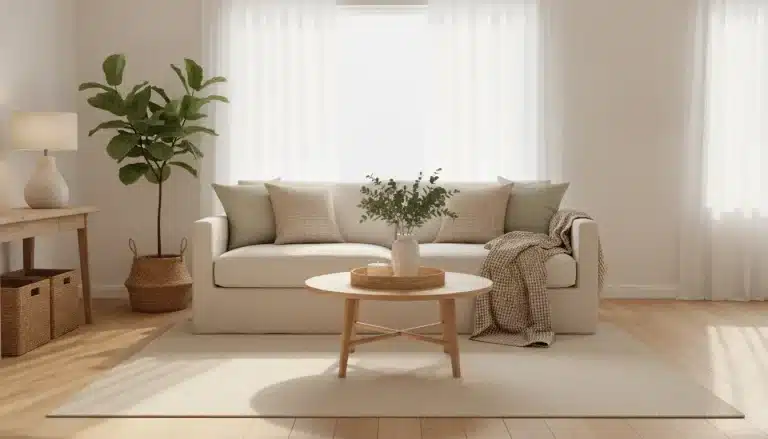
3. Choose a Linen or Slipcover Sofa
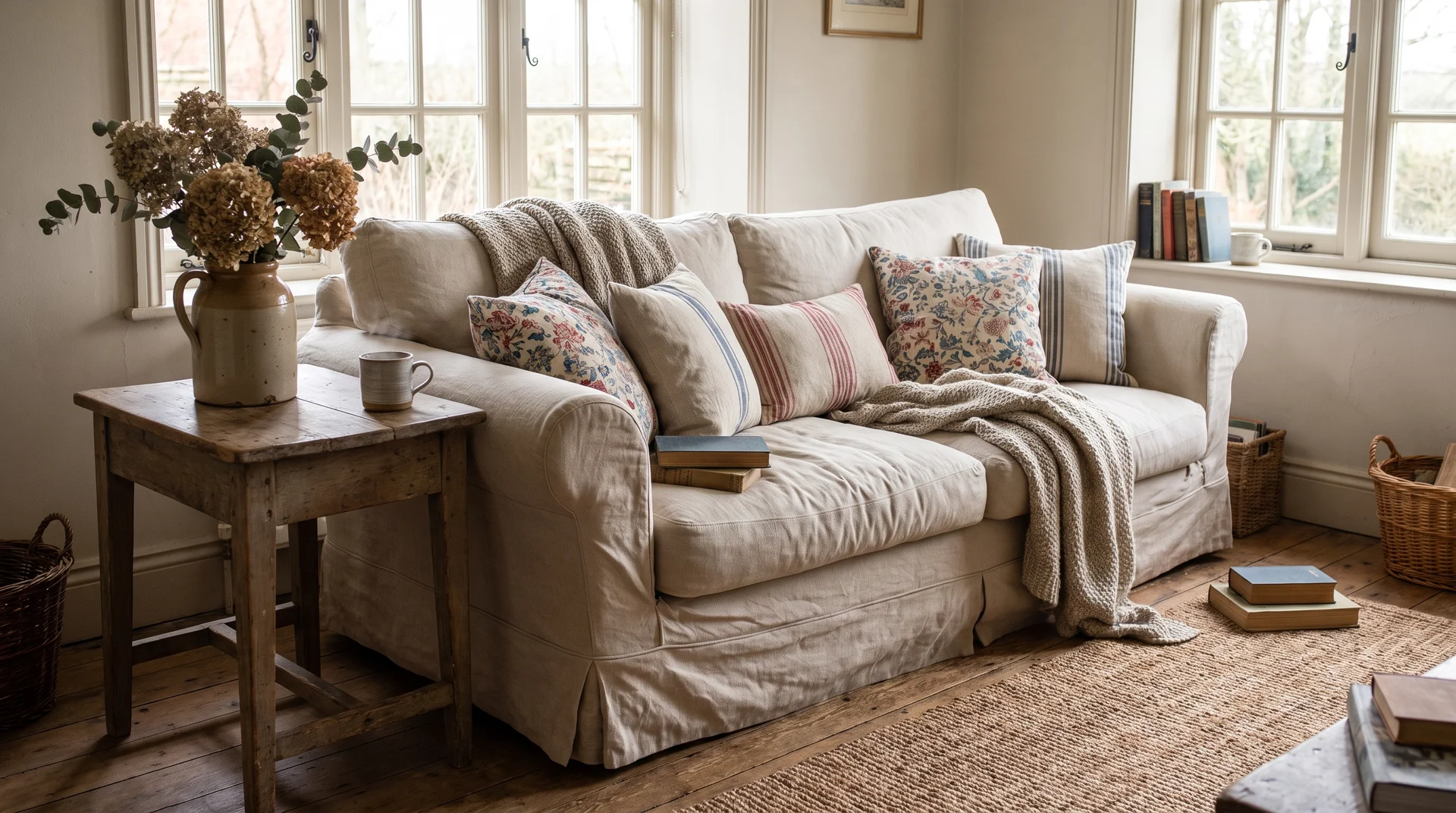
The sofa anchors the room, and the choice of material determines whether the space reads as refined or relaxed.
Linen and linen-blend upholstery is the most common choice in cottage living rooms because it creases slightly and softens with use.
Those qualities look intentional in this style. A perfectly smooth, pristine sofa works against the atmosphere the rest of the room is trying to build.
Slipcovers deserve more attention than they get in most cottage decorating guides. A washable slipcover in a natural linen or cotton fabric is affordable, adjustable, and deliberately casual in appearance.
For US homes with children, pets, or high daily use, a slipcover sofa in cream or soft sage is a more practical long-term choice than an upholstered piece in the same colors. Cream, dusty blue, and soft sage are the palette colors that carry best in a linen sofa format.
4. Layer Rugs and Textiles
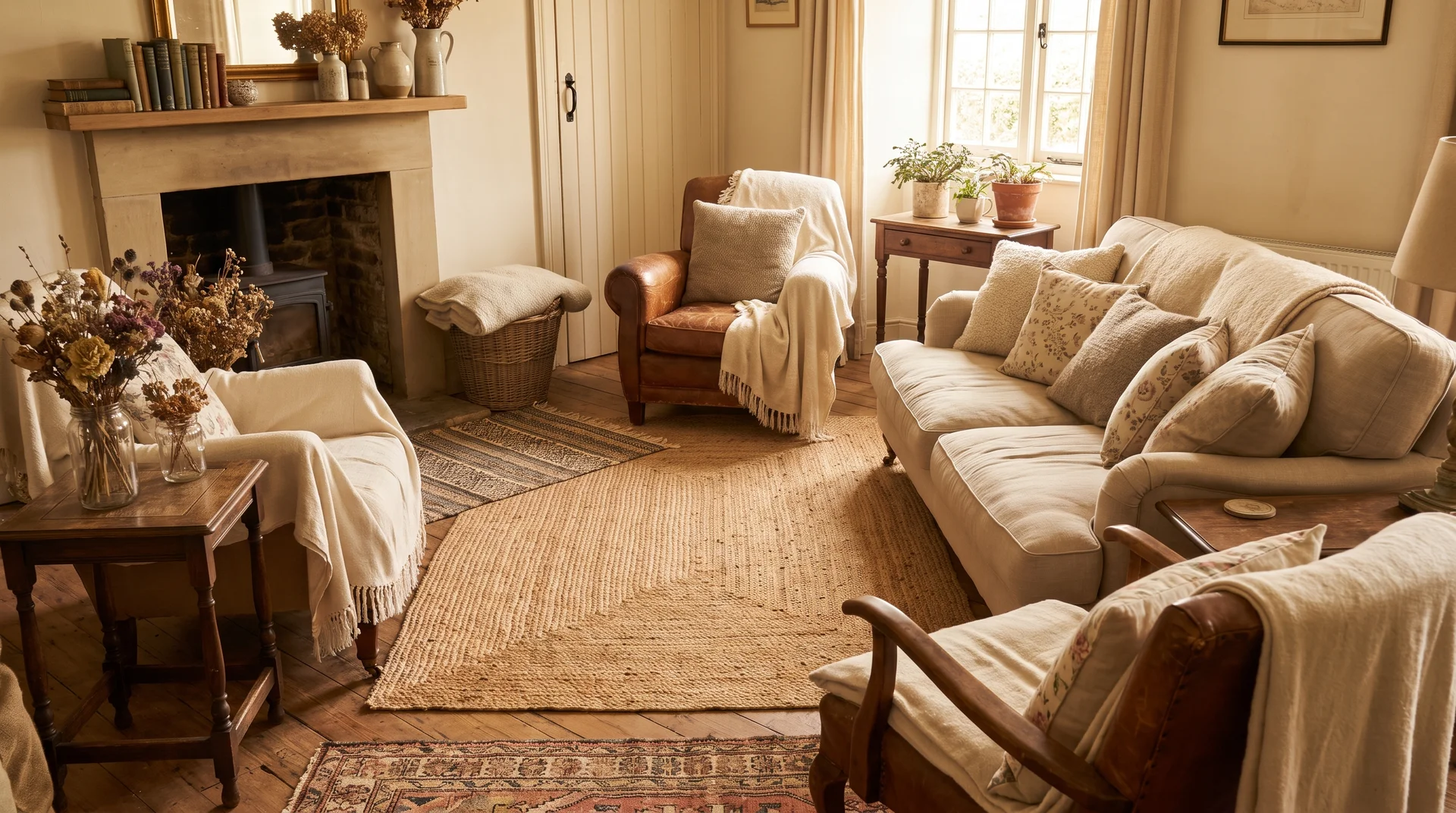
A cottage living room without layered textiles is just a well-painted room. The textiles are what create the enveloping, cozy quality the style is known for.
Start with a natural fiber base rug in jute or sisal, then layer a smaller printed or woven rug on top. If there is somewhere to sit, there should be somewhere to reach for a throw. That is the practical rule.
Cushions should mix textures rather than match as a set. Linen, cotton, velvet, and embroidered fabrics all belong together in a cottage living room. The mix should feel collected rather than curated.
One floral, one stripe, and one plain per seating group is the pattern-mixing combination that reads as layered without reading as chaotic.
5. Bring Natural Wood
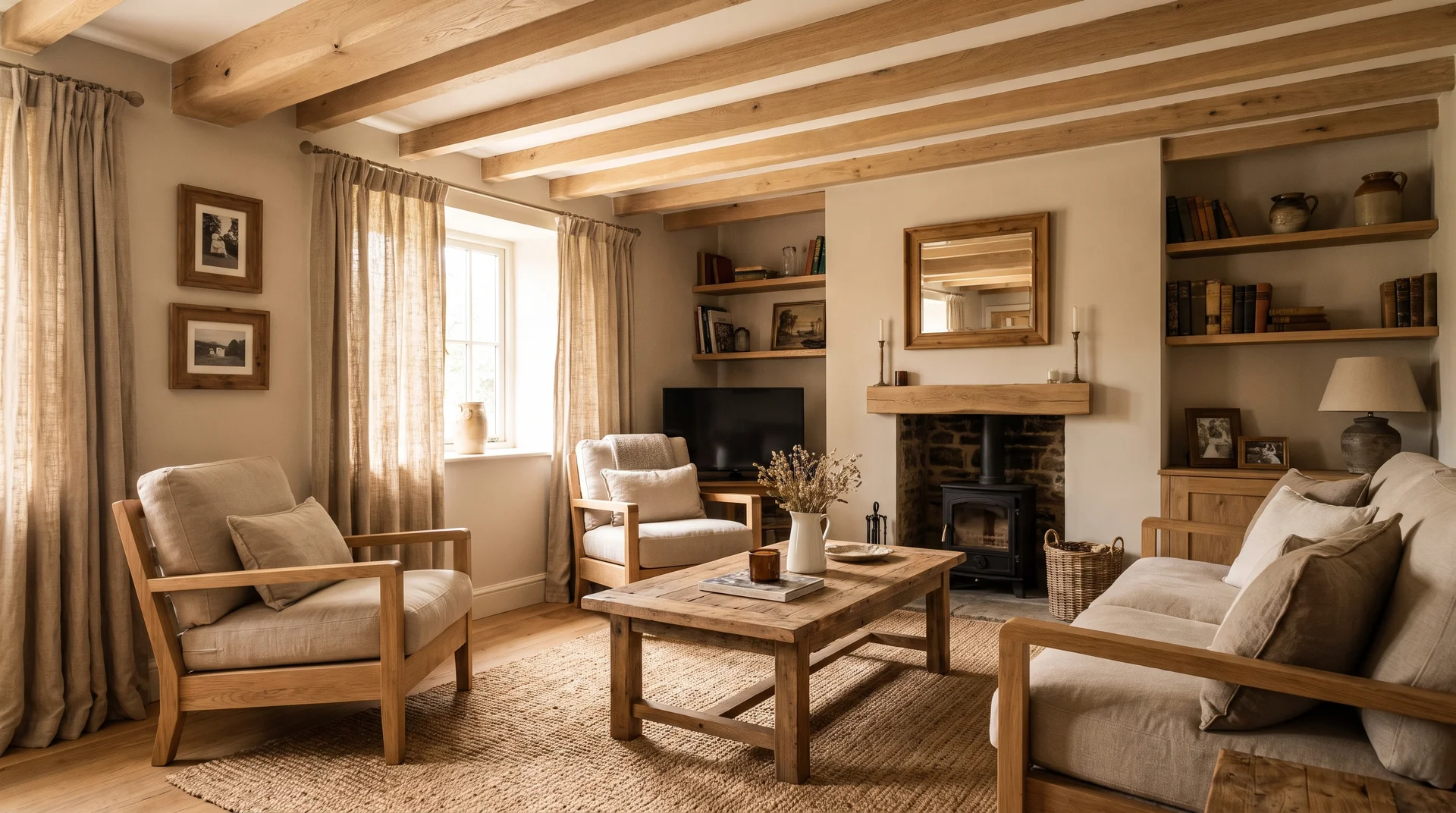
Natural wood in a cottage living room reads as warmth rather than rustic when the tone stays light to medium. Oak, pine, and ash all work well. Exposed ceiling beams are the most impactful single wood element a cottage room can have.
One false beam added to a plain ceiling adds more character than almost any furniture purchase. Reclaimed or lightly distressed wood on a coffee table reads as authentic to the style.
High-gloss lacquered wood reads as contemporary and pulls against the cottage atmosphere rather than supporting it.
Wood frames on artwork, mirrors, and windows carry the material through the room without requiring major furniture investment, which is useful for anyone building a cottage living room gradually rather than all at once.
6. Use Floral and Botanical Patterns
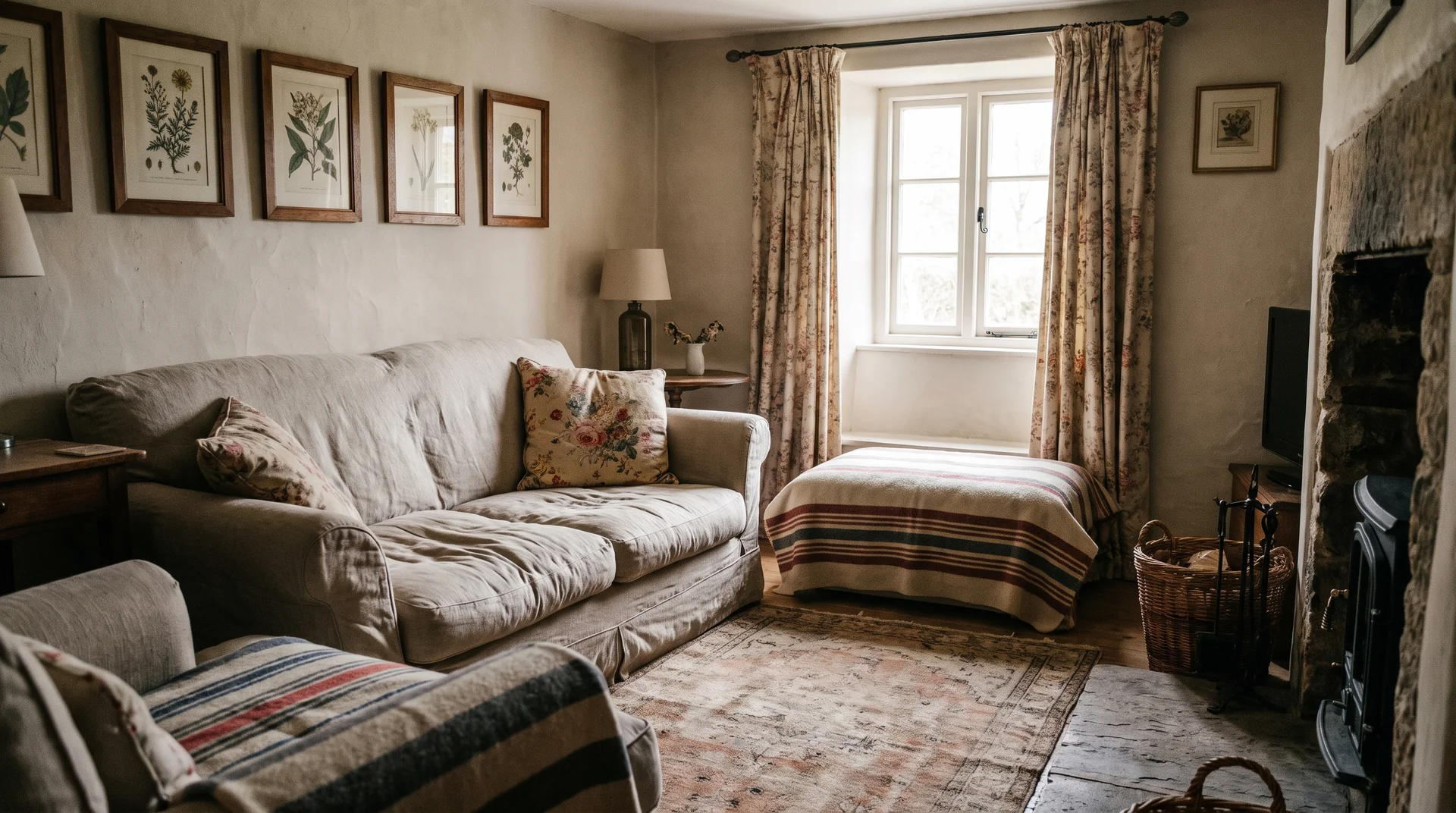
Florals are one of the defining visual elements of cottage style. Used with restraint, they read as personal and full of character. Used without it, they compete with everything else in the room.
The key variable is scale, not quantity. One large-scale botanical print on a single cushion or curtain has more impact than three small-scale florals fighting across the room.
Vintage or faded floral patterns read as more authentically cottage than bright, saturated prints. Mix florals with plains and stripes rather than with other florals.
Botanical prints in simple wood frames on the wall are the lower-commitment version of the same idea. They bring the language of the pattern into the room without requiring a full upholstery or curtain commitment.
7. Add Vintage and Antique Pieces
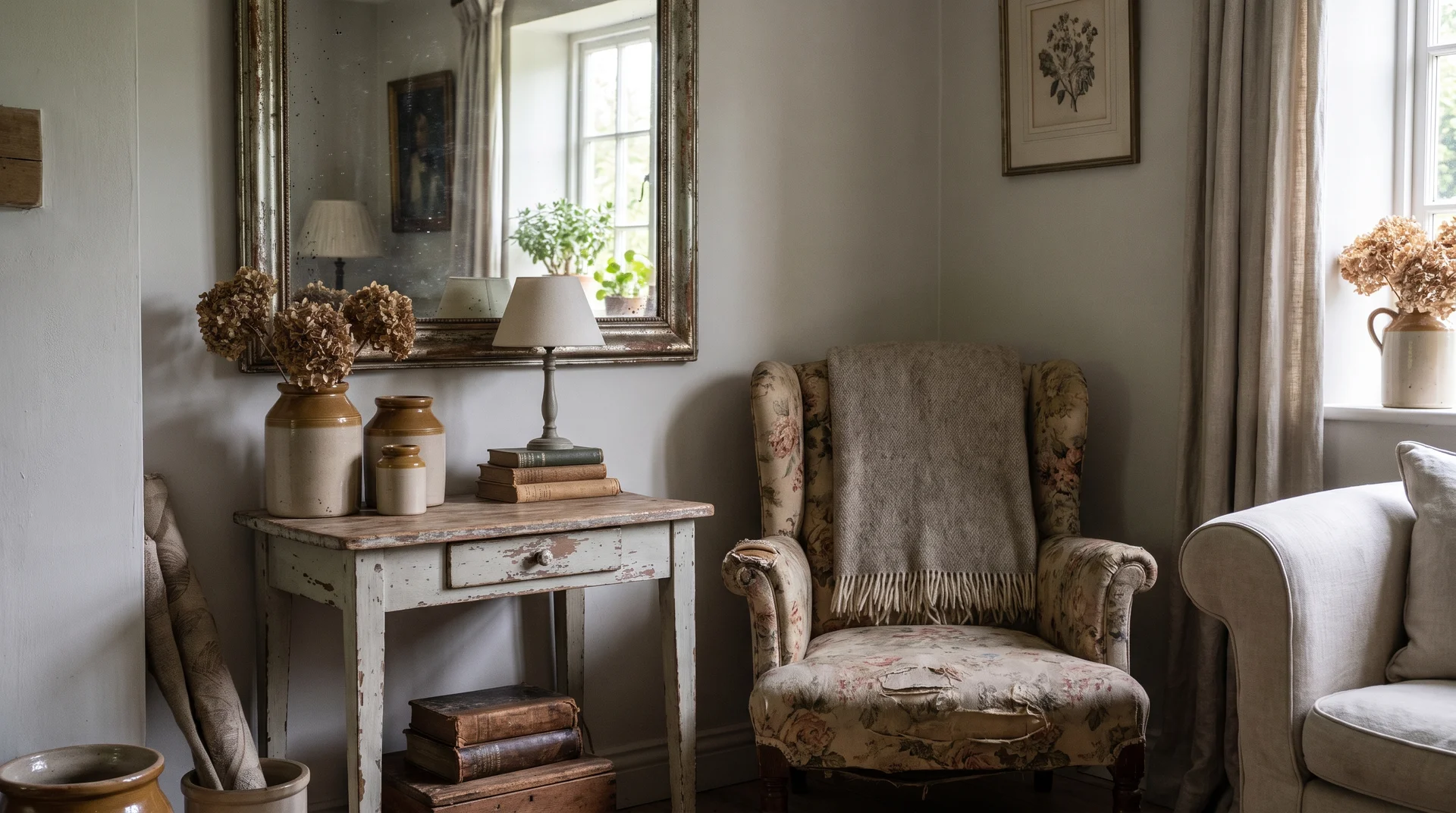
Cottage living rooms collect things. They do not purchase sets. One or two true vintage pieces change the character of every modern piece around them in a way that nothing from a retail collection can replicate.
The most useful vintage additions for a cottage living room: an upholstered armchair in a worn fabric, a painted side table, a wooden-framed mirror, and ceramic or pottery objects.
For US homeowners working on a budget, estate sales, thrift stores, and Facebook Marketplace are the most reliable sources of authentic vintage cottage pieces at reasonable prices.
The patina on a real piece does more design work than a new reproduction of the same item at any price point.
8. Create a Fireplace Anchor
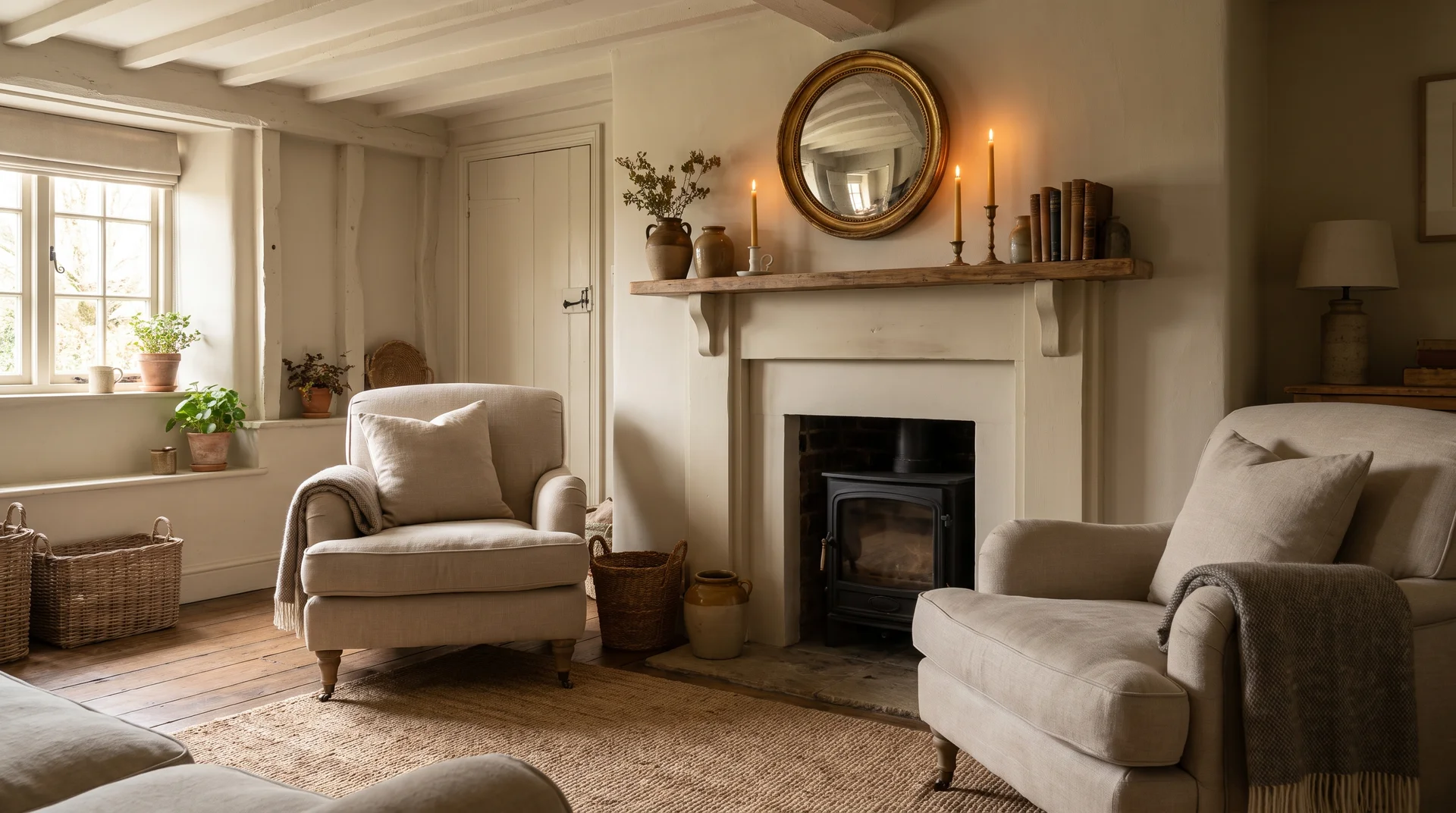
A fireplace is the natural anchor of a cottage living room. The room is arranged around it rather than around the television. The surround can be painted wood, stone, brick, or tile; all read as cottage depending on the execution.
The mantel display matters as much as the surround itself: varying heights, a mirror or artwork above, and candles on either side are the arrangement that works across cottage living room styles.
For US homes without an existing fireplace, a faux fireplace surround with a candle cluster inside or a statement mirror positioned at the same focal point creates a similar visual anchor without structural work.
The room still needs something to arrange around, and this approach provides it.
9. Layer Cottage Living Room Lighting
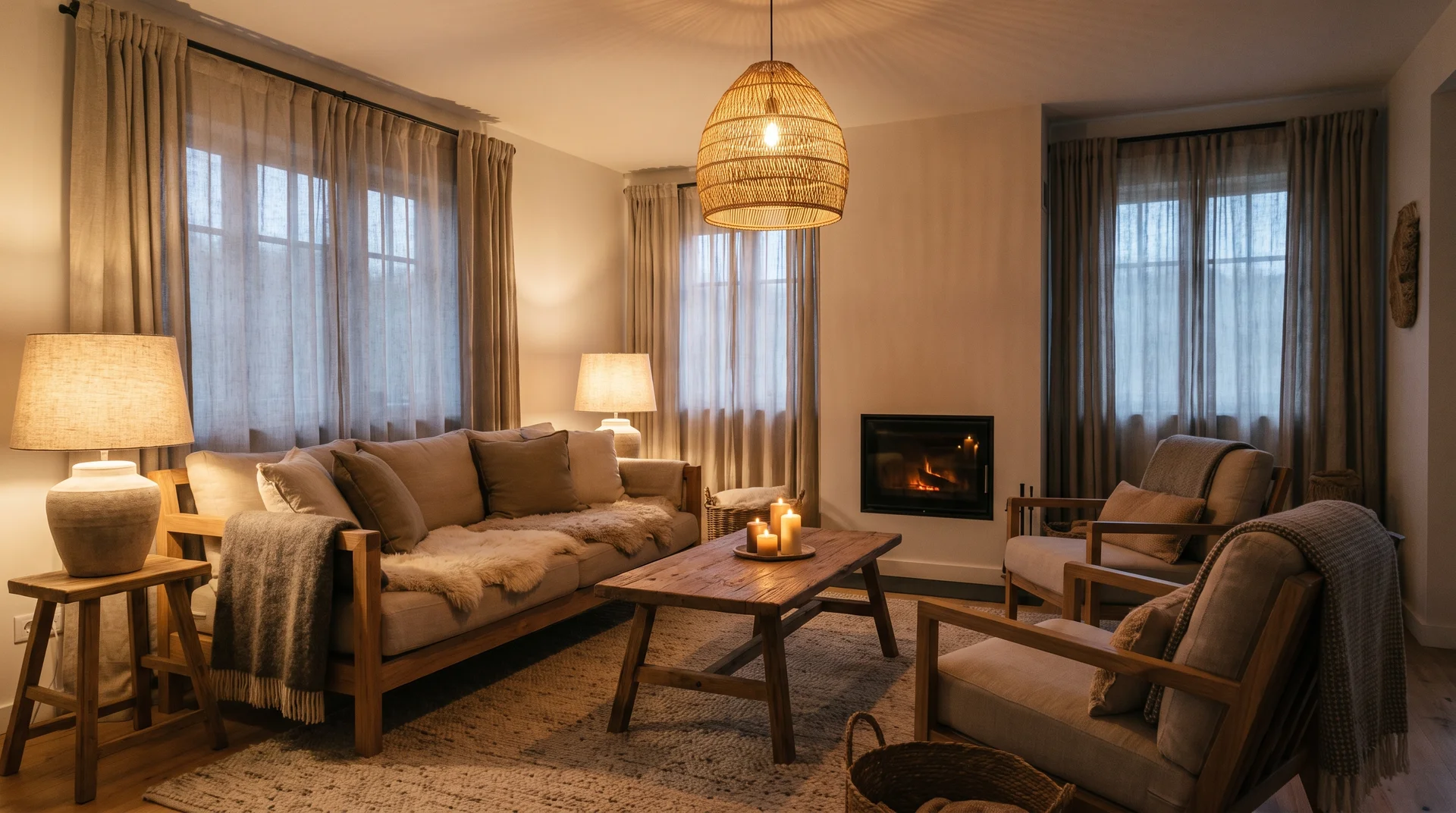
Overhead lighting is the single biggest obstacle to a cozy cottage living room. A single central fixture creates flat, even light that eliminates the warmth that every other design decision is trying to build.
Replace or supplement it with layered sources: one table lamp per seating area, a floor lamp in a corner, and candles on the coffee table and mantel.
Pendant lights in wicker, rattan, or ceramic work well in a cottage living room. Linen drum shades read softer than structured lampshades and agree with the natural material palette the style relies on.
Keep all bulbs at a warm temperature: 2700K throughout. Anything cooler reads as contemporary and works against the cottage palette and atmosphere.
10. Display Books and Collections
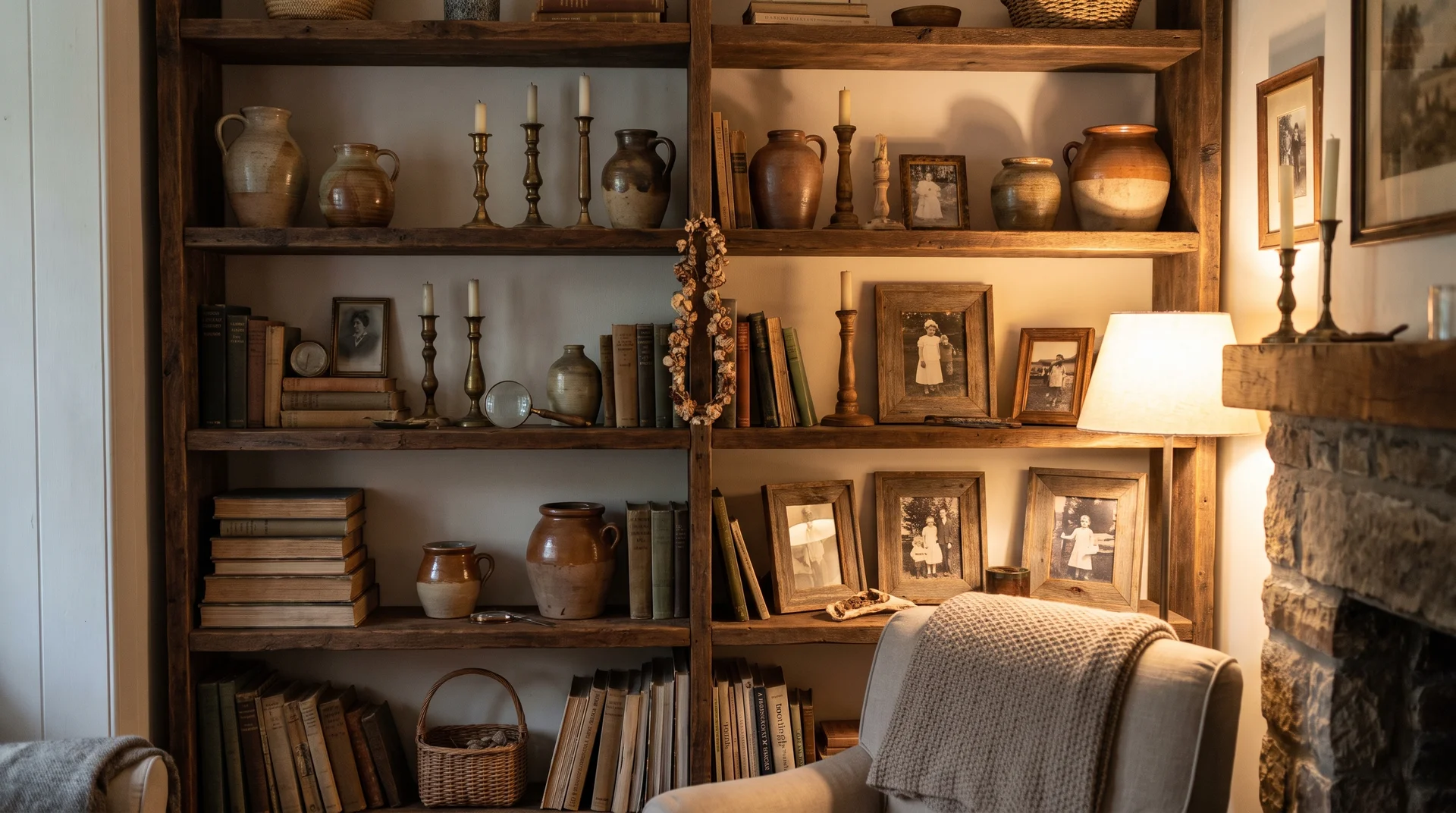
Cottage living rooms are allowed to have things. The style is not minimal, and it does not ask you to clear every surface.
Books stacked on a coffee table, arranged on open shelving, and propped on a mantel are the most personal element a cottage living room can have.
Collections work the same way: ceramics, vintage pottery, candlesticks, small framed photographs. The practical rule for displaying a collection without it looking cluttered is odd numbers and varying heights.
Three objects of different heights read as a composed grouping. Four of the same height read as a lineup. This is the difference between a cottage room that looks collected and one that looks crowded.
11. Bring Houseplants and Fresh Flowers
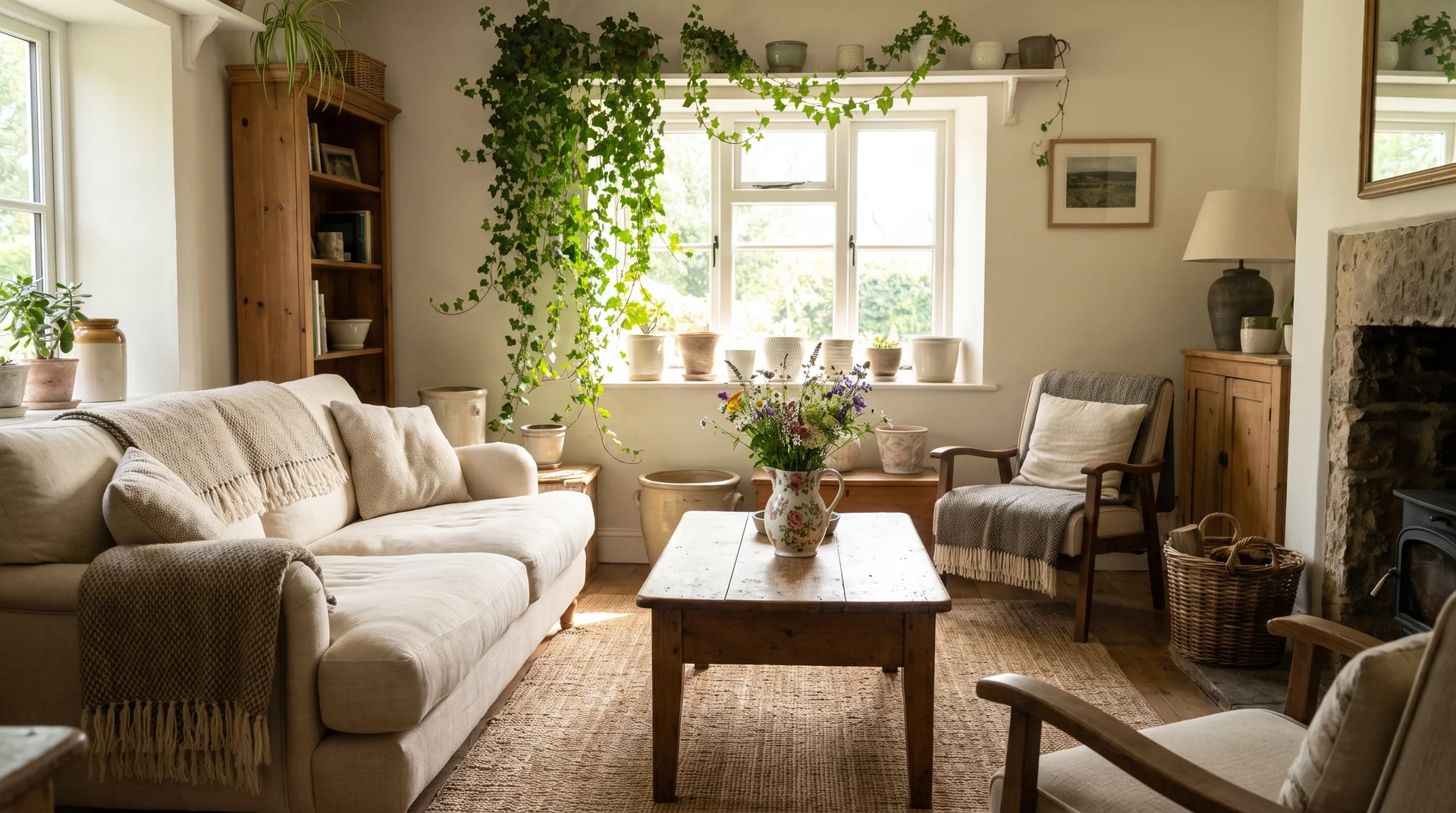
A cottage living room should feel alive. Plants and fresh flowers do more for the atmosphere than almost any purchased decor item at any price point.
A trailing ivy, a potted hydrangea, or a fiddle leaf fig in a ceramic or wicker vessel all work. Fresh-cut flowers in simple vases on the coffee table, windowsill, and mantel bring seasonal color that changes throughout the year.
Cutting garden flowers in a vintage pitcher costs almost nothing and reads as beautifully authentic.
It is one of those details that makes a room look as though the person who lives there is paying attention, which is the quality that gives cottage rooms the feel.
12. Choose Curtains That Add Softness
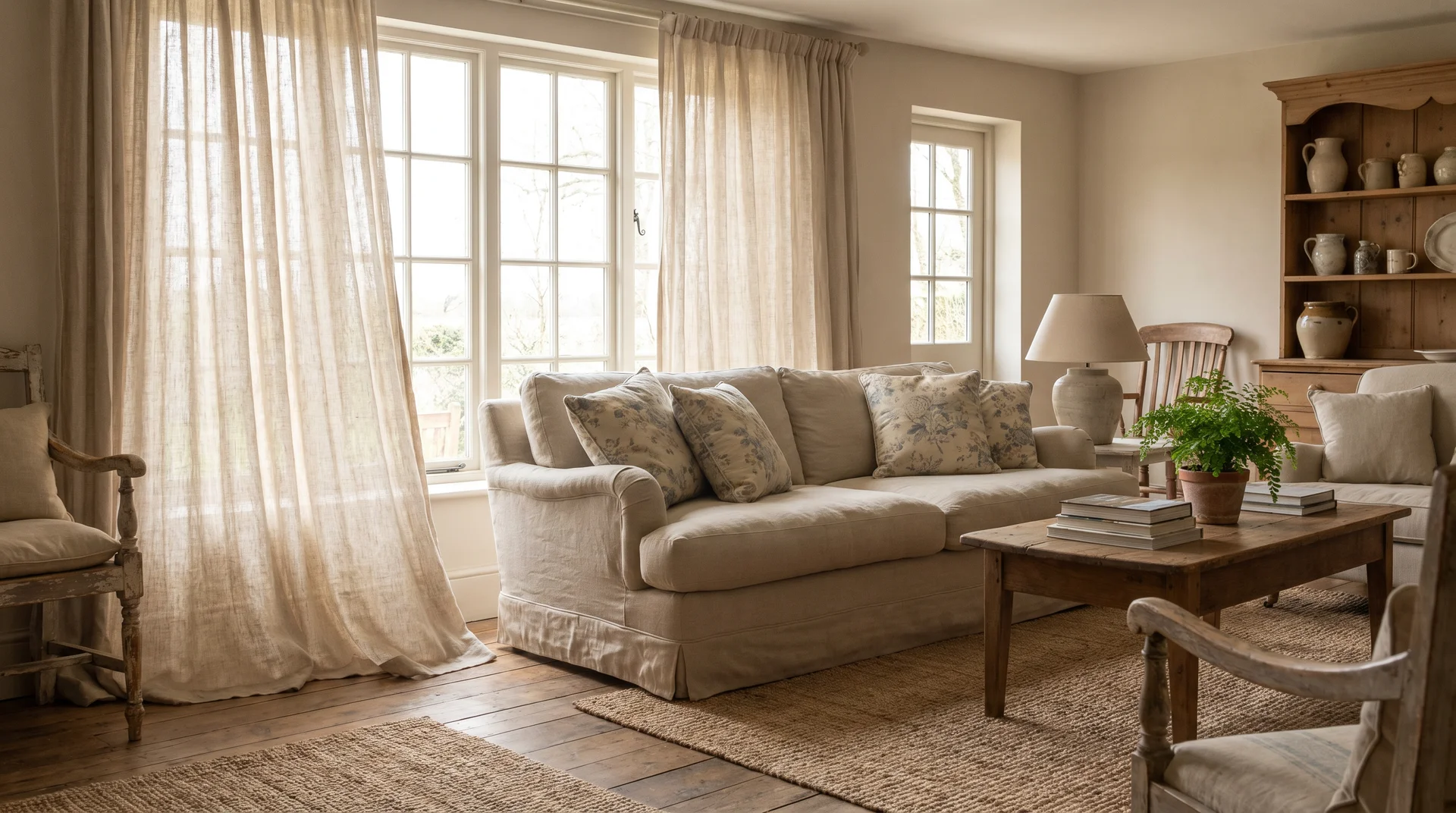
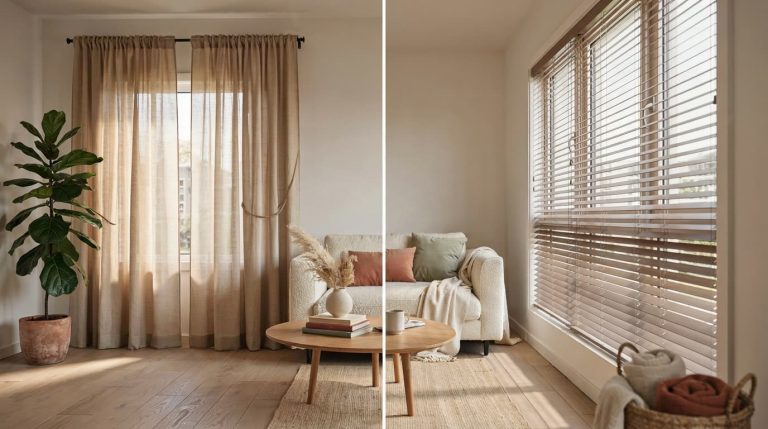
Curtains in a cottage living room should use a fabric that filters rather than blocks light. Linen and cotton voile are the two most useful choices: both preserve the soft, warm quality of natural light in the room. Patterns to consider: a small floral, a ticking stripe, or plain natural linen.
All three read as cottage without committing to a specific sub-style. Mount the rod as close to the ceiling cornice as possible to make the window read taller.
Allow the fabric to just touch the floor or puddle slightly. Avoid stiff, structured curtains that hold a rigid shape.
The slight softness of natural fabric draping to the floor is what produces the cottage look, not the pattern alone.
13. Keep the Room Personal
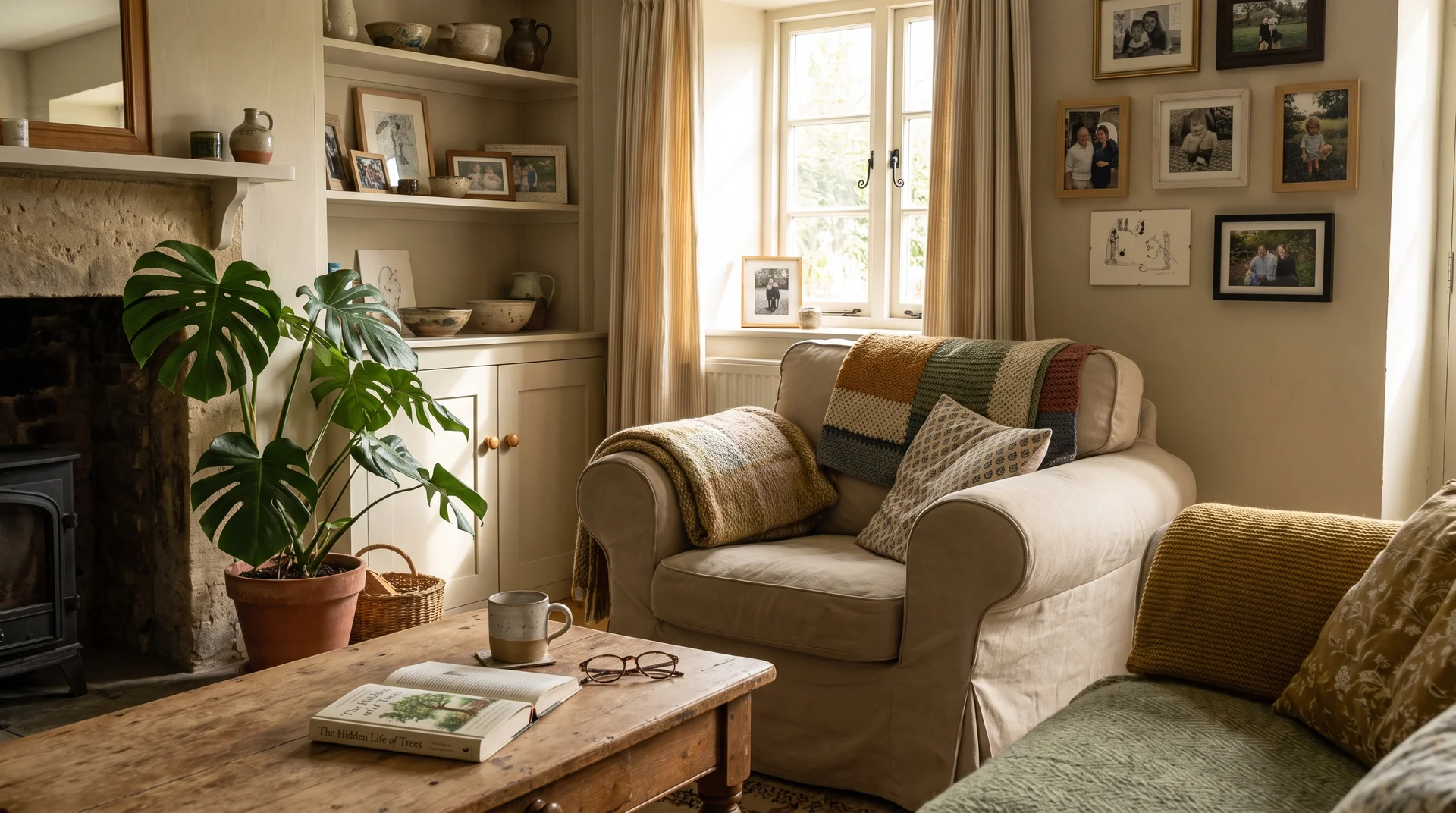
The reason cottage living rooms feel better than rooms decorated from a single retail collection is that they look as though someone lives in them.
Personal photographs in simple frames, a book left open on the coffee table, a houseplant that someone has been tending. These are the details that produce the feeling the style aims to evoke.
Every decision in a cottage living room is in service of that feeling. The paint color, the slipcover sofa, the collected ceramics on the mantel. All of it is just the method. The feeling is the point.
Cottage Style vs Farmhouse vs Country: What Is the Difference?
These three styles overlap enough to cause real confusion. Here is how they actually differ:
| Style | Character | Key Materials | The Feeling It Chases |
|---|---|---|---|
| Country | Rustic, heavy, warm | Dark wood, plaid fabrics, stone | A working farm interior |
| Farmhouse | Clean, minimal, functional | Shiplap, open shelving, industrial accents | A modern barn with white walls |
| Cottage | Soft, layered, personal | Linen, florals, painted wood, natural fiber | An English garden room or New England beach house |
| Modern Cottage | Warm but uncluttered | Natural textures, muted palette, fewer ornaments | Cottage warmth without the visual noise |
Modern cottage is the direction most US living rooms take right now. It keeps the warmth and softness of traditional cottage while reducing the visual busyness that smaller US rooms struggle to carry.
How to Set Up a Cottage Living Room: Step by Step
Creating a cottage living room is not about changing everything at once. A thoughtful order of decisions helps build a space that feels natural, comfortable, and balanced.
Step 1: Choose Your Sub-Style
Decide whether you prefer an English, modern, rustic, or coastal cottage. This guides your furniture, colors, and materials and stops the room from pulling in too many directions at once.
Step 2: Start with the Walls and Floor
Walls, flooring, and large furniture form the base of the room. A calm, neutral base provides more flexibility to change accents later. Get this right before buying any decorative pieces.
Step 3: Choose the Sofa First
The sofa is the room’s largest investment. Choose for comfort and durability. A linen or slipcover sofa in cream, sage, or dusty blue is the starting point for almost every cottage living room style.
Step 4: Add Texture Through Layers
Rugs, curtains, cushions, and throws create depth without requiring bold colors. This is the step where the room starts to feel cottage rather than just neutral.
Step 5: Add Personal Details Last
Books, framed photographs, plants, ceramics, and vintage finds go in last. These are the items that tell a story. Let them earn their place in the room rather than filling shelves all at once.
Conclusion
The cottage living room is one of the few interior design styles that rewards starting rather than waiting until every decision is made.
Pick one wall treatment, choose a curtain fabric, bring in one piece of second-hand furniture with some history, and see what the room tells you from there. Cottage style accumulates. It is not installed.
The rooms that do this best were not planned in a single afternoon; they were added to over time by someone who knew what they liked and kept paying attention.
Start with the color, get the sofa right, bring in something alive, and trust that the rest follows.
Frequently Asked Questions
What Is Cottagecore And Is It The Same As Cottage Style?
Cottagecore is a social media aesthetic inspired by rural simplicity, foraging, and handmade living. It overlaps with cottage style but leans more whimsical and maximalist. Traditional cottage interior design is softer, more restrained, and more livable in the long term.
What Is The Difference Between Cottage Style And Shabby Chic?
Shabby chic relies on artificially distressed furniture and chaotic floral layering, while cottage style in 2026 prioritizes historically grounded, purposefully restrained spaces with authentic materials. Cottage style ages naturally; shabby chic is a manufactured effect.
How Do I Stop A Cottage Living Room From Looking Cluttered?
Stick to one bold floral and support it with smaller, quieter prints. Avoid overbuying new pieces and let each item earn its place through charm and history rather than volume.