

Infrared Imaging, Intelligence, and Integrated Readiness for Modern Missions

(IR explained for defense, security, and operators who need answers—not buzzwords)
What “IR” Really Means in Defense & Security
In defense and security missions, IR means infrared—the invisible portion of the electromagnetic spectrum that enables operators to detect activity, assess intent, and manage risk when visible light fails.
In other markets, IR can mean interest rates or investor relations.
That definition does not apply here.
For defense forces, border agencies, and critical-infrastructure operators, IR is a sensing capability embedded in EO/IR systems, thermal imaging cameras, and C5ISR architectures engineered to operate across time, terrain, and contested environments.
Infrared imaging enables:
- Detection of people, vehicles, and vessels in total darkness
- Persistent surveillance through fog, dust, smoke, and haze
- Long-range situational awareness across remote or denied terrain
This article focuses on IR as it is used in real operations—not as a lab experiment, consumer product, or marketing acronym.
Where IR Proves Its Value
Real Missions. Measurable Outcomes.
IR earns operational trust because it performs when other sensors degrade.
- Border surveillance: Thermal imaging detects human movement across miles of terrain with no illumination
- Maritime security: IR identifies small, unlit vessels in high sea states and poor weather
- Airborne ISR: IR tracks convoys and maneuver forces without revealing platform position
- Counter-UAS: IR detects heat from drone motors and batteries that radar often misses
- Space sensing: IR identifies missile launches and thermal anomalies from orbit
When visibility disappears, IR preserves decision time.
What IR Is Inside an EO/IR System
Infrared radiation spans wavelengths beyond visible light—roughly 0.7 μm to 14 μm. Every object above absolute zero emits IR energy, enabling passive detection without illumination.
Modern EO/IR systems integrate:
- Visible cameras for context and fine detail
- IR sensors for thermal contrast and detection
- Stabilization, networking, and analytics for actionable data
Systems engineered as integrated solutions—rather than loosely connected components—deliver higher reliability, lower false alarms, and consistent performance across platforms.
Understanding IR Bands: SWIR, MWIR, and LWIR
Not all IR behaves the same. Each band supports distinct mission needs.
|
Band |
What It Sees Best |
Typical Applications |
|---|---|---|
|
Reflected energy |
Identification, covert illumination |
|
|
MWIR |
Hot objects |
Long-range detection, missile warning |
|
LWIR |
Ambient heat |
Personnel and vehicle detection at night |
Band selection is driven by range, environment, power, and platform constraints—not trends.
SWIR: Precision Without a Visible Signature
SWIR behaves similarly to visible light but operates where visible cameras struggle.
Used for:
- To see through fog and haze
- Long-range identification
- Laser detection including
- Covert surveillance with eye-safe illumination
SWIR is particularly effective in compact systems, unmanned platforms, and towers where low SWaP (size weight and power) is critical.
MWIR: Long-Range Detection and High-Speed Tracking
MWIR excels at detecting engines, exhaust plumes, and recently fired weapons.
Advantages include:
- Exceptional sensitivity
- High frame rates
- Superior long-range performance
Cooled MWIR systems require more power and sustainment—but deliver mission-decisive detection in time-critical scenarios.
LWIR: The Backbone of Persistent Surveillance
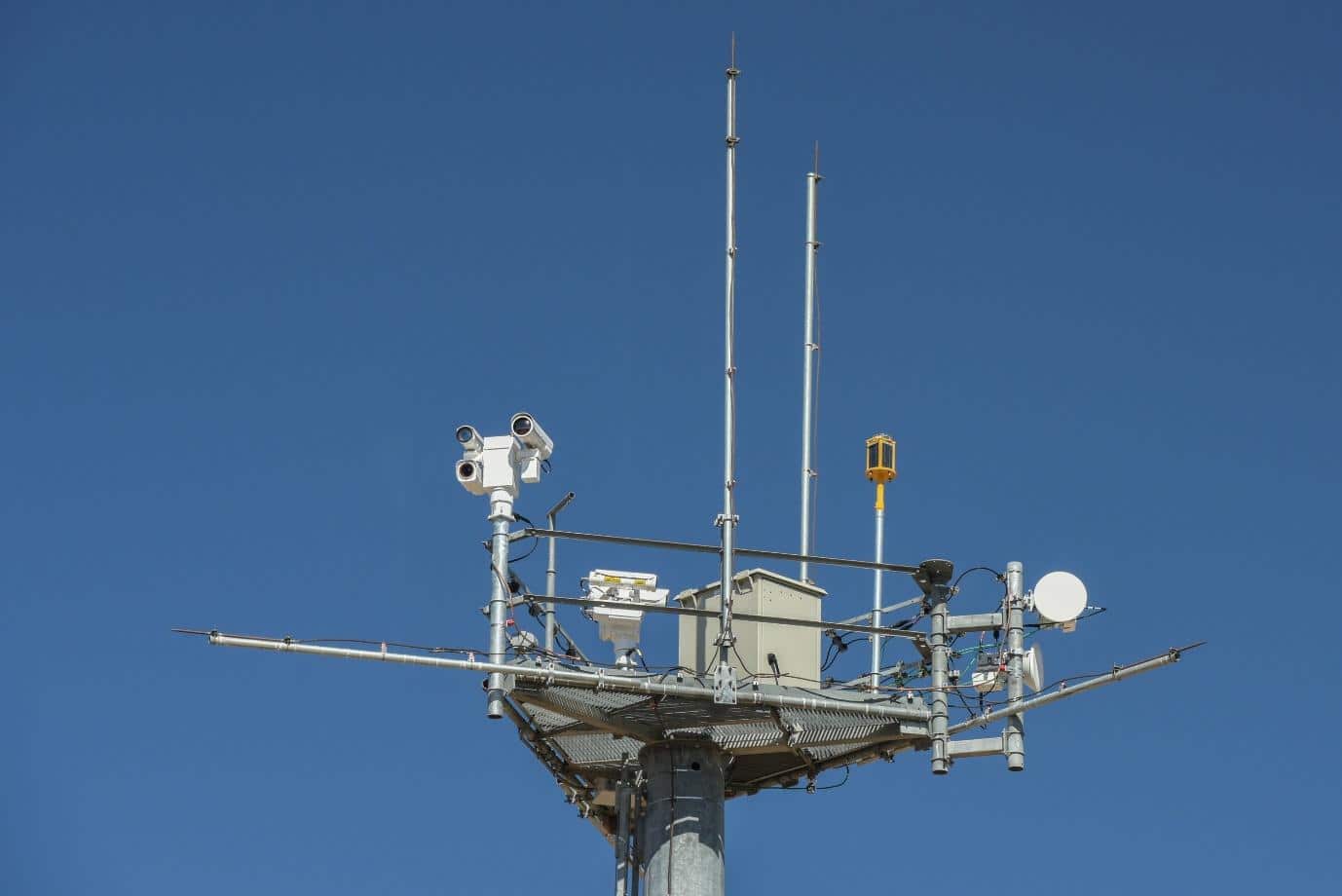
LWIR detects heat emitted near ambient temperature, making it ideal for:
- Short range border crossings
- Perimeter and base security
- Night operations with zero illumination
LWIR systems are optimized for 24/7 operation, minimal maintenance, and harsh environments—forming the backbone of persistent surveillance architectures.From IR Data to Decisions: C5ISR Integration
IR imagery delivers value only when integrated into decision systems.
Modern C5ISR platforms use IR to:
- Fuse EO/IR with radar, RF, AIS, and contextual data
- Reduce false alarms
- Prioritize threats
- Deliver actionable intelligence in real time
Operators interact with data using intuitive tools designed to reduce cognitive load:
- Drag imagery across displays
- Right click for contextual actions
- Long press for advanced controls
- Change anchor time to align alerts with events
- Search through hours of archived data efficiently
The objective is speed, clarity, and confidence—not more screens.
The Digital Backbone Behind IR Systems
Modern IR performance depends on a resilient digital backbone—secure networking, edge computing, and analytics that connect sensors to operators.
This same architecture supports industrial technologies across chemical processing, industrial manufacturing, life sciences, food, and other regulated markets where uptime and accuracy matter.
Across these applications, IR systems help:
- Analyze operational data in real time
- Identify anomalies before failure
- Reduce downtime across fluid transfer equipment and loading systems
- Support distributed teams working on-site or from home
Robust services segment designs ensure scalability, secure access for each provider, and continuity across markets.
Autonomous IR Surveillance Towers
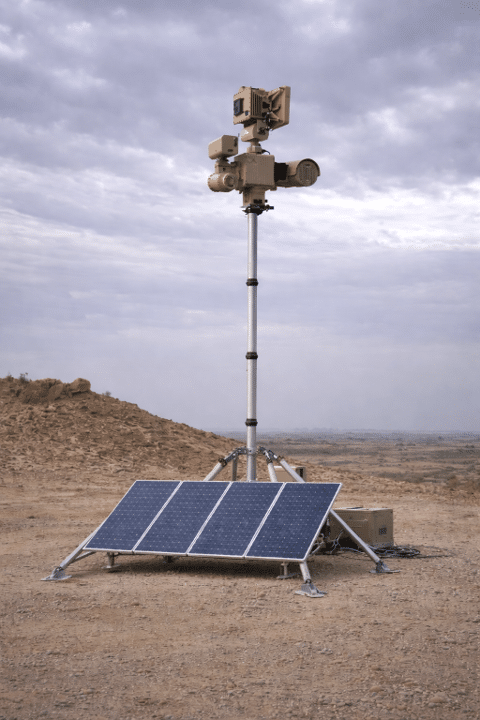
Autonomous towers integrate IR sensors, visible cameras, radar and onboard analytics to reduce operator burden and send threat information directly to operators in the f.
Capabilities include:
- Continuous 360° scanning
- Automatic slew-to-cue
- Human and vehicle classification
- Remote operation over secure networks
These systems operate in deserts, arctic cold, coastal humidity, and contested regions—often solar-powered and infrastructure-light.
IR Beyond Defense: Industrial and Infrastructure Applications
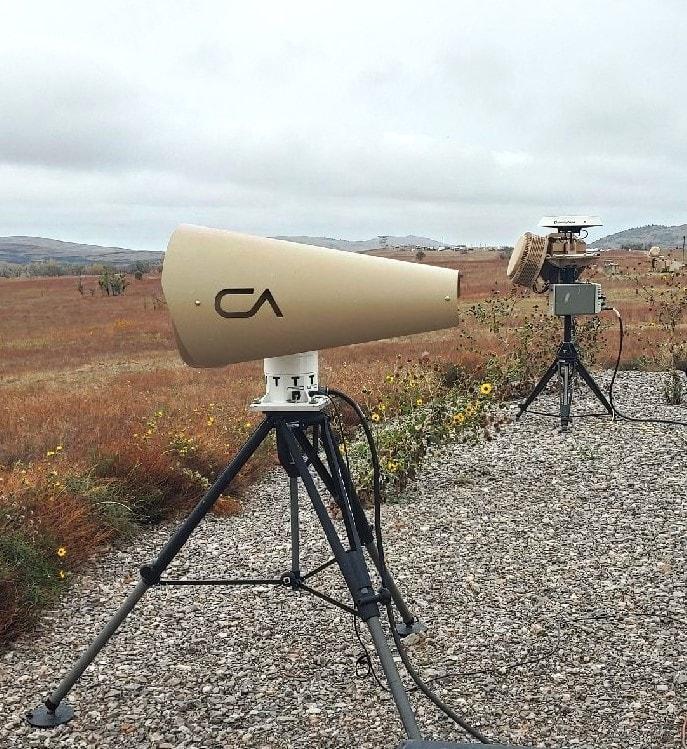
Mission-grade IR also protects high-value civilian infrastructure.
Applications include:
- Chemical processing facilities
- Power generation and substations
- Transportation hubs and loading systems
- LNG and fluid transfer equipment
IR detects overheating, leaks, and anomalies early—protecting parts, products, and time-critical operations across markets.
These capabilities are increasingly valued by equity stakeholders safeguarding complex assets with long life cycles.
Why Vertical Integration Matters
Clear Aligndesigns, manufactures, integrates, and sustains IR systems in-house.
This enables:
- Faster prototype delivery
- Configuration control
- Supply-chain security
- Rapid response to urgent mission needs
For defense and security operators, vertical integration is not a business preference—it is an operational advantage.
Defining IR for Your Mission
Every mission imposes different constraints: range, environment, power, platform, and threat profile.
Effective IR deployment requires:
- Mission analysis
- Correct band and optics selection
- Integrated EO/IR system design
- Validation in real operating conditions
Whether the mission involves border security, counter-UAS, maritime patrol, aerospace ISR, or space sensing, IR remains foundational to situational awareness.
IR is not just imaging.
It is readiness measured in time saved, threats detected, and decisions made with confidence.