Maximising Small Spaces: Smart Solutions for Compact Australian Homes

Let’s face it about the Australian housing market: unless you have an extra million or two just lying around, the reality is that you’re probably working with less space than you’d like. Whether it’s a one-bedroom apartment in Melbourne’s Southbank, a terrace in Sydney’s Inner West, or a small townhouse on the Gold Coast, small space living is the reality for many Australians.
But here’s what I’ve learned from years of visiting compact homes across the country that are beautifully designed: size is just a number. The difference between a cramped, cluttered space and a stylish, functional home has nothing to do with size and everything to do with smart decisions.
Let me take you through the solutions that actually work—not the Pinterest-perfect ideas that look great in theory but don’t work in practice, but the practical solutions that make small Australian homes feel spacious, organized, and actually enjoyable to live in.
Modular and Multi-Purpose Furniture: Your Space-Saving Starting Point
The first mistake people make in small homes? Buying furniture that’s designed for larger homes and trying to squeeze it in. That three-seater sofa may look amazing in the showroom, but in your 45-square-meter apartment, it’s a space-sucking nightmare.
Sofa beds have come a long way. Do you remember those awful pull-out sofas from the ’90s that were awful as sofas and even worse as beds? Australian brands have totally transformed this sector. Make sure to get ones with good mattress support systems—you shouldn’t have to sacrifice having a living room for having guests to stay over.
Companies like Koala and Brosa, which are Australian brands, have sofa beds that look like they belong in designer homes. The trick is to find ones where the mechanism to convert them is smooth enough that you’ll actually use it, not just think, “That’s too much work” and leave it as a sofa all the time.
Dining tables that convert are a lifesaver in small apartments. While extendable tables are great, consider ones with drop-down leaves or even wall-mounted ones that fold down when needed. I’ve seen some clever designs in Sydney apartments where a slim console table doubles as a desk during the day but extends to seat six for dinner parties.
Australian brand Freedom has great modular dining options that are designed specifically for our small apartments. Their designs take into account Australian apartment sizes—not too large for our smaller apartments compared to American or European ones.
Stackable and nesting furniture are great for flexibility without the long-term commitment. Stackable chairs are great for storing away when not in use. Coffee tables that nest together give you space when you need it for dinner parties but are out of the way when not in use.
Look for furniture that does more than one thing. An ottoman that doubles as a storage space and a seat. A bed frame that has drawers underneath. A TV stand that doubles as a room divider in a studio apartment.
The cost of quality modular furniture pays for itself quickly in small spaces. The cheap stuff that doesn’t quite fit or work properly is only a source of frustration. Buy once, buy well.
Clever Storage Solutions: Making Every Centimetre Count
Storage in small spaces isn’t about having enough—it’s about making the most of what you have. Most compact Australian homes have more storage potential than their owners realize; it’s just a matter of finding it in unexpected places that people don’t normally look.
Vertical space is criminally underutilized. While floor space is at a premium, think about walls. Walls stretch all the way up to the ceiling. Floor-to-ceiling shelving is a dramatic way to increase storage space without taking up any of your precious living space.
In Australian apartments with typical 2.4-meter ceilings, install shelving that goes all the way to the top. It may make your ceilings appear even higher, which is a psychological boon in a small space. Of course, you’ll need a step stool to reach the top shelves, but that’s no problem for seasonal items or things you don’t need to access on a daily basis.
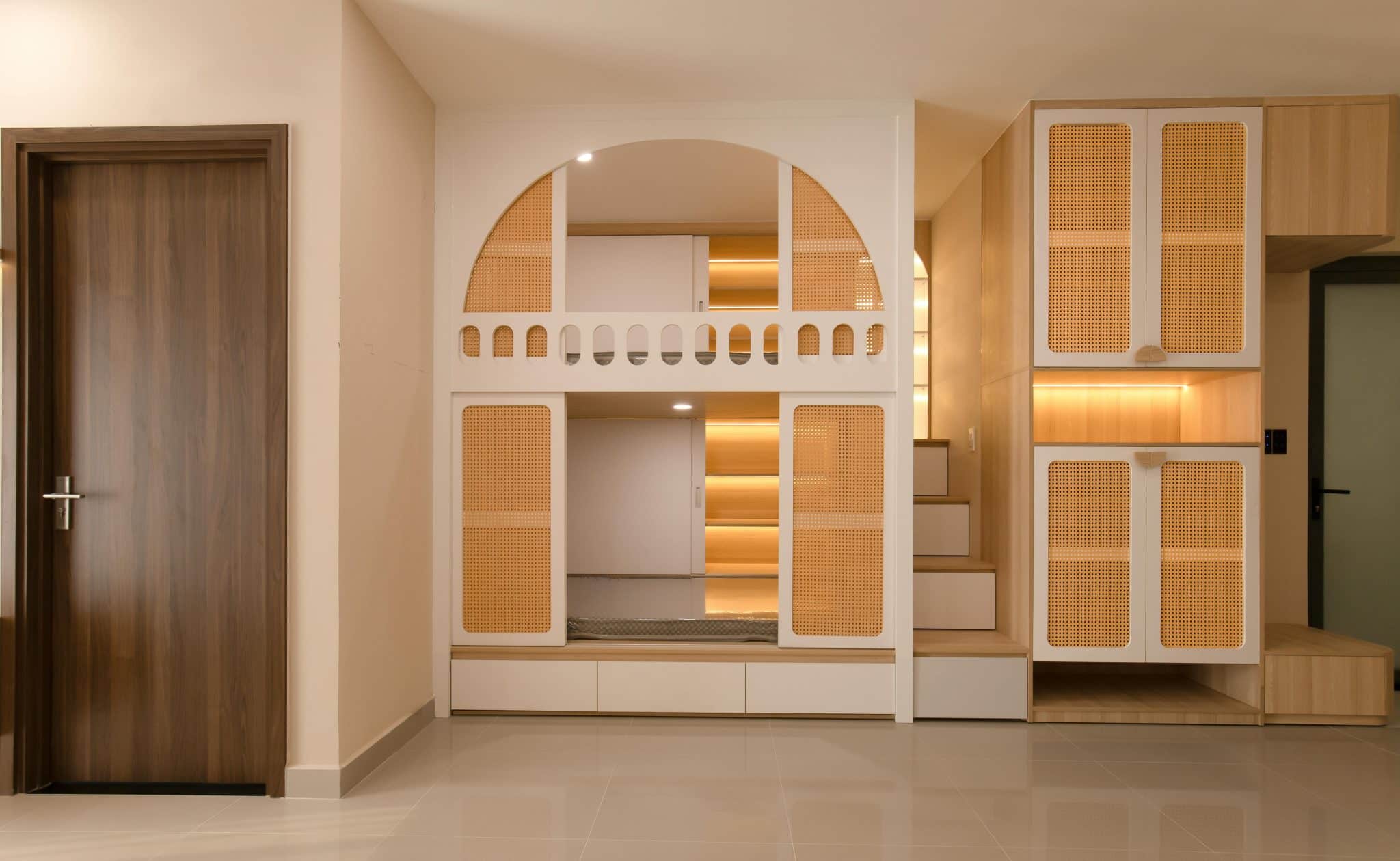
Under-bed storage is a no-brainer, but it’s often done badly. Instead of jamming random boxes under the bed, install drawers or use vacuum storage bags for seasonal clothing. Hydraulic lift mechanisms on bed frames allow you to access the entire space under the bed, we’re talking serious storage space here.
For tenants who cannot make extensive changes to the property, freestanding storage solutions are convenient. Modular shelving systems such as IKEA’s KALLAX or IVAR are easily customizable for different rooms and can be taken along when moving. They are not bespoke, but they are flexible.
Hidden compartments and dual-purpose spaces are what distinguish amateur small-space living from expert-level space optimization. Coffee tables with lift-top mechanisms conceal storage space inside. Storage ottomans with hollow interiors conceal everything from blankets to books. Even decorative baskets double as functional storage.
Corner spaces are commonly wasted in small homes. Corner shelving units, lazy susans in kitchen cabinets, or even bespoke corner desks turn these awkward spaces into functional areas.
In small Australian homes, especially apartments, entryways and corridors can be optimized. A slim console table with storage space for keys, mail, and other items can be placed without taking up too much room. Hooks above the console keep bags and coats organized without needing a dedicated coat rack.
Compact Appliances for Everyday Living
In small homes, every centimeter of space used for appliances means a centimeter less for living. Therefore, each appliance must earn its place in the home.
Compact kitchen appliances in small Australian apartments must be highly functional. A small home does not need multiple appliances for different tasks.
A good food processor can perform the same functions as a blender, chopper, and mixer. An air fryer that also serves as a small oven, toaster, and dehydrator replaces the need for multiple appliances. Such appliances pay for themselves by freeing up space.
Slimline dishwashers, built for Australian apartment kitchens, will fit under standard benchtops but use less width than full-size dishwashers. They’re more than sufficient for singles and couples and also provide much-needed kitchen storage space.
Vertical storage of kitchen appliances, where appliances stack rather than spread out, is also incredibly effective for small kitchens. A toaster and kettle that sit side by side, or appliances that can be stored in overhead cabinets when not in use, help to keep kitchens uncluttered.
Solutions for hydration also require consideration. In small kitchens or home offices, having access to fresh, filtered water doesn’t have to mean taking up half the benchtop with filtration systems or storing cases of bottled water.
A space-efficient water dispenser in Australia delivers fresh, filtered water without hogging valuable kitchen or office space. Modern models made for small homes fit seamlessly into corners or alongside fridges, providing both cold and ambient water without the space requirements of traditional water coolers.
Neverfail has models that are specifically designed for Australian apartments and small homes, taking our space requirements into consideration. The advantage goes beyond mere convenience; staying hydrated is a key component of health and wellness, and when water is readily available at the right temperature, you’re more likely to drink enough throughout the day.
This is especially important during Australian summers when temperatures are known to soar. Having access to cold, filtered water on demand is far superior to constantly refilling water jugs or purchasing single-use plastic water bottles, to say nothing of the environmental impact.
Home office must-haves also requires consideration. With the rise of remote and hybrid work arrangements for Australians, having a home office has become a necessary component of even the smallest homes.
Folding desks that can be wall-mounted and folded away when not in use give you a work space without having to give up space permanently. Some models come with storage for office supplies, so everything is stowed away tidily.
Portable printers, which are all-in-one units that print, scan, and copy, do away with the need for separate units. They can be placed anywhere with a power source, not necessarily right next to your computer.
Cable organization in small spaces is more than just a matter of looks; it’s also practical. Cables that are all over the place create a mess that makes a space look smaller and more cluttered. Cable organizers and wireless charging stations keep everything streamlined.
Lighting and Layout Hacks: Making Space Appear Larger
While you may not have much actual space, you can create the illusion of space with clever design choices. Lighting and layout go a long way in making a space appear larger or smaller.
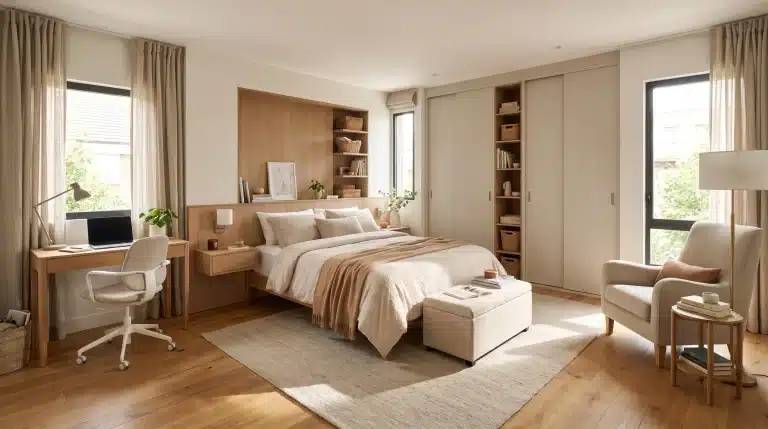
Make the most of natural light in your small Australian home. Use it to your advantage wherever you can. Install sheer curtains or blinds that can roll up completely to allow maximum light to pour in while still giving you privacy when you need it.
In apartments with limited window space, such as those internal studios or bedrooms in older buildings, every scrap of natural light counts. Don’t place furniture in front of windows. Place your bed or sofa to take advantage of natural light instead of obstructing its path.
Mirrors are the oldest trick in the book when it comes to making the most of small space because they actually work. Use them to reflect light and create the illusion of depth. A large mirror placed opposite a window will effectively double the natural light in a room.
Full-length mirrors are functional as dressing aids and decorative as space expanders. In narrow corridors, positioning a mirror against one wall can create the illusion of a wider space.
Ceiling treatments can change the perception of space. This is where many people miss out on a great design opportunity. White ceilings that are flat do not add any character to the space or make it seem larger.
Wood slat ceilings can add a lot of character to the space and actually make small spaces seem larger because of the horizontal or vertical lines that add visual interest. These lines also help to draw the eye and create visual interest that can help to offset the boxy feel of small apartments.
Sculptform’s timber ceiling systems are great for Australian apartments. They are made locally, and the timber is sustainable. They also come in slat designs that are perfect for small apartments. The slats do not have a heavy feel to them like solid timber panels might, but instead add warmth and texture to the space while still keeping it light and airy.
In apartments where the living, dining, and kitchen areas are all combined into one space, wood slat ceilings can help to section off areas without using walls. This can be achieved by installing the slats in different directions or at different heights to create separation between areas without blocking the sightlines.
The acoustic properties of wood slat ceilings are also important. Hard surfaces in small apartments such as concrete, tile, and glass can create an echoey effect that can make the space feel harsh. Wood slat ceilings can help to absorb sound and make the space feel more comfortable. This is especially important in high-rise apartments where noise from neighboring apartments can be a problem.
Light colors make spaces feel larger psychologically. This does not mean that everything has to be white, although white is a great choice for small apartments in Australia, but using light colors in neutral or pastel shades can help to make a space feel larger.
However, an accent wall painted in a darker shade can create interest without making a room appear smaller if done correctly. The trick is to achieve balance—light with dark accents.
Layering lighting is a huge help. Lighting a room solely with overhead lighting results in harsh shadows and flat areas. Mix ambient lighting, task lighting, and accent lighting to create depth.
In small living rooms, floor lamps are a great space-saving solution that also deliver necessary task lighting. Under-cabinet lighting in kitchens illuminates work areas without needing additional overhead lighting. LED strips are energy-efficient and ideal for creating ambient lighting in small rooms. Install LED strips on wooden slat ceilings for indirect lighting that showcases the ceiling feature while providing soft ambient illumination.
Layout is more important than furniture quality. High-end furniture with poor layout makes a room unusable. Think about functionality—you shouldn’t have to walk through an obstacle course to move around your home.
In studio apartments or open-plan living, define areas without walls. A rug defines the living space. A bookshelf separates sleeping and living areas. Use furniture placement to guide movement through the room without obstacles.
Floating furniture, furniture not pushed against walls—is actually effective in small rooms to create the illusion of space. This is a paradox, but it’s true. A sofa pushed back against the wall with a slim console table behind it creates depth and layers.
Personalisation Without Clutter: Making It Your Own
The minimalist look is the most prominent in small space design tips, but minimalism does not have to be boring and impersonal. Your home should be an expression of your personality and a warm, inviting space, not a model apartment.
Strategic personalisation is what makes the difference. Instead of scattering all sorts of decorative objects around, think carefully about it. It is always better to have a few special objects displayed in an attractive way than to have dozens of them collecting dust.
Wall art occupies no floor space but helps to personalize the space. In Australian homes, it is always a good idea to support local artists. Pieces from Melbourne galleries or Sydney markets are always a great conversation starter and help to personalize your space.
Gallery walls are a great way to use a small space if done correctly. A group of smaller frames will fill a wall without the need for a single large, expensive piece of art. Mix and match photographs, prints, and paintings for a more interesting effect.
Plants bring life without taking up much space. Vertical gardens, hanging planters, or wall-mounted planters will bring nature inside while keeping floor space free. Australian natives like Devil’s Ivy or String of Pearls are perfect for indoor growing and are well adapted to the Australian climate.
For those who don’t have green thumbs, high-quality artificial plants have come a long way. Modern artificial plants look amazingly realistic and require no maintenance at all. They are ideal for busy professionals who live in small apartments.
Textiles add warmth and texture without taking up much space. Throw cushions, blankets, and rugs are always a great way to add warmth and style to your space while remaining functional. In cooler Australian cities like Melbourne, Hobart, or Canberra, textiles also provide warmth.
Use patterns and colors that will complement your overall design. In small spaces, too many different patterns will create a visually confusing effect. It is always better to stick to a consistent color scheme with perhaps one or two accent colors.
Books and collections are always a problem in small homes. If you are a bookworm with hundreds of books, storage space becomes a priority. Floor-to-ceiling bookshelves, as mentioned earlier, but also consider rotating displays—keep your favorites out and store the rest.
Digital options mean you don’t need to store things physically. E-readers and tablets mean you can store thousands of books without taking up any physical space. Not everyone enjoys reading digitally, but for book lovers living in small spaces, it’s definitely something to consider for at least part of your collection.
The Luxury of Thoughtful Living
What small space living teaches you about is the idea that less really can be more. Not in some preachy, minimalistic manifesto sort of way, but in a very real, very practical way. When you can’t just accumulate as much as you want, you start to think more carefully about what you bring into your home.
Each purchase is a consideration. Does this add value? Will I even use it? Where will it go? This level of thinking isn’t just about physical objects, either. It’s about how you live in general.
Small space living means you have to be efficient. You develop systems for keeping things organized because there just isn’t room for clutter. These are good habits to get into, no matter what your living situation is down the line.
Australian apartment living, especially in our capital cities, is likely to remain small-scale for the foreseeable future. The issue of housing affordability means that many of us are living in smaller spaces for longer than our parents did. And that’s fine. With the right solutions, small spaces can definitely offer the functionality, the comfort, and the style you deserve.
The trick is to stop thinking of yourself as making do until you can afford a bigger space. Instead, you have to be willing to take on the challenge of making your current space work beautifully. Invest in high-quality pieces that do multiple things. Make the most of vertical space. Choose appliances and solutions that are scaled properly for your needs.
Think about architectural upgrades such as timber slat ceilings that can give homes character without taking up valuable floor space. Such design elements can transform small homes from being purely functional to truly beautiful.
Your home should enhance your life, not limit it. Whether that is 150 square meters or 50 square meters, clever design makes it possible.